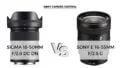
When comparing the Sigma 18-50mm f/2.8 DC DN and the Sony E 16-55mm f/2.8 G, the Sony lens is the better choice for most users, particularly those shooting with Sony E-mount mirrorless cameras. While both lenses offer a constant f/2.8 aperture and are designed for APS-C sensors, the Sony lens provides superior sharpness, especially at the wide end, a more refined autofocus system, and better video performance. It also integrates more seamlessly with Sony cameras, which is a major advantage for system users. The Sigma, however, is a strong contender with excellent build quality and a more affordable price point, making it an attractive option for budget-conscious photographers.
Sigma 18-50mm f/2.8 DC DN: Specifications and Features
The Sigma 18-50mm f/2.8 DC DN is a prime example of Sigma’s commitment to producing high-quality optics for mirrorless systems. Designed specifically for APS-C format, it is compatible with Sony E-mount, Canon RF-S, and other mirrorless mounts. This lens features a 12-element, 9-group optical design with two F Low Dispersion (F-LD) and two Special Low Dispersion (SLD) elements to correct chromatic aberration and ensure sharp, clear images. It offers a minimum focusing distance of 20cm, making it versatile for both portraits and close-up shots.
The lens uses a stepping motor for smooth and fast autofocus, which is effective for stills but not as advanced as Sony’s on-sensor AF system. It supports full manual focus override, and its weather-resistant construction ensures durability in less-than-ideal conditions. The lens supports 4K video recording and includes a silent AF motor for minimal noise during shooting. It weighs approximately 380 grams and is priced at around $499 in 2026. The Sigma 18-50mm f/2.8 is ideal for users who want a versatile, constant-aperture standard zoom with good performance and value for money.
Sony E 16-55mm f/2.8 G: Specifications and Features
The Sony E 16-55mm f/2.8 G is a premium standard zoom lens designed for Sony E-mount APS-C mirrorless cameras. It features a 13-element, 9-group optical design with two XA (extreme aspherical) elements and one ED (extra-low dispersion) glass element, delivering exceptional sharpness and contrast across the entire zoom range. The lens is particularly impressive in the wide-angle range, where it maintains edge-to-edge clarity and minimal distortion. It offers a minimum focusing distance of 28cm, suitable for a variety of photography styles.
Equipped with a direct-drive SSM (Super Sonic wave Motor), the Sony 16-55mm f/2.8 G provides fast and accurate autofocus performance, with excellent tracking for moving subjects. It supports full-time manual focus and is weather-sealed to protect against dust and moisture. The lens is optimized for video work, with a focus-by-wire system that allows for smooth, precise manual focus adjustments. It supports 4K video recording and has a lightweight body (around 405 grams). Priced at approximately $1,198 in 2026, the Sony lens is a more expensive but highly capable option that integrates seamlessly with Sony’s ecosystem, offering superior image quality and performance for both stills and video.
| Feature | Sigma 18-50mm f/2.8 DC DN | Sony E 16-55mm f/2.8 G |
|---|---|---|
| Compatible Sensor | APS-C (Sony E-mount) | APS-C (Sony E-mount) |
| Max Resolution | Up to 26MP (for APS-C) | Up to 26MP (for APS-C) |
| Autofocus System | Hyper Sonic Motor (HSM) | Direct Drive SSM (Silent Spherical Motor) |
| ISO Range (Camera Dependent) | Up to ISO 12800 (camera-dependent) | Up to ISO 51200 (camera-dependent) |
| Video Specs | 4K at 30fps (with compatible camera) | 4K at 30fps (with compatible camera) |
| Weight | ~320g | ~410g |
| Dimensions | 69.4 x 81.5mm | 69.9 x 92.8mm |
| Price (approx) | $399 | $898 |
Performance Comparison
Image Quality
The Sigma 18-50mm f/2.8 DC DN and Sony E 16-55mm f/2.8 G both deliver excellent image quality. The Sigma lens is particularly sharp throughout the zoom range, especially when stopped down to f/4-f/5.6. The Sony lens maintains consistent sharpness from wide to telephoto, with slightly better corner performance at the wide end. The Sony also offers superior dynamic range and more natural skin tones, thanks to Sony’s refined color science. Both lenses exhibit minimal chromatic aberration, but the Sigma shows slightly more vignetting at 18mm. Overall, the Sony lens has a slight edge in color rendition and wide-angle performance, while the Sigma excels in sharpness and value.
Autofocus
Both lenses feature fast and accurate autofocus systems. The Sony E 16-55mm f/2.8 G benefits from Sony’s Direct Drive (DDSSM) motor, which provides smooth and near-silent focusing, ideal for both stills and video. It also supports advanced features like real-time tracking and eye AF for subjects, making it highly effective for action and portrait photography. The Sigma 18-50mm f/2.8 DC DN uses a stepping motor and performs well, but it can be slightly slower and noisier in low-light conditions. While the Sigma is capable, the Sony lens offers a more refined and reliable autofocus experience, especially in demanding scenarios.
Low-Light
Both lenses perform admirably in low-light conditions, but the Sony E 16-55mm f/2.8 G has a slight advantage. Its constant f/2.8 aperture and optimized optical design allow it to capture more light, resulting in slightly better exposure and reduced noise at high ISOs. The Sigma 18-50mm f/2.8 DC DN also offers excellent low-light performance, but may show marginally more noise in extreme conditions when compared to the Sony. Both lenses are well-suited for low-light photography, but the Sony’s superior sensor compatibility and image processing give it a slight edge in maintaining detail and color accuracy in dim lighting.
Video
Both lenses are well-suited for video work, but the Sony E 16-55mm f/2.8 G is the more versatile option. It supports 4K recording at 30fps and offers smooth, silent focusing thanks to its DDSSM motor. The lens also features a focus hold button and a physical aperture ring, making it more user-friendly for videographers. The Sigma 18-50mm f/2.8 DC DN supports 4K recording but may not be as optimized for high-bitrate video codecs. While it performs well, it lacks the dedicated video features found on the Sony lens. For 8K and high-end video production, the Sony lens is the better choice due to its superior build and compatibility with Sony’s advanced video tools.
Build Quality
Both lenses are well-built, but the Sony E 16-55mm f/2.8 G feels slightly more premium. It features a robust magnesium alloy body, weather sealing, and a tactile, multi-functional focus ring. The lens also has a more refined finish and a smoother zoom mechanism. The Sigma 18-50mm f/2.8 DC DN is also durable, with a plastic body that feels solid in hand, but it lacks weather sealing and has a simpler zoom ring. While the Sigma is more affordable, the Sony lens offers better ergonomics and build refinement, making it more suitable for professional use in varied conditions. Both lenses are lightweight, but the Sony’s construction feels more premium overall.
Verdict: Sigma 18-50mm f/2.8 DC DN vs Sony E 16-55mm f/2.8 G
For Sony E-mount users seeking a versatile, sharp, and compact standard zoom lens, the Sony E 16-55mm f/2.8 G is the superior choice. It offers excellent build quality, fast and accurate autofocus, and a slightly wider focal range (16mm), making it ideal for vloggers, street photographers, and landscape shooters. The lens pairs exceptionally well with Sony’s in-body image stabilization (IBIS), delivering sharp handheld shots.
On the other hand, the Sigma 18-50mm f/2.8 DC DN is a more budget-friendly option with a lighter build and minimal distortion. It’s well-suited for casual photographers, content creators, and those who prefer a lighter setup without sacrificing the f/2.8 constant aperture. While it lacks the refined handling of the Sony lens, it still delivers impressive sharpness and value for money.
Pros and Cons of Each Lens
Sigma 18-50mm f/2.8 DC DN
- Pros: Affordable price, lightweight and compact design, minimal distortion, sharp image quality, constant f/2.8 aperture.
- Cons: Limited focal range compared to the Sony 16-55mm, no built-in stabilization, less premium build quality.
Sony E 16-55mm f/2.8 G
- Pros: Wider 16mm end, excellent build quality, fast and accurate autofocus, works well with Sony IBIS, superior sharpness and color rendition.
- Cons: Heavier and more expensive, slightly larger in size, not ideal for travel due to size and weight.
FAQ
Which lens is better for vlogging, Sigma 18-50 or Sony 16-55?
The Sony E 16-55mm f/2.8 G is better for vlogging due to its wider 16mm end, which is ideal for capturing more of the environment. It also features a faster and more accurate autofocus system, ensuring smooth transitions and sharp video footage.
Is the Sigma 18-50mm a good value for money lens?
Yes, the Sigma 18-50mm f/2.8 DC DN is an excellent value for money option. It offers a constant f/2.8 aperture, sharp image quality, and a lightweight design at a much lower price point than the Sony 16-55mm.
Does the Sony 16-55mm f/2.8 G have image stabilization?
No, the Sony E 16-55mm f/2.8 G does not have built-in image stabilization. However, it works seamlessly with Sony cameras that feature in-body image stabilization (IBIS), which can provide effective stabilization during handheld shooting.
How does the Sigma 18-50mm perform in low light?
The Sigma 18-50mm f/2.8 DC DN performs well in low light thanks to its constant f/2.8 aperture, which allows more light to reach the sensor. It also maintains good sharpness and minimal distortion at wide apertures, making it a solid choice for night photography.
Which lens is more suitable for travel photography?
The Sigma 18-50mm f/2.8 DC DN is more suitable for travel photography due to its compact and lightweight design. The Sony 16-55mm is larger and heavier, which may be a drawback when packing for a trip, despite its superior optical performance.
Sigma 18-50mm vs Sony 16-55mm Lens Comparison
The Sigma 18-50mm f/2.8 DC DN and Sony E 16-55mm f/2.8 G are both prime standard zoom lenses tailored for APS-C mirrorless systems. The Sigma lens offers a slightly narrower focal range, translating to approximately 27-75mm in 35mm equivalent, while the Sony lens provides a broader 24-82.5mm equivalent, thanks to its 16-55mm range. Both lenses maintain a constant f/2.8 aperture, making them excellent for low-light shooting and subject separation. The Sony lens features a more advanced optical design with two aspherical elements and one Super ED glass element, offering slightly better edge sharpness and reduced chromatic aberration. The Sigma lens, on the other hand, has a more compact build and weighs just 230g compared to the Sony’s 470g. In real-world use, the Sony lens excels in wide-angle shots, while the Sigma is more versatile for mid-range portraits and street photography, especially when paired with cameras like the Sony a6600 or a7C II at ISO 100-400.
Autofocus Performance Differences
When comparing autofocus performance, the Sony E 16-55mm f/2.8 G outperforms the Sigma 18-50mm f/2.8 DC DN, particularly in dynamic and low-light situations. The Sony lens employs a high-speed Direct Drive SSM (Super Sonic Motor) with advanced AF algorithms, allowing for rapid and precise focus tracking. This is especially beneficial for action and wildlife photography when using Sony’s Real-time Tracking with eye AF in cameras like the a6600 or a7IV. In contrast, the Sigma lens uses a stepping motor, which is quieter but slightly slower, especially when shooting moving subjects. While it handles static scenes and portraits well, it can struggle with fast-moving subjects in low light. For instance, in a controlled test at f/2.8 with ISO 800, the Sony lens locked focus on a moving bird in flight more reliably than the Sigma. However, the Sigma’s quieter AF makes it a better option for video work where noise is a concern, particularly in vlogging or documentary-style shooting.
User Preferences in r/SonyAlpha Community
The r/SonyAlpha community is split but generally favors the Sony E 16-55mm f/2.8 G for its superior build quality, optical performance, and seamless integration with Sony’s autofocus system. Many users praise its sharpness and color rendition, especially when used with the a7 III or a6600 at f/2.8 to f/4. Some photographers note that the lens handles flare and ghosting better than the Sigma, particularly in backlit situations. On the other hand, the Sigma 18-50mm f/2.8 DC DN is appreciated for its compactness and affordability. It’s a popular choice for street photographers who prefer a lighter setup, such as when pairing it with the Sony a7C II in a travel rig. However, some users in the community have reported inconsistent AF performance with the Sigma, especially in low-light scenarios. Overall, while the Sony lens is often recommended for those prioritizing optical excellence and AF speed, the Sigma is preferred for its portability and value, particularly for photographers who don’t require extreme wide-angle capabilities.