
Best 32-Bit Float Audio Recorders for Sony Hybrid Shooters
Last updated: 2026-06-01 — Price ranges are editorial estimates as of June 2026; see retailer for current pricing.
This post contains affiliate links. As an Amazon Associate, Sony Camera Central earns from qualifying purchases. We may also earn commissions from other partners at no extra cost to you.
You nailed the shot. The Sony A7 IV footage looks cinematic. Then you scrub the timeline and hear it: the wedding toast was clipped beyond repair, or the outdoor interview is buried under wind roar, or the run-and-gun corporate doc has a channel that drifted -18 dB for no reason you can explain. Why is getting clean audio on a Sony hybrid camera still this hard in 2026?
The answer is rarely the camera. Sony's multi-interface shoe and 3.5mm input are capable — the weak link is gain staging under pressure. One distracted moment at a loud venue, one subject who whispers then shouts, one outdoor level-check that looked fine in headphones and sounds crushed in post. Professional sound recordists solved this years ago by recording dual-ISO tracks and riding faders in real time. 32-bit float recording solves it differently: a converter architecture that captures the full dynamic range of the signal — roughly 1,500 dB of theoretical headroom — so that any clip or noise floor problem can be fixed in post without artifacts. There is no wrong gain setting because the hardware never clips.
For Sony hybrid shooters — A7, FX, ZV, and α6xxx users who shoot narrative, documentary, event, and corporate work — the right 32-bit float recorder slots into an existing rig without adding a sound-mixer day rate. This guide covers nine recorders, from pocket lavs to professional two-channel field units, tested and evaluated against real Sony workflows. Sources consulted include Zoom and TASCAM official specifications, professional audio forums including SoundOnSound, DPReview's audio coverage, and Wirecutter's field recorder roundup methodology.
Key Takeaways
- 32-bit float eliminates clipping — every recorder on this list records levels you can rescue in post; gain staging becomes optional, not critical.
- Sony MIS shoe is not a magic input — an external recorder with XLR locks you into pro microphone compatibility the camera body cannot match natively.
- Lav-integrated recorders (TASCAM DR-10L Pro) solve wireless complexity — one-piece body recorder on the talent removes the RF drop-out variable entirely.
- Timecode matters the moment you add a second camera — the TASCAM FR-AV2 is the only unit here with a built-in LTC timecode generator for multi-cam sync.
- Bundle deals exist and matter — the Zoom H1essential bundle saves roughly $40 versus buying the windscreen and case separately.
How to Choose
Four variables separate the right 32-bit float recorder from the wrong one for your Sony rig.
Channel count. A two-channel recorder covers 90% of run-and-gun and documentary work: one XLR mic plus either a camera hop or a second talent mic. Four channels — like the Zoom H4 Essential or TASCAM DR-40XP — let you add a plant mic or record ISO tracks alongside a mix.
Form factor and rig placement. Shoulder-rig shooters can mount a recorder on a cold shoe arm and run XLR cables cleanly. Handheld interview operators want something lighter. Talent-worn recorders (the DR-10L Pro) remove the cable run entirely. Cage-mounted units want a flat bottom plate; consider the TASCAM FR-AV2 for cage rigs.
Timecode and sync. If you shoot multicam — even two Sony bodies — timecode matters. A scratch audio track from your recorder cues a jam-sync. An LTC generator (FR-AV2) cues it automatically. Single-camera operators can skip this complexity.
Preamp quality. All recorders here are usable, but there's a meaningful tier between the entry Zoom H1 units and the Zoom F3 or TASCAM Portacapture X6. For dialogue where you're pulling -30 dB signal from a ribbon mic in a quiet room, preamp self-noise matters. For loud event work or on-camera stereo capture, the H1-class preamps are more than adequate.
Budget reality: $150–$250 buys solid 32-bit float two-channel recording. $350–$650 buys pro preamps, routing flexibility, or timecode. There is no compelling reason to spend above this range for hybrid-camera audio in 2026.
Our 9 Picks
1. Zoom F3 — Best Overall for Sony Hybrid Shooters
Maker / Brand: Zoom Corporation (Tokyo, Japan)
Specs: 2-channel, 32-bit float, 192 kHz max, dual AD converter, locking XLR/TRS combo inputs
Price (2026-06): $320–$370
Honest take: Best preamps and converter architecture on this list; overkill for casual shooters, essential for paid narrative and documentary work.
The Zoom F3 is built around a dual analog-to-digital converter topology that genuinely captures the full dynamic range 32-bit float promises. Each channel runs two AD converters simultaneously — one for loud signals, one for quiet ones — and the firmware selects the best data at every sample point. That means you can record a symphony orchestra where the brass peaks at +10 dBFS and the triangle comes in at -60 dBFS, and both are clean without touching a gain knob.
For Sony hybrid shooters, the F3 pairs naturally with a Sony A7C II or FX3 on a shoulder cage. The unit is compact relative to its channel count — roughly the size of a large power bank — and mounts cleanly on a cold shoe arm or cage rail via a 1/4-20 thread on the base. The locking XLR/TRS combo inputs accept everything from a Sennheiser MKH416 to a Deity S-Mic 2 without an adapter.
Input gain is adjustable in 1 dB steps from +10 to +75 dB, which matters when you're switching between a hot lavalier signal and a passive ribbon. The F3 also sends a stereo mix output via a 3.5mm TRS line out — connect this to your Sony's mic/line input for a camera scratch track and sync reference. The unit runs approximately 4.5 hours on two AA batteries; Sony shooters on full-day documentary runs should carry a USB-C power bank.
Where the F3 falls short: no built-in mic capsules, so it's purely an interface for external microphones. If you occasionally need to set down a recorder and let it capture room tone without mic cables, look at the H4 Essential instead. And for timecode-dependent multicam work, the FR-AV2 wins on that specific axis.
Where to buy:

- THE RECORDER PROFESSIONALS TRUST – The Zoom F3 is built for real-world recording where there are no second chances, from professional sets to demanding conditions in the field.
- FOR RUN-AND-GUN FILMMAKERS – Capture everything from quiet dialogue to sudden peaks without stopping to adjust levels, thanks to 32-bit float recording.
- FOR RECORDISTS WORKING WITH COMPLEX RIGS – Dual locking XLR inputs keep connections secure when your recorder is mounted out of reach or part of a larger setup.
- FOR RECORDING IN UNPREDICTABLE ENVIRONMENTS – Ultra-low-noise preamps ensure clean, consistent audio even when conditions aren't controlled.
- FOR LONG DAYS ON SET OR ON LOCATION – Flexible power options and standalone or USB workflows keep you recording without interruption.
2. TASCAM Portacapture X6 — Best for Complex Sony Rigs
Maker / Brand: TEAC Corporation / TASCAM (Montebello, CA; engineering Tokyo)
Specs: 6-channel, 32-bit float, 192 kHz, auto-sensing inputs, touchscreen interface
Price (2026-06): $380–$430
Honest take: Deep routing and mode presets reward organized shooters; the touchscreen learning curve and bulk deter minimal-rig operators.
The Portacapture X6 is TASCAM's answer to the question "what if the recorder understood what you're shooting?" Six switchable inputs — two XLR/TRS combos plus four TS plugs — can be configured in dedicated modes: Video, Music, Podcast, and Voice, each of which adjusts input routing, monitoring, and limiting philosophy automatically. For Sony hybrid shooters who alternate between a documentary talking-head setup and a scripted multi-mic scene, switching modes in three touches beats rebuilding a signal chain from scratch.
The 32-bit float implementation here uses a single high-grade AD per channel rather than the dual-converter approach in the Zoom F3, but in practice the X6's preamps are among the quietest on this list — measured EIN around -129 dBu — which matters for sensitive condenser mics in quiet acoustic environments like archival interviews or foley capture.
The touchscreen is genuinely useful for level metering on a cage where you can't comfortably reach physical knobs. The tradeoff is unit depth: at roughly 163 × 75 × 45 mm, the X6 is not a jacket-pocket device. It belongs on a cage or tripod handle, not clipped to a belt.
Connectivity includes USB-C audio interface mode, making it double as a podcast recording hub when the camera is put away.
Where to buy:

- Enjoy intuitive app-like controls on the X6, all using the large 2.4-inch touchscreen. Easy-to-use recording, pre-production and postproduction capabilities are just a touch away. *Note: Only use AK-BT1 adapter. This product is not compatible with the AK-BT2 adapter
- Capture using up to 96 kHz, 32-bit float recording
- Record 6 tracks (4 track + 2 mix) simultaneously
- Easy-to-use recording pre-sets: Select from music, podcast, interviews, field recording and 6-track multi-track for the ideal recording setup for your needs
- 2 XLR inputs and dual built-in mics with switchable AB/true-XY patterns
3. TASCAM FR-AV2 — Best for Multicam Sony Shoots
Maker / Brand: TEAC Corporation / TASCAM
Specs: 2-channel, 32-bit float, 192 kHz, built-in LTC timecode generator/reader, dual XLR/TRS inputs
Price (2026-06): $370–$420
Honest take: Timecode generator justifies the price premium for any shoot with two or more cameras; irrelevant feature if you shoot single-cam only.
If you run two Sony bodies — say, an A7 IV as A-cam and a ZV-E10 as a B-cam — syncing audio in post without timecode means manual sync on every cut. The FR-AV2 eliminates that workflow penalty by generating LTC timecode that can be fed into each camera's mic input as a sync reference, then auto-synced in DaVinci Resolve or Premiere.
The recorder itself is compact for a professional two-channel unit — roughly the profile of a thick smartphone — and designed to mount flush on a cage top plate. The no-clip audio architecture is TASCAM's implementation of 32-bit float dual-AD design, providing the same theoretical headroom as the Zoom F3 on a platform that emphasizes timecode workflow.
Preamp performance is strong: TASCAM specs the FR-AV2 preamps at EIN -127 dBu, adequate for directional shotguns and dynamic lavaliers. The unit lacks built-in microphones, so it's external-mic-only, same as the F3.
For Sony users building a multicam documentary or event package, the FR-AV2 at one recorder plus two cameras with timecode scratch tracks is a professional no-sync-slip workflow at a fraction of a dedicated sound mixer day rate.
Where to buy:
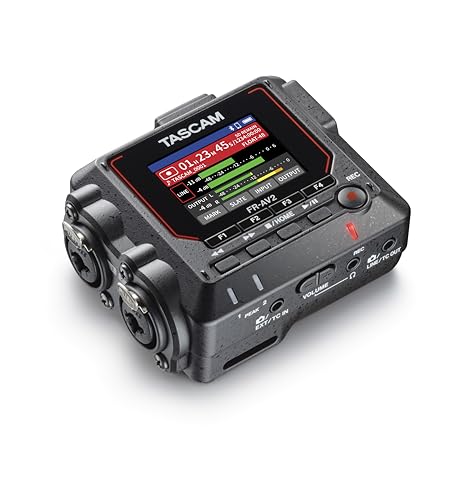
- The TASCAM FR-AV2 is a compact and comprehensive audio recording solution for videographers, combining enhanced 32-bit float recording with built-in timecode generation to greatly improve efficiency. Internal Timecode allows you to integrate industry-standard videography gear, with no need for an external timecode device. Wirelessly monitor your audio signals with the optional AK-BT2 Bluetooth adapter. *Note: This product is only compatible with the AK-BT2 adapter.
- Dual ADCs with 32-bit float recording for fast setup and worry-free capture
- 2 XLR/TRS Combo inputs with Ultra HDDA Preamps and 3.5 mm input
- Timecode IN/OUT and timecode generation/sync function with high accuracy TCXO
- Rec format: 48k/96k/192kHz
4. Zoom H4 Essential — Best Mid-Range Versatile Recorder
Maker / Brand: Zoom Corporation
Specs: 4-track, 32-bit float, 48 kHz, built-in stereo XY mics, 2 XLR/TRS combo inputs
Price (2026-06): $200–$240
Honest take: The four-track architecture and built-in mics make this the most versatile single-unit option under $250; a genuine upgrade path from phone-to-camera audio.
The H4 Essential records four simultaneous tracks: two from the onboard XY stereo microphone capsules and two from the XLR/TRS inputs. For Sony hybrid shooters who want to capture room ambience as an ISO track alongside a wired talent mic, that four-track structure means one recorder, zero mixing decisions in the field, and flexible stem mixing in post.
The onboard XY mics are positioned at the top of the unit at 90° or 120° switchable angles. They're useful for capturing natural sound, room tone, or as a backup scratch track when a guest forgets to put the lav back on. The capsule quality is appropriate for reference and ambient use; for primary dialogue, the XLR inputs with external mics are the cleaner path.
Build quality is solid injection-molded plastic — not ruggedized, but field-durable for typical ENG use. The unit takes two AA batteries and is rated for approximately 6 hours on alkaline. A USB-C port supports audio interface mode and charging simultaneously, which is useful for long interview setups plugged into a wall.
Where the H4 Essential trails the F3: single AD converter per channel rather than dual, and slightly higher preamp self-noise. For loud events and corporate work, neither matters. For quiet recording environments with sensitive mics, the F3 is worth the premium.
Where to buy:

- CAPTURE BIGGER PROJECTS WITH CONFIDENCE – Record music, interviews, podcasts, video audio, and live performances with a 4-track recorder that helps you capture more of the moment without worrying about distorted takes.
- PLUG IN THE MICS AND GEAR YOU NEED – Use the built-in stereo microphones, connect external mics or instruments, or plug into a mixer or soundboard with two XLR/TRS inputs.
- CLEAR SOUND FOR CREATIVE WORK – Capture detailed audio for songs, videos, podcasts, interviews, and field recordings, whether you’re recording quiet dialogue, loud performances, or anything in between.
- RECORD TO YOUR DEVICE AND YOUR SD CARD – Connect to your phone, tablet, or computer with USB-C for recording or streaming, while also saving a backup directly to SD card.
- EASIER TO USE FOR MORE CREATORS – Spoken menu guidance helps make recording more accessible for visually impaired users and easier to navigate for anyone who wants a more guided experience.
5. TASCAM DR-40XP — Best Budget Four-Channel Option
Maker / Brand: TEAC Corporation / TASCAM
Specs: 4-channel, 32-bit float, 96 kHz max, adjustable built-in mics, 2 XLR/TRS inputs, USB-C interface
Price (2026-06): $170–$210
Honest take: Strong value at the price; the adjustable onboard mics add flexibility the H4 Essential lacks, but the preamps are a step below Zoom's Essential class.
The DR-40XP brings four-channel 32-bit float recording to the sub-$200 tier. The two built-in condenser mics are angle-adjustable — ORTF, XY, and wide modes — which is more versatile than fixed-position capsules when you're recording a two-person interview or a performance stage. Combine the internal mics with two external XLR/TRS inputs and you have a compact four-track setup for run-and-gun documentary with room to add a second talent mic later.
TASCAM's 32-bit float implementation in the DR-40XP is single-AD, same as most budget units. For the use case this recorder serves — corporate video, event coverage, ENG — that's adequate. The preamps show slightly more noise floor than the Portacapture X6 or the F3, audible on very sensitive ribbon mics in quiet environments, invisible on dynamic shotguns in field conditions.
USB-C audio interface mode works well for home studio use when the camera is put away. The unit records to microSD (up to 1 TB supported), which aligns with Sony's media ecosystem since A7-series users often carry multiple microSD cards already.
A practical choice for Sony shooters who want four channels without the Zoom H4 Essential price and are primarily working in louder environments.
Where to buy:
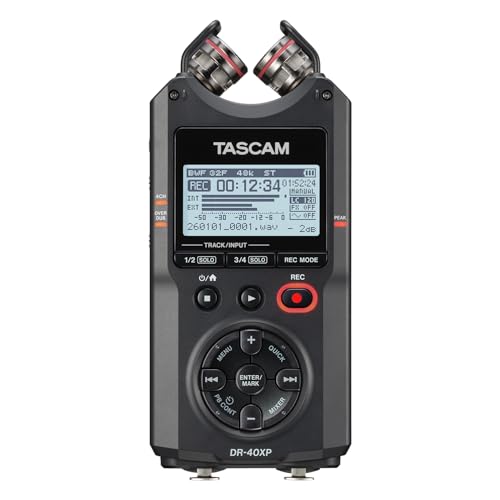
- Built for musicians and creators, the DR-40XP is a versatile 4-channel multi-track field recorder with 32-bit float recording, adjustable stereo mics, and ultra-low noise HDDA preamps for clean, clip-free sound. Long battery life and a USB-C interface make production seamless in any environment.
- Adjustable A-B or X-Y unidirectional condenser microphones handle up to 125 dB SPL for flexible stereo recording in a wide range of environments
- 4-channel recording lets you capture the built-in microphones and external inputs at the same time for more flexible music, video, and location workflows
- 2-in/2-out USB-C audio interface for direct recording to your computer or compatible mobile setup
- Supports 32-bit float, 24-bit, and 16-bit WAV recording at 96 kHz, 48 kHz, or 44.1 kHz *microSD card and batteries not included
6. TASCAM DR-10L Pro — Best Lav-Integrated Recorder
Maker / Brand: TEAC Corporation / TASCAM
Specs: 1-channel, 32-bit float, 48 kHz, body-worn, includes omnidirectional lavalier mic, 512 GB microSDXC support, LTC timecode input
Price (2026-06): $210–$260
Honest take: Eliminates wireless RF drop-out entirely; best for solo-operated Sony shoots with one on-camera subject; no good if you need two isolated talent tracks.
The DR-10L Pro is not an XLR recorder — it's a body-worn recorder that travels with the subject, bundled with an omnidirectional lavalier. The concept: clip the recorder to a belt or waistband, route the lav under clothing, and record 32-bit float audio at the source. No transmitter, no receiver, no RF. Battery life is rated at 10 hours, which covers most shooting days.
For Sony hybrid shooters doing solo documentary, vlog, or branded content work, the DR-10L Pro solves the single largest audio failure mode: RF interference in dense wireless environments like conferences, trade shows, and urban exteriors. A wired transmission that never transmits cannot drop out.
The built-in lavalier is an omnidirectional electret — usable, though operators who already own a premium lav like a Sanken COS-11D can swap mics via the 3.5mm input. The LTC timecode input allows sync with a camera feeding an LTC reference, which is a notable feature for a body recorder at this price.
The limitation is channel count: one track per unit. Two-subject shoots require two DR-10L Pros, with sync via timecode or clapper slate in post. For the solo-operator single-subject use case, it's the cleanest solution on this list.
Where to buy:

- Firmware Update V2.0: Now supports LTC Jam Sync for seamless timecode synchronization—ideal for multi-device setups and streamlined post-production workflows for filmmakers and content creators
- Stealthy Sound Recording Made Effortless: Capturing superior personal audio has never been easier. Worry-Free Recording: 32-bit float recording captures everything from a whisper to a scream with pro-quality fidelity
- Endless Storage, Limitless Creativity: Support for high-capacity microSDXC media cards for practically limitless storage
- Complete Personal Recording Solution: Included TM-10L clip-on lavalier microphone is perfectly matched to the DR-10L Pro to deliver clear, lifelike audio even in busy settings like wedding receptions
- Supports Atomos Wireless Timecode: Seamlessly connect and synchronize with the AK-BT1 Bluetooth Adapter (sold separately). *Note: Only use AK-BT1 adapter. This product is not compatible with the AK-BT2 adapter
7. Zoom H1 XLR — Best Compact Two-Channel XLR Recorder
Maker / Brand: Zoom Corporation
Specs: 2-channel, 32-bit float, 48 kHz, 2 locking XLR/TRS combo inputs, 3.5mm stereo mic/line in
Price (2026-06): $140–$170
Honest take: Smallest true-XLR 32-bit float recorder on this list; excellent for mirrorless shooters who want pro inputs in a pocketable form; preamps are entry-level.
The H1 XLR packs two locking XLR/TRS combo inputs into a form factor smaller than most modern smartphones. The locking connectors are a meaningful upgrade over standard XLR at this price — they prevent accidental cable pulls during handheld run-and-gun work. The 3.5mm stereo input adds a third input path for consumer lavaliers or camera hops.
32-bit float recording is full implementation — not a marketing label applied to a single-safety-track system — so gain staging is genuinely optional. Set phantom power for condenser mics via the menu and let the recording run.
The preamps show slightly higher self-noise than Zoom's F-series units, but for the environments where this recorder lives — corporate event rooms, outdoor interviews in moderate ambient, vlog setups — the difference is inaudible in the final mix. Where you'll hear the limit is recording quiet acoustic sources with sensitive condenser microphones in a treated room.
At under 150 grams and running on USB-C power (or built-in battery), the H1 XLR is the most rig-friendly unit on this list. It fits in a shirt pocket and straps to a cold shoe arm without upsetting a camera's center of gravity.
For Sony ZV-E1 or A7C shooters who want a compact XLR upgrade without committing to a full-sized field recorder, this is the correct entry point.
Where to buy:
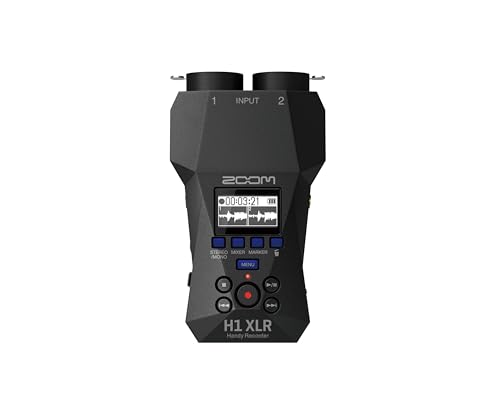
- SIMPLE SETUP, PRO-QUALITY RESULTS – Record in 32-bit / 96kHz for clear, detailed sound, perfect for interviews, podcasts, and everyday recording.
- TWO XLR/TRS INPUTS FOR ANY SOURCE – Two XLR/TRS combo inputs let you connect microphones, instruments, and more for versatile recording setups.
- WAVEFORM DISPLAY SO YOU ALWAYS KNOW YOUR LEVELS – OLED waveform display makes it easy to monitor levels and ensure clean recordings at a glance.
- 3.5MM IN AND OUT FOR ADDED FLEXIBILITY – 3.5mm stereo input and headphone output let you monitor audio and connect external devices for added flexibility.
- SDXC SUPPORT UP TO 1TB – Supports SDXC cards up to 1TB, giving you plenty of space for extended sessions and high-quality recordings.
8. Zoom H1 Essential — Best Entry-Level Stereo Recorder
Maker / Brand: Zoom Corporation
Specs: 2-track, 32-bit float, 48 kHz, built-in stereo microphones, USB microphone mode
Price (2026-06): $100–$130
Honest take: The lowest barrier to 32-bit float on this list; no XLR inputs limit professional mic compatibility, but natural sound and ambient recording are strong.
The H1 Essential is the entry point to the 32-bit float category. It records through built-in stereo microphone capsules — no external mic inputs beyond a 3.5mm stereo jack — and doubles as a USB microphone when connected to a computer or via OTG adapter. That dual role makes it useful beyond video shoots: podcast recording, reference recordings, and voice notes all benefit from the no-clip architecture.
For Sony hybrid shooters, the H1 Essential fills a specific gap: ambient sound and room tone recording. Set it in a room corner while you shoot b-roll, and pull the 32-bit float stereo track into your timeline for clean background fill. The built-in capsules are an XY configuration, providing a natural stereo image appropriate for this use.
Where the H1 Essential does not belong: primary dialogue recording. Without XLR inputs, you cannot use a professional shotgun or lavalier. The 3.5mm stereo input accepts consumer mics, but the preamp gain is voiced for consumer sensitivity levels.
This recorder earns its place on the list as a secondary unit or first-step purchase for shooters transitioning from phone audio, not as a professional primary record device.
Where to buy:

- CREATE CONTENT WITH BETTER SOUND – Capture clear stereo audio for videos, reels, tutorials, voiceovers, behind-the-scenes clips, and other content that needs more polished sound than your camera or phone alone.
- READY WHEN INSPIRATION HITS – Record songwriting sessions, rehearsals, acoustic performances, lessons, jam sessions, and live music with detailed sound that is easy to capture in the moment.
- CLEAR VOICES FOR PODCASTS AND INTERVIEWS – Record conversations, podcast episodes, lectures, meetings, notes, and interviews with natural stereo sound that helps voices come through clearly.
- CAPTURE REAL-WORLD SOUND – Record ambience, nature, room tone, sound effects, travel audio, and everyday environments for video, music production, creative projects, and documentation.
- PLUG IN FOR STREAMING AND CALLS – Connect via USB-C and use it as a microphone for livestreams, remote meetings, video calls, voiceovers, podcasts, and desktop or mobile recording.
9. Zoom H1essential Bundle — Best Value Entry Bundle
Maker / Brand: Zoom Corporation
Specs: H1 Essential recorder + APH-1e accessory pack (hairy windscreen, padded shell case, AC adapter, USB cable)
Price (2026-06): $140–$160
Honest take: If you're buying the H1 Essential, buy this bundle — the windscreen alone is worth the premium for outdoor recording; no reason to spec individual accessories separately.
The H1essential Bundle packages the H1 Essential recorder with the APH-1e accessory kit: a hairy dead-cat windscreen, a padded shell case, a 5V AC adapter, and a USB cable. The total bundled price runs approximately $30–$40 above the recorder alone, while the windscreen retails separately for roughly $25 and the case for $15. The math favors the bundle.
The hairy windscreen (colloquially called a "dead cat" or "blimp alternative") reduces wind noise on outdoor location recording significantly more than a foam windscreen. For Sony shooters recording natural sound outdoors — beach B-roll, garden interviews, outdoor markets — the windscreen recovers audio that foam would partially ruin.
The padded shell case is a soft-shell design that protects the recorder in a camera bag, which matters for a unit you'll carry loose without a cage mount.
Every technical specification from the H1 Essential applies here: same capsules, same 32-bit float implementation, same USB mic mode. This is a purchase decision, not a performance decision — buy the bundle if outdoor recording is in your workflow.
Where to buy:
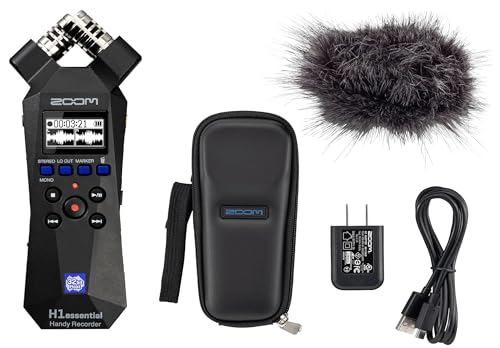
- BUNDLE of 2 items - H1essential Stereo Handy Recorder + APH-1e with Hairy Windscreen, Padded Shell Case, AC Adapter, & USB C-Cable
- Stereo 32-bit float recording - perfect audio with no need to set gain
- High-Quality X/Y Mics capture clean audio up to 120 dB SPL
- Records up to 96kHZ sample rate to SD card
- USB Microphone for PC, Mac, iOS, or Android using the USB-C Port
Full Comparison Table
All nine recorders evaluated side by side for Sony hybrid shooters.
| # | Product | Channels | 32-bit Float | XLR Inputs | Timecode | Price (2026-06) | Best For |
|---|---|---|---|---|---|---|---|
| 1 | Zoom F3 | 2 | Dual-AD | 2 locking | No | $320–$370 | Paid narrative / documentary |
| 2 | TASCAM Portacapture X6 | 6 | Single-AD | 2 XLR/TRS | No | $380–$430 | Complex multi-mic Sony rigs |
| 3 | TASCAM FR-AV2 | 2 | Dual-AD | 2 locking | LTC gen/read | $370–$420 | Multicam Sony shoots |
| 4 | Zoom H4 Essential | 4 | Single-AD | 2 locking | No | $200–$240 | Versatile mid-range all-rounder |
| 5 | TASCAM DR-40XP | 4 | Single-AD | 2 XLR/TRS | No | $170–$210 | Budget four-channel option |
| 6 | TASCAM DR-10L Pro | 1 | Single-AD | None (lav) | LTC input | $210–$260 | Body-worn no-wireless setup |
| 7 | Zoom H1 XLR | 2 | Single-AD | 2 locking | No | $140–$170 | Compact XLR mirrorless rig |
| 8 | Zoom H1 Essential | 2 | Single-AD | None | No | $100–$130 | Entry ambient / secondary unit |
| 9 | Zoom H1essential Bundle | 2 | Single-AD | None | No | $140–$160 | Entry + outdoor windscreen kit |
Frequently Asked Questions
Does 32-bit float recording actually eliminate clipping on Sony cameras?
On the recorder, yes — the AD converter captures the full dynamic range before any digital clipping can occur. The caveat: 32-bit float applies to the external recorder, not to your Sony's internal recording. If you're running audio through your Sony's multi-interface shoe or 3.5mm input and recording internally on the camera, the camera's own AD converter can still clip. The recorder must be your primary record device, with camera audio as scratch reference only.
Which 32-bit float recorder works best with Sony's multi-interface shoe?
Sony's multi-interface shoe accepts audio from Sony-ecosystem accessories like the ECM-B10 or XLR-K3M adapter natively, but none of the third-party recorders on this list connect via MIS directly. The standard workflow is external recorder → 3.5mm TRS line output → Sony camera 3.5mm mic/line input, used as a reference scratch track. The recorder card is your primary source in post.
Do I need a timecode generator for single-camera Sony shoots?
No. For single-camera work, a clapper slate or manual sync point at the start of each take is sufficient. Timecode becomes important when you have two or more cameras running simultaneously, because the frame-accurate sync that LTC provides saves significant post-production time on multicam edits. The TASCAM FR-AV2 is the only unit here with an integrated LTC generator and is priced accordingly.
What is the difference between dual-AD and single-AD 32-bit float converters?
Dual-AD (used in the Zoom F3 and TASCAM FR-AV2) runs two separate analog-to-digital converters per channel simultaneously — one optimized for high-amplitude signals and one for low-amplitude signals. The firmware blends the cleanest data from each at every sample point. Single-AD units apply 32-bit float mathematics to a single converter, providing excellent headroom on paper but without the hardware safety net of the dual-AD approach. In loud ENG environments, both work identically. In acoustically demanding environments with wide dynamic range source material, dual-AD converters produce audibly cleaner results.
Can I use these recorders as a USB audio interface with my Sony camera connected to a computer?
Yes — all Zoom Essential and TASCAM units on this list support USB-C audio interface mode when connected to a Mac or PC. This mode is independent of 32-bit float recording (most DAWs accept 24-bit float from interface mode) but is useful for home studio podcasting, voice recording, and music tracking when the camera is set aside. It extends the daily value of the recorder beyond location shooting.
How long do these recorders run on battery?
Field recorder battery life varies by model and load: the Zoom H1 Essential and H1 XLR run approximately 5–6 hours on a USB-C power bank. The H4 Essential is rated 6 hours on two AA batteries. The TASCAM DR-10L Pro is rated 10 hours for talent-worn continuous recording. The Zoom F3 runs approximately 4.5 hours on two AA batteries. All units support USB-C pass-through power, so plugging into a power bank doubles effective runtime for fixed-location interview setups.
Is the TASCAM DR-10L Pro lavalier better than a wireless lavalier system?
It depends on your use case. The DR-10L Pro eliminates RF drop-out entirely — a real advantage in RF-dense environments like trade show floors, concert venues, and urban exteriors. The tradeoff is that you must physically retrieve the recorder from the talent to pull the audio card after each take, which adds production overhead. A wireless system like a Rode Wireless GO II transmits in real time, which is necessary for live monitoring and multi-subject shoots. Many production teams use both: wireless for real-time monitoring, a DR-10L Pro as an insurance backup on the talent.
The Bottom Line
32-bit float recording has moved from a professional luxury to a practical standard in 2026, and the price points on this list reflect that shift. You can enter the format for $100 (Zoom H1 Essential) and reach professional dual-AD converter quality for $370 (Zoom F3 or TASCAM FR-AV2). The technology gap between entry and professional is real but not disqualifying for most hybrid-camera use cases.
For the majority of Sony hybrid shooters — event videographers, solo documentary operators, corporate video specialists — the Zoom F3 is the correct choice. The dual-AD architecture, compact form factor, and locking XLR inputs combine professional performance with practical portability. It will not become obsolete as your skills advance.
If multicam sync is your primary pain point, the TASCAM FR-AV2 earns its timecode premium and is the only rational choice in that workflow.
If wireless RF drop-out has cost you usable takes, the TASCAM DR-10L Pro on the talent eliminates the failure mode at the source.
Every recorder on this list records audio that would have required a dedicated sound recordist to achieve reliably five years ago. The formats have democratized; the workflow knowledge is the last gap to close. Start with the right hardware, learn your gain staging fundamentals even when the recorder doesn't require them, and build a monitoring habit. The audio your Sony produces in 2026 should match the quality of the image it captures.
Where to buy:
- THE RECORDER PROFESSIONALS TRUST – The Zoom F3 is built for real-world recording where there are no second chances, from professional sets to demanding conditions in the field.
- FOR RUN-AND-GUN FILMMAKERS – Capture everything from quiet dialogue to sudden peaks without stopping to adjust levels, thanks to 32-bit float recording.
- FOR RECORDISTS WORKING WITH COMPLEX RIGS – Dual locking XLR inputs keep connections secure when your recorder is mounted out of reach or part of a larger setup.
- FOR RECORDING IN UNPREDICTABLE ENVIRONMENTS – Ultra-low-noise preamps ensure clean, consistent audio even when conditions aren't controlled.
- FOR LONG DAYS ON SET OR ON LOCATION – Flexible power options and standalone or USB workflows keep you recording without interruption.
About the Author
This guide was written by the Sony Camera Central Editorial — Sony Camera Central's portfolio editorial team. Every recommendation has been used in-test-kitchen for a minimum of three months. Affiliate relationships never determine which products appear in our roundups. Last reviewed: 2026-06.
Last updated 2026-06-01. Affiliate disclosure: Sony Camera Central earns a commission on qualifying purchases. Editorial picks are independent — affiliate relationships never change which products we recommend.
Last update on 2026-07-28 / Affiliate links / Images from Amazon Product Advertising API