
Last updated: April 2026
Are you looking to enhance the storage performance and data protection of your Synology system?
In this article, we’ll explore the various RAID types available for your Synology NAS. RAID (Redundant Array of Independent Disks) is a data storage virtualization technology that combines multiple physical disk drives into a single logical unit to improve performance, increase capacity, or provide data redundancy — depending on the configuration chosen. Synology’s DSM (DiskStation Manager) — the Linux-based operating system powering all Synology NAS devices — supports all major RAID levels natively through its built-in Storage Manager interface.
Key Takeaways
- RAID 0 delivers the highest read/write performance by striping data across all drives, but has zero fault tolerance — one drive failure loses all data in the volume.
- RAID 1 mirrors data across two drives for full redundancy, making it the safest option for critical two-drive setups at the cost of 50% usable capacity.
- RAID 5 is the most popular choice for Synology NAS users, balancing performance, capacity efficiency, and single-drive fault tolerance across a minimum of three drives.
- RAID 6 adds a second parity block to survive up to two simultaneous drive failures — recommended for arrays of six or more drives where rebuild-window risk is higher.
- RAID 10 combines mirroring and striping for maximum speed and redundancy, but requires at least four drives and consumes 50% of raw capacity.
You’ll learn about Synology RAID types like RAID 0, RAID 1, RAID 5, RAID 6, and RAID 10, and how each one can optimize your storage solution.
With these innovative RAID options, you can ensure both speed and security for your important data.
Synology RAID Types at a Glance
| RAID Level | Min. Drives | Usable Capacity | Fault Tolerance | Read / Write Performance | Best For |
|---|---|---|---|---|---|
| RAID 0 | 2 | N drives (100%) | None | Excellent / Excellent | Scratch storage, caches, non-critical data |
| RAID 1 | 2 | 1 drive (50%) | 1 drive failure | Good / Moderate | Critical files, small setups, OS volumes |
| RAID 5 | 3 | (N−1) drives | 1 drive failure | Good / Moderate | General NAS use, home & small business |
| RAID 6 | 4 | (N−2) drives | Up to 2 drive failures | Good / Moderate | Large arrays, enterprise, archival |
| RAID 10 | 4 | N/2 drives (50%) | 1 per mirror pair | Excellent / Excellent | Databases, virtualization, high-I/O workloads |
Table of Contents
What Is RAID 0 on Synology NAS?
RAID 0 on Synology NAS maximizes storage capacity and sequential read/write performance by striping data across all drives simultaneously — but provides absolutely no fault tolerance. A single drive failure in a RAID 0 array results in total, unrecoverable data loss across the entire volume, making it unsuitable for any data you cannot afford to lose.
RAID 0 combines multiple drives into a single logical volume using data striping — the process of splitting incoming data into fixed-size sequential blocks (stripe units) and writing those blocks in parallel across every drive in the array. Because all drives work simultaneously on every read and write operation, throughput scales linearly with the number of drives added to the volume.
Because there is no parity overhead and no mirroring, RAID 0 delivers 100% usable capacity: four 4 TB drives in RAID 0 yield 16 TB of usable space. However, the complete absence of redundancy means RAID 0 should only be used for temporary or replaceable data — such as render caches, download queues, or transcoding scratch space — where raw throughput outweighs durability concerns.
Best for: Video editors and content creators who need maximum sequential throughput for working files and cache storage, and who maintain verified off-array backups of all source material.
What Is RAID 1 on Synology NAS?
RAID 1 on Synology NAS mirrors your data across two drives simultaneously, so if one drive fails completely, an exact, fully intact copy remains on the second drive — making it the simplest and most reliable path to data redundancy in a two-drive setup. The trade-off is storage efficiency: usable capacity is limited to 50% of total raw storage regardless of drive size.
In a RAID 1 configuration, drive mirroring writes every bit of data to both drives at precisely the same time. Synology DSM monitors both drives continuously and will alert you immediately upon a drive failure, while continuing to serve data from the healthy mirror with no interruption to users or applications. This continuous monitoring is handled by DSM’s Storage Manager, which polls drive health using S.M.A.R.T. (Self-Monitoring, Analysis and Reporting Technology) diagnostics.
Read performance on RAID 1 can be enhanced on compatible Synology models through simultaneous read load balancing across both drives. Write performance, however, is constrained to the speed of a single drive since both mirrors must confirm a write before the operation is marked complete. RAID 1 requires exactly two drives of equal or differing capacity — though usable space is always limited to the smaller drive’s size when drives are mismatched.
Best for: Home users and small offices who prioritize data safety over raw capacity — particularly for NAS OS boot volumes, financial documents, and irreplaceable personal archives.
What Is RAID 5 on Synology NAS?
RAID 5 on Synology NAS stripes data across a minimum of three drives while distributing a single set of parity information across all drives, allowing the array to survive any one drive failure with zero data loss. It is the most widely deployed RAID level for home and small-business NAS systems precisely because it efficiently balances usable capacity, read/write performance, and fault tolerance within a single configuration.
Parity is a calculated checksum value derived mathematically from the data blocks written to the other drives. When a drive fails, Synology DSM reconstructs the missing data by performing XOR (exclusive OR) operations — a binary logic function that compares bits across the surviving drives’ data and parity blocks to recalculate exactly what was lost. The array remains online in a degraded state during the rebuild — though performance is reduced and a second drive failure during this window would cause total data loss.
With RAID 5, usable capacity equals (N−1) × individual drive size. Three 4 TB drives produce 8 TB of usable space, with the equivalent of one drive’s capacity consumed by distributed parity. RAID 5 requires a minimum of 3 drives and can tolerate exactly one simultaneous drive failure. Because rebuild times on large modern drives can span 24–48 hours or more, a separate backup remains essential even with RAID 5 in place.
Best for: Home media servers, small business file shares, and general-purpose Synology NAS deployments where balancing storage efficiency and single-drive protection is the priority.
What Is RAID 6 on Synology NAS?
RAID 6 on Synology NAS adds a second independent parity block to RAID 5’s architecture, enabling the array to survive up to two simultaneous drive failures without any data loss. This makes it the recommended RAID level for larger arrays of six or more drives, where the statistical probability of a second drive failing during a lengthy RAID 5 rebuild becomes a genuine operational risk.
Also known as double-parity RAID, RAID 6 calculates two separate parity values — commonly using Reed-Solomon error correction (an algebraic coding scheme that can detect and reconstruct multiple lost data blocks from a redundant set) — and distributes both across all drives in the array. The protection benefit comes at a cost: write performance is moderately lower than RAID 5 because each write operation must update two independent parity sets, and two full drives of capacity are consumed by parity overhead rather than one.
To better understand how RAID 6 compares to all Synology RAID types, see the comprehensive table below:
| RAID Level | Min. Drives | Fault Tolerance | Usable Capacity | Performance | Best For |
|---|---|---|---|---|---|
| RAID 0 | 2 | None | N drives (100%) | Excellent | Scratch storage, caches |
| RAID 1 | 2 | 1 drive failure | 1 drive (50%) | Good read / Moderate write | Critical small setups |
| RAID 5 | 3 | 1 drive failure | (N−1) drives | Good | General NAS, small business |
| RAID 6 | 4 | Up to 2 drive failures | (N−2) drives | Moderate | Large arrays, enterprise, archival |
| RAID 10 | 4 | 1 per mirror pair | N/2 drives (50%) | Excellent | Databases, virtualization |
Best for: Synology NAS deployments with six or more drives, long-term archival storage, and enterprise environments where the cost of dual-drive failure protection justifies the additional two-drive capacity overhead.
What Is RAID 10 on Synology NAS?
RAID 10 on Synology NAS delivers both the throughput of RAID 0 striping and the redundancy of RAID 1 mirroring by combining paired mirror sets into a single striped array — making it the top choice for workloads that demand simultaneously high performance and strong data protection. It requires a minimum of four drives and consumes 50% of raw capacity, but no other standard RAID level matches this combination of speed, fault tolerance, and fast rebuild times.
Also known as RAID 1+0, this configuration first mirrors drives in pairs — each pair holds a bit-perfect duplicate of its data — then stripes data across those mirror pairs for parallel throughput. As long as at least one drive in each mirrored pair remains operational, the entire array stays online. RAID 10 can survive multiple simultaneous drive failures, provided no two failures occur within the same mirrored pair.
RAID 10 also offers the fastest rebuild times of any redundant RAID level available on Synology NAS. During a rebuild, DSM only needs to copy data from the surviving mirror to the replacement drive — not recalculate parity across the entire array as RAID 5 and RAID 6 must. This dramatically shortens the degraded window during which a second failure within the same pair could cause data loss.
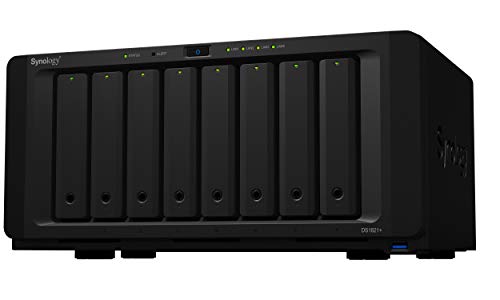
Best for: Database servers, virtualization hosts (e.g., VMware ESXi, Microsoft Hyper-V running on Synology), and high-transaction applications requiring both high IOPS and reliable fault tolerance. An excellent match for the Synology DS1821+ (Best for: small businesses and power users needing an expandable 8-bay NAS with enterprise-grade RAID support and AMD Ryzen processing power) in production VM or database environments.Synology 8 Bay DiskStation DS1821+ (Diskless), 8-bay; 4gb ddr4. 
Frequently Asked Questions: Synology RAID Types
Which Synology RAID type should I use for a home NAS?
For most home users with three or more drives, RAID 5 offers the best balance of usable capacity, read performance, and fault tolerance — tolerating a single drive failure while preserving (N−1) drives of usable storage. If you only have two drives, RAID 1 is the appropriate choice over RAID 0, since it protects against the most common point of failure: a single drive dying. Regardless of RAID level chosen, always maintain a separate off-NAS backup — RAID is not a substitute for backup.
What is the difference between RAID 5 and RAID 6 on Synology?
RAID 5 uses one distributed parity block and tolerates a single drive failure; RAID 6 uses two independent parity blocks and tolerates up to two simultaneous drive failures. RAID 6 requires a minimum of four drives versus three for RAID 5, and sacrifices one additional drive’s worth of capacity to the second parity set. For arrays of six or more drives — common on models like the Synology DS1821+ — RAID 6 is generally recommended because the statistical likelihood of a second drive failure during a multi-day RAID 5 rebuild increases significantly with larger drive counts and capacities.
Is RAID 0 safe to use on a Synology NAS?
RAID 0 provides zero fault tolerance — a single drive failure destroys the entire array’s data with no possibility of recovery from the remaining drives. It is appropriate only for non-critical, easily replaceable data such as download caches, transcoding scratch space, or temporary working files where maximum throughput is the priority and total volume loss is an acceptable outcome. It should never be the sole storage location for important or irreplaceable data.
Can I change RAID types on a Synology NAS without losing data?
Synology DSM supports certain in-place RAID migrations — for example, expanding from RAID 1 to RAID 5, or from RAID 5 to RAID 6, by adding drives to an existing volume. However, not all migration paths are supported; moving to a lower RAID level typically requires destroying and recreating the volume. Always back up all data to a separate destination before attempting any RAID configuration change, regardless of whether DSM describes the migration as non-destructive.
Does RAID replace backup on a Synology NAS?
No — RAID is not a backup. RAID protects against drive hardware failure only. It does not protect against accidental file deletion, ransomware encryption, file system corruption, NAS controller failure, theft, fire, or flood. The widely accepted 3-2-1 backup rule recommends maintaining at least three copies of data, on two different storage media, with one copy stored off-site or in the cloud. Synology’s own Hyper Backup application supports scheduled backups to remote Synology NAS units, rsync servers, and major cloud providers to help meet this standard.
—