Disclosure: As an Amazon Associate, Sony Camera Central earns from qualifying purchases. This post contains affiliate links — we may earn a commission at no extra cost to you.
Last updated: April 2026
As you undoubtedly know, a pan-tilt tripod head is the pinnacle of human engineering, rivaling the wheel in its significance for modern civilization—or at least, that’s what you might believe after seeing the difference it can make in your photography.
Key Takeaways
- A pan-tilt tripod head — a camera support accessory that enables independent rotation on horizontal (pan) and vertical (tilt) axes — gives photographers precise, repeatable framing control unavailable with a standard ball head.
- Load capacity is the single most critical specification: always choose a head rated above the combined weight of your camera body, heaviest lens, and all accessories.
- Fluid heads use viscous-damped chambers to create smooth, resistance-regulated movement — best suited for video panning and subject tracking.
- Motorized pan-tilt heads add remote operation convenience (typically 20 m+) but are limited to light loads (under 2.2 lbs / 1 kg in most consumer models).
- Arca Swiss-compatible quick-release plates — a dovetail-clamp standard originating from Swiss camera manufacturer Arca-Swiss — are now the de facto industry default for fast, tool-free camera mounting.
You’re in search of stability that rivals the foundations of the Earth and precision that would make a Swiss watchmaker nod in approval. The pan-tilt tripod head is not just an accessory; it’s a crucial ally in the pursuit of that perfect shot. Whether you’re a seasoned professional or an ardent enthusiast, the right head attached to your tripod can transform your photographic experience. This matters more than ever with modern high-resolution cameras: according to DPReview (Sanyal, 2022, DPReview), a 61 MP full-frame sensor is “unforgiving” of camera shake and technique — a reminder that even cameras equipped with advanced in-body stabilization rely on a stable, precisely controlled tripod head to deliver maximum sharpness in long exposures and panoramic compositions.
However, with an ocean of options out there, you’re probably wondering which ones stand out for their exceptional quality and reliability. Let’s explore together the top contenders that promise to elevate your camera game and leave you wondering how you ever managed without them.
Acratech Panoramic & Tilt Head with QR, 25 lbs Load Capacity
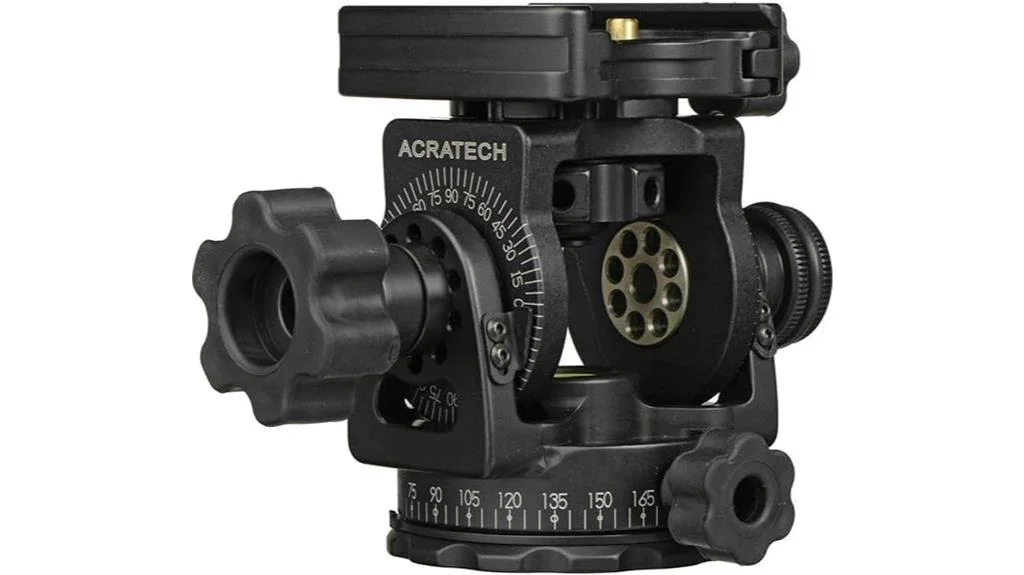
If you’re into creating multi-row panoramas or using long lenses without the bulk of a gimbal head, the Acratech Panoramic & Tilt Head with QR is your go-to gear, supporting up to 25 lbs with remarkable ease. This head is specifically designed to handle the heft of a 600 f4.0 lens, making it a solid choice for photographers who prioritize balance and stability over heavy equipment. Weighing less than a pound, it’s a breeze to carry on any shoot, and the large bullseye level ensures your shots are perfectly aligned. Plus, with fully adjustable tension control, you’ve got the precision you need at your fingertips. Say goodbye to a cumbersome setup; this head’s got you covered for those stunning landscapes and detailed panoramas.
Best For: Photographers who require a lightweight yet sturdy solution for multi-row panoramas or long lens photography without using a heavy gimbal head.
Pros:
- Supports heavy lenses up to 600mm f4.0, providing balance and stability.
- Weighs less than 1 lb, making it highly portable for fieldwork.
- Features a large bullseye level for precise alignment and fully adjustable tension control.
Cons:
- May not be ideal for all heavy long lens uses as per some user experiences.
K&F Concept Fluid Tripod Head with Arca Swiss-Compatible Mount
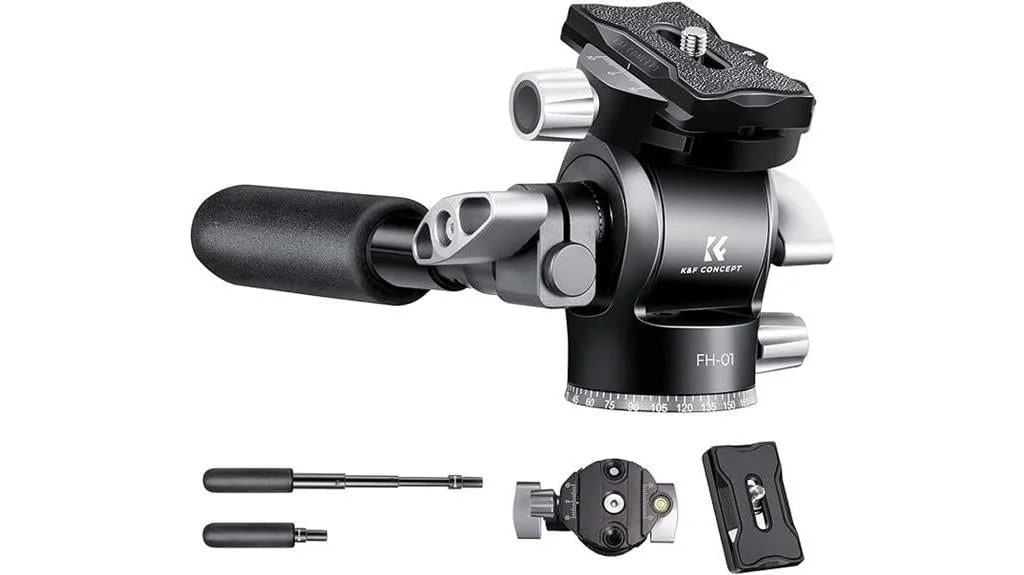
The K&F Concept Fluid Tripod Head is an ideal choice for amateur videographers and photographers seeking fluid movement and stability in their shots. It features an Arca Swiss-compatible mount — a widely adopted dovetail quick-release standard that allows rapid camera swapping across compatible heads and plates — and a silky smooth damping design. With an impressive load-bearing capacity of 11.02 lb / 5 kg, you can trust it to secure your gear.
The tripod head also includes precise tilt and pan locking knobs, ensuring maximum accuracy in your compositions. Crafted from durable aluminum alloy, it’s built to last. The telescopic handle enhances handling and portability, making it perfect for on-the-go shooting.
Users have lauded its build quality and adjustability, noting its versatility for various applications. Whether you’re vlogging, capturing wildlife, or filming yourself, this tripod head is praised for its smoothness and stability. It’s also described as a good value, offering professional-level functionality with few limitations considering its reasonable price.
Despite a few mixed reviews, the consensus is clear: this tripod head is a solid investment for your photography kit.
Best For: Enthusiast videographers and photographers who need a reliable, smooth fluid tripod head without breaking the bank.
Pros:
- Exceptional smoothness for fluid panning and tilting, enhancing video and photo quality.
- Strong build quality and material with an aluminum alloy construction, ensuring durability.
- Great value for the price, offering features that cater to both amateurs and professionals with some limitations.
Cons:
- Some users report a lack of adjustability in the counterbalance feature.
NEEWER Tripod Fluid Head with Quick Release Plate (GM24)
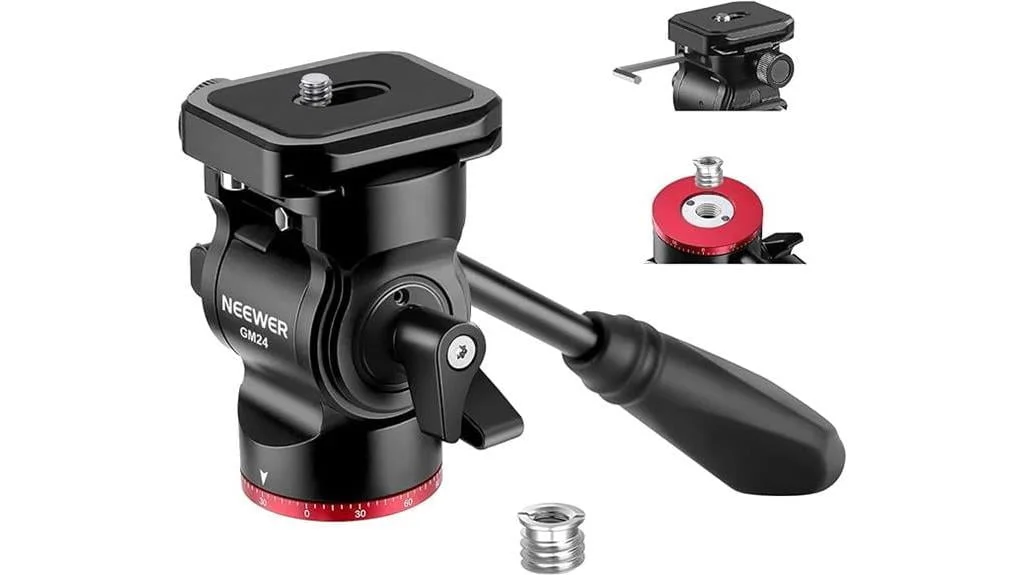
Capturing smooth panoramic shots and precise tilts just got easier with the NEEWER GM24 Tripod Fluid Head. Its all-metal construction ensures durability, while the 360° panoramic rotation and -55° to 90° tilting capabilities let you capture the action from any angle. You’ll appreciate the quick release plate with a 1/4′ screw that makes camera installation a breeze. Plus, the detachable handle can be adjusted for left or right-hand use, suiting your shooting style perfectly.
Despite its compact size, the GM24 can handle a maximum load of 6.6 lb / 3 kg, making it suitable for a variety of camera types. Users praise its lightweight yet sturdy build, smooth operation, and easy setup. While it doesn’t come with a bag and the handle might feel short, the overwhelming positive feedback, including a discount offer, confirms its value in your photography gear.
Best For: Amateur and professional photographers seeking a durable, lightweight tripod fluid head for smooth video capture and photography.
Pros:
- Sturdy all-metal construction enhances durability
- Fluid head design allows for smooth, shake-free movements
- Versatile compatibility with various camera types and easy camera installation
Cons:
- Lacks a carrying bag for convenient transportation
Moman Video Fluid Head for Tripods with Quick Release (Max Load 22 lbs / 10 kg)
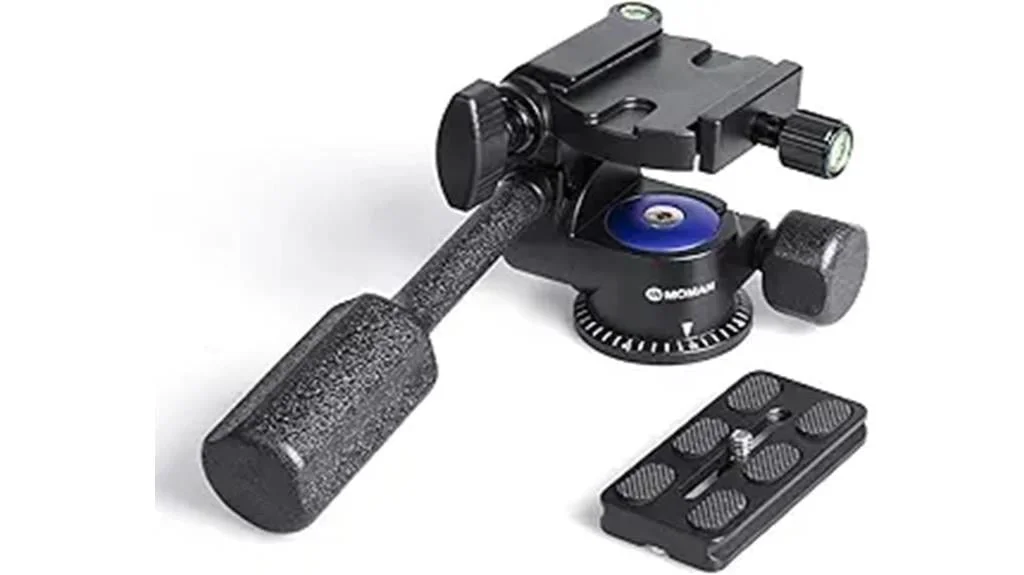
For photographers requiring a robust and versatile pan-tilt head, the Moman Video Fluid Head supports up to 22 lbs, making it ideal for heavy camera setups. You’ll find its multi-angle shooting capabilities and 360-degree swivel feature to be a boon for capturing smooth panoramic shots and dynamic angles. It’s compatible with a range of devices, ensuring you can use it with most of your gear.
The anti-slip pads add an extra layer of security, so your equipment stays safe. Weighing just 1.37 pounds, this head is portable despite its sturdy build. Customer feedback highlights the smoothness and quality, particularly praising its performance with the Milky Way and spotting scopes. However, do note that some users found limitations in vertical movement and the handle angle, which may affect certain shooting requirements.
Best For: Enthusiast and professional photographers or videographers seeking a lightweight yet sturdy fluid head for smooth panning and tilting with heavy camera setups including large mirrorless bodies paired with telephoto lenses.
Pros:
- Supports heavy equipment up to 22 lbs, making it versatile for different camera setups
- Offers 360-degree swivel and multi-angle shooting capabilities for creative flexibility
- Anti-slip pads ensure added equipment security and stability during use
Cons:
- Some users reported limitations with vertical movement, not going full 90 degrees
NEEWER Tripod Fluid Head with Leveling Base & Arca Type QR Plate (GM27)
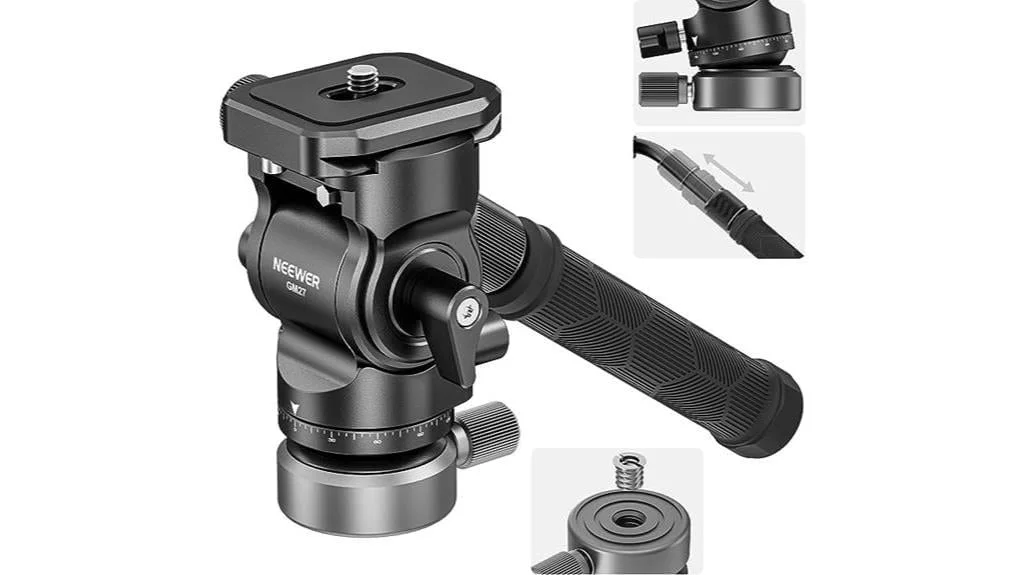
If you’re seeking precision and smooth control in your photography, the NEEWER Tripod Fluid Head with Leveling Base & Arca Type QR Plate (GM27) may be your ideal companion, especially with its integrated leveling bowl that facilitates quick adjustments. Built from rugged aluminum alloy, this fluid head ensures steady movements and has a fixed friction damping for consistent tension during tilts and pans.
The 360° pan and -55°/+90° tilt range, coupled with a detachable telescopic handle, offer comfortable operation, while compatibility with Arca Swiss QR system adds versatility.
Weighing just 13.7 ounces and supporting a maximum load of 8.8 lb, it’s praised for its compact size yet impressive ability to handle heavy setups. Despite its small level display, which some users find hard to see, its overall smooth performance and durability have garnered positive feedback.
Best For: Professional and amateur photographers and videographers looking for a lightweight, precise, and durable fluid tripod head with a built-in leveling bowl for fast, accurate setup in the field.
Pros:
- Compact size with strong load capacity, suitable for both lightweight and heavy camera setups.
- Smooth panning and tilting with fixed friction damping for consistent movement control.
- Built from rugged aluminum alloy, ensuring durability and reliability in various shooting conditions.
Cons:
- The small level display can be challenging to see, making it difficult to level the camera quickly.
SmallRig Tripod Fluid Head with Quick Release Plate (Model 3259B)
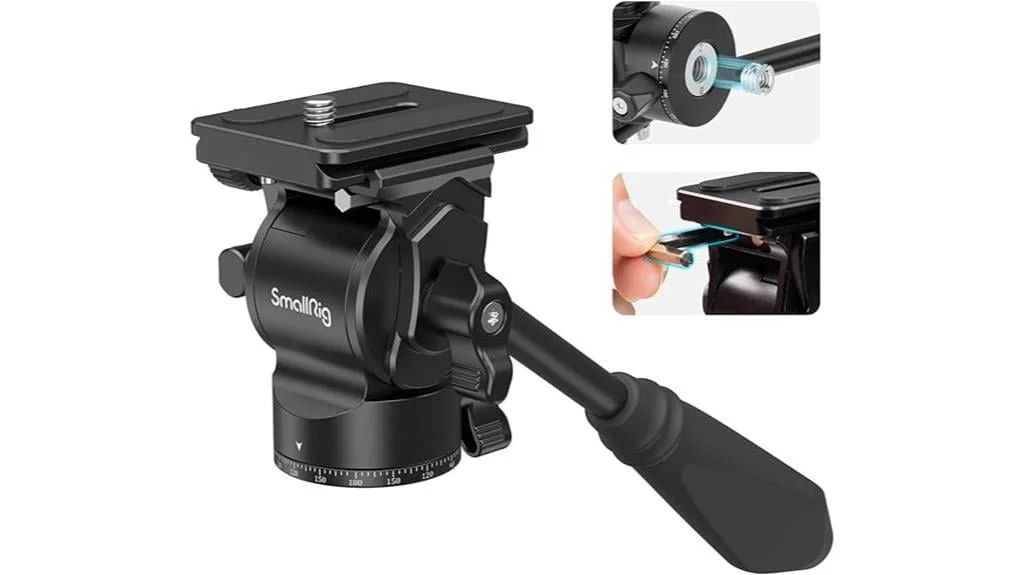
Photography enthusiasts seeking a compact and portable pan-tilt solution will find the SmallRig Tripod Fluid Head with Quick Release Plate (Model 3259B) particularly suitable for their needs.
Weighing just 9.8 ounces, its lightweight yet sturdy construction makes it ideal for travel and outdoor use. You’ll appreciate the fluid movement it offers for smooth panning and tilting, ensuring your shots are steady and precise.
Compatible with a range of cameras and lenses, it’s a versatile choice with a quick release plate for Arca-Swiss that simplifies camera attachment. Despite some concerns about the smoothness of vertical tilt and horizontal pan, you’ll find its performance reliable for video recording, hunting, or other applications. It’s a good value, delivering the quality and durability you need in a pan-tilt tripod head.
Best For: Photography enthusiasts who need an ultra-lightweight and portable pan-tilt tripod head for smooth operation during travel, hiking, and outdoor shoots where pack weight is a priority.
Pros:
- Compact and portable design ideal for travel
- Fluid movement for smooth panning and tilting
- Wide compatibility with different camera types and lenses
Cons:
- Some limitations in vertical tilt and horizontal pan smoothness
OlyCelotti Motorized Pan Tilt Camera Mount with Remote Control
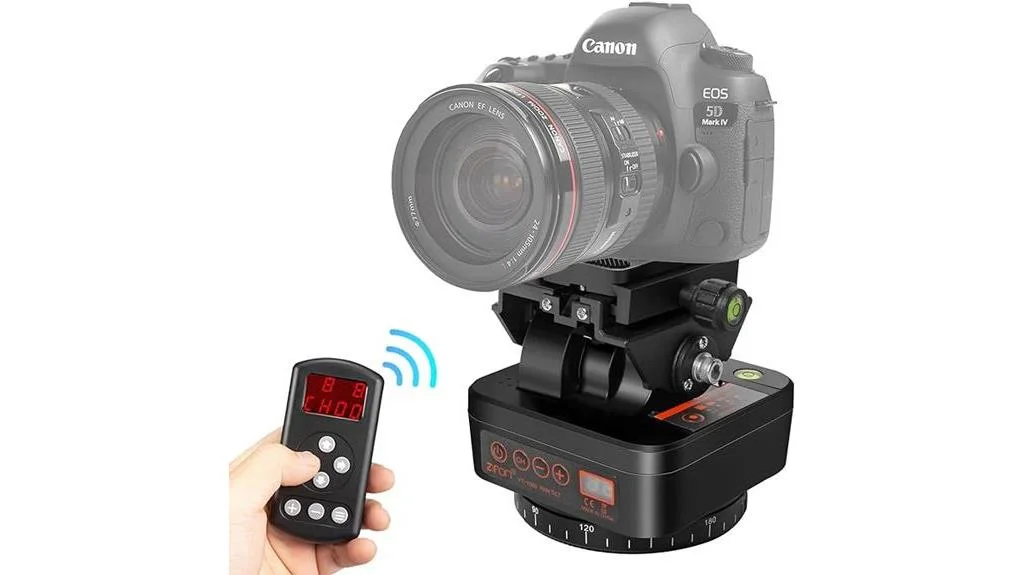
Exploring dynamic angles in your shots becomes effortless with the OlyCelotti Motorized Pan Tilt Camera Mount. This camera mount is ideal for videographers and photographers seeking remote control capabilities. You’ll appreciate its 360° horizontal and 35° vertical rotations, adjustable through 8 speeds for precision. The 2.4G remote control lets you operate from up to 20 m away, dodging any interference with ease.
The OlyCelotti Motorized Pan Tilt Camera Mount supports a variety of gear up to 2.2 lb, including DSLR cameras and smartphones, making it a versatile choice for live streaming or photo shoots. Charging is a breeze with its Type C port, and the built-in 18500 mAh lithium battery keeps you going for about 10 hours. Its compact build of PC and aluminum ensures durability without sacrificing portability. Just be mindful of its weight limit and slight jerkiness at lower speeds.
Best For: Videographers and photographers looking for a motorized solution to add dynamic remote-controlled movement to their shots — especially suited for live streaming, solo content creation, and lightweight DSLR or smartphone setups.
Pros:
- Offers both horizontal and vertical rotations, enhancing the range of motion for dynamic shots.
- Long-lasting battery life with up to 10 hours of operation, minimizing the need for frequent charging.
- Broad compatibility with various devices including DSLRs, smartphones, and GoPro cameras, providing versatility for different shooting requirements.
Cons:
- Limited weight capacity may restrict the use of heavier camera setups.
Motorized Tripod Head with Remote Control for Cameras and Smartphones
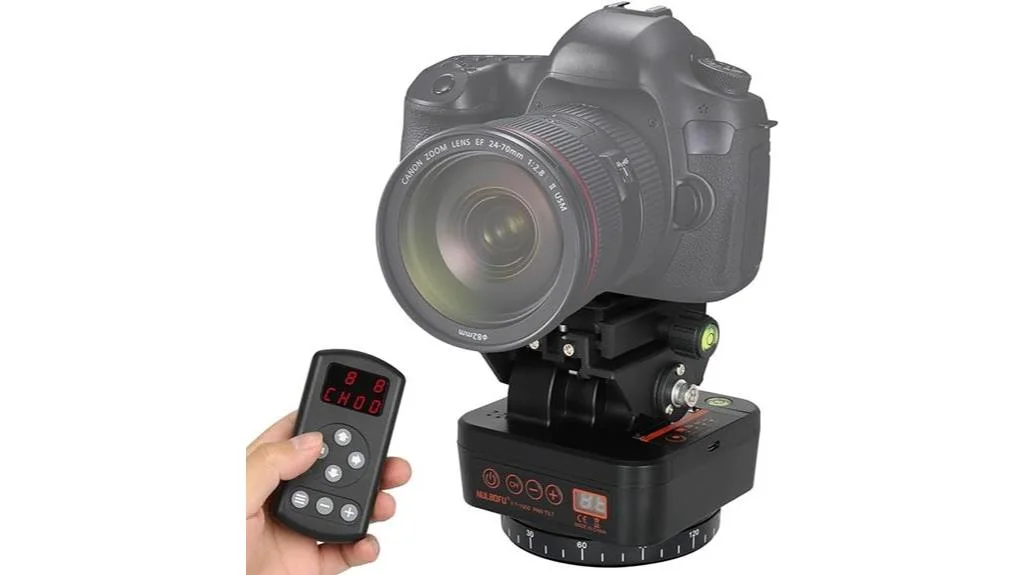
For photographers and videographers looking to elevate their craft with seamless panning and tilting, the NULBOFU motorized tripod head with remote control stands out as an ideal choice for both cameras and smartphones. You’ll appreciate its wireless remote, utilizing 2.4G technology for reliable communication. With the ability to support devices under 1 kg, it’s perfect for lightweight setups.
The head offers 360° horizontal and 35° vertical rotation, featuring eight speed settings to match your shooting requirements. Its built-in lithium battery charges in just two hours, ensuring you’re back in action quickly. Plus, with a remote distance of over 20 meters, you can capture the perfect shot from afar.
Its sturdy build and compact design, combined with user-friendly app controls, make it a top pick for precision and stability.
Best For: Professional and amateur photographers and videographers who need a lightweight, versatile motorized tripod head for smooth remote-controlled panning and tilting — particularly ideal for smartphone creators and vloggers working solo.
Pros:
- Wireless remote control allows for operation from a distance of over 20 meters.
- Fast 2-hour charging for the built-in lithium battery minimizes downtime.
- Eight speed settings provide versatility for various shooting scenarios.
Cons:
- Limited to devices weighing less than 1 kg, which may not accommodate heavier camera setups.
Avella Tripod Fluid Head with Quick Release Plate (V502)
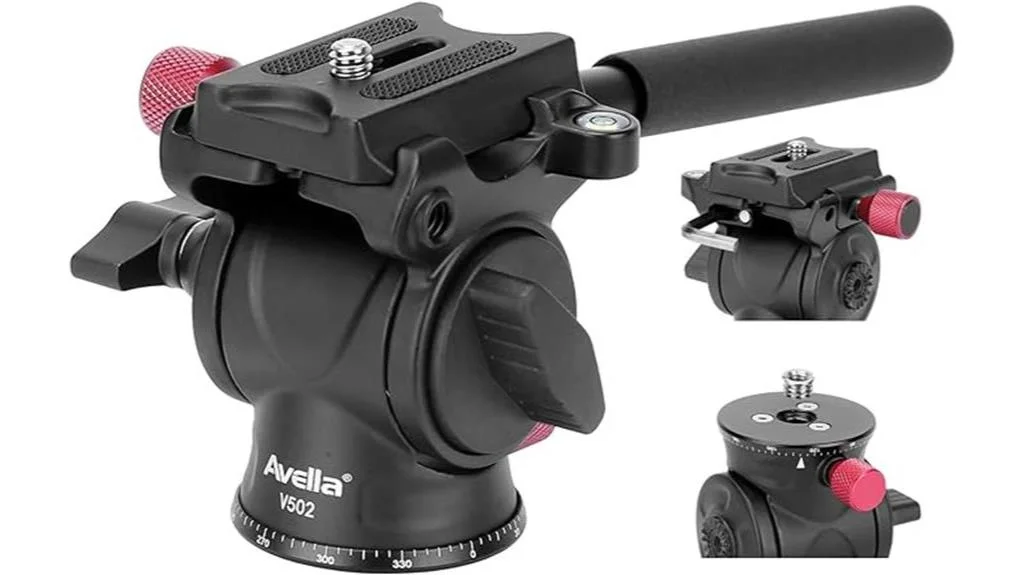
If you’re in need of a compact and versatile pan-tilt head, the Avella Tripod Fluid Head with Quick Release Plate (V502) stands out for its portability and seamless 360° panoramic capabilities. It offers a tilt range of -45° to 90° and comes with a convenient quick release plate featuring a 1/4 screw for easy attachment. The detachable handle and lightweight design have garnered positive reviews for smooth panning and stable tilt control. It’s compatible with a range of cameras, from DSLRs to smartphones, and supports a maximum load of 6.6 lb / 3 kg.
You’ll appreciate its ability to provide more control than standard pan heads, and it includes a phone mount bracket, which adds value. The build quality is impressive for the price, ensuring you get a reliable fluid head movement that’s easy to adjust and secure.
Best For: Content creators and hobbyist photographers looking for an affordable, lightweight fluid head for smooth panning and tilting across a wide range of cameras and smartphones — an especially strong value pick for those just getting started with tripod heads.
Pros:
- Compact and portable design ideal for on-the-go shooting
- Smooth fluid head movement for professional-looking pans and tilts
- Versatile compatibility with DSLRs, mirrorless cameras, and smartphone rigs
Cons:
- Limited maximum load capacity of 6.6 lb / 3 kg may not support heavier camera setups
Pan-Tilt Tripod Head Comparison
Use the table below to compare all nine heads side-by-side across the specifications that matter most for your shooting style.
| Product | Max Load | Head Weight | Head Type | QR Standard | Notable Feature | Best For |
|---|---|---|---|---|---|---|
| Acratech Panoramic & Tilt with QR | 25 lbs (11.3 kg) | < 1 lb | Pan-tilt / Panoramic | Arca Swiss | Large bullseye level; adjustable tension | Long-lens panoramas |
| K&F Concept Fluid Head | 11.02 lbs (5 kg) | N/A | Fluid pan-tilt | Arca Swiss | Telescopic handle; smooth damping | Amateur video & photo |
| NEEWER GM24 Fluid Head | 6.6 lbs (3 kg) | Compact | Fluid pan-tilt | 1/4″ screw | 360° pan; -55° to +90° tilt; all-metal | Budget fluid head users |
| Moman Video Fluid Head | 22 lbs (10 kg) | 1.37 lbs | Fluid pan-tilt | Quick release | Anti-slip pads; 360° swivel | Heavy-camera video setups |
| NEEWER GM27 Fluid Head | 8.8 lbs (4 kg) | 13.7 oz | Fluid pan-tilt | Arca Swiss | Integrated leveling bowl | Quick-level field work |
| SmallRig 3259B | N/A | 9.8 oz | Fluid pan-tilt | Arca Swiss | Ultra-lightweight travel design | Travel & outdoor shooting |
| OlyCelotti Motorized Mount | 2.2 lbs (1 kg) | Compact | Motorized pan-tilt | 1/4″ screw | 2.4G remote; 10-hr battery; 8 speeds | Live streaming & solo content |
| NULBOFU Motorized Head | < 2.2 lbs (1 kg) | Compact | Motorized pan-tilt | 1/4″ screw | 2.4G remote; 2-hr charge; app control | Smartphones & light cameras |
| Avella V502 Fluid Head | 6.6 lbs (3 kg) | Lightweight | Fluid pan-tilt | 1/4″ screw | Includes phone mount bracket | Content creators & hobbyists |
Factors to Consider When Choosing a Pan-Tilt Tripod Head
When you’re in the market for a pan-tilt tripod head, you’ll want to consider its load capacity to ensure it can handle your camera’s weight.
It’s crucial to check the smoothness of its fluid motion, especially if you’re into video shooting or time-lapse photography.
Lastly, don’t overlook the material’s durability and the compatibility with your existing equipment for a hassle-free photography experience.
What Load Capacity Do You Need for Your Camera Setup?
Your tripod head’s load capacity must exceed the combined weight of your camera body, your heaviest lens, and any attached accessories — period. Don’t overlook this detail; it’s the difference between seamless operation and potential disaster.
For more on this subject, check out Best Tripod for Sony A7III.
Manufacturers rate their tripod heads with a maximum load capacity, which you must compare with the weight of your gear. Remember, you’re not just accounting for your camera body, but also the heaviest lens you might use, along with any additional accessories like flash units or external monitors. Modern full-frame mirrorless cameras paired with telephoto glass can push a system well past 3 kg — always choose a head with a comfortable margin above your actual load. According to Sony Electronics Inc. (2022, Sony Official Product Page), even a mirrorless body like the Sony α7R V features 8-stop in-body image stabilization that reduces blur from handheld movement — but IBIS does not replace a properly rated tripod head for long exposures, focus stacking, or precision panoramic work where any mount flex is unacceptable.
If you choose a tripod head that’s too weak for your gear, you risk instability, which can lead to camera shake or worse, damage to your equipment. It’s always better to err on the side of caution and pick a head with a higher load capacity than you currently need.
Why Does Fluid Motion Quality Matter for Video and Photography?
Fluid motion quality is essential because it determines how smoothly you can pan and tilt during recording — poor damping introduces visible jerkiness that is nearly impossible to fix in post-production. A fluid head achieves this through viscous damping: a chamber filled with a thick, temperature-stable fluid creates consistent resistance against movement, so your pans feel buttery and controlled rather than sudden and mechanical.
You’ll find that a tripod head with superior fluid motion quality not only enhances stability but also enables precise control, essential for both still photography and videography. When evaluating fluid motion quality, test the head at multiple tension settings — the best fluid heads maintain even resistance throughout the full range of movement, not just at the extremes.
How Does Build Material Strength Affect Durability and Performance?
Build material strength directly determines how long your tripod head will last and how reliably it will hold your camera at the angle you set. Aluminum alloy — the material used in most heads on this list — strikes an excellent balance between stiffness, weight, and corrosion resistance, making it the dominant choice for professional-grade pan-tilt heads.
You’ll notice that stronger materials enhance the load capacity, ensuring your gear remains secure. The material’s robustness directly influences how well the tripod head withstands wear and tear, impacts, and harsh environmental conditions. Avoid pan-tilt heads with plastic main structural components if you plan to use them with DSLRs or mirrorless cameras heavier than 1 kg.
How Do You Ensure Mounting Compatibility with Your Camera?
Confirm that the tripod head’s quick-release system matches the plates already in your kit before purchasing — mismatched systems force you to carry multiple plate types and slow down your setup in the field. Most tripod heads use a standard 1/4-inch screw, but it’s crucial to check that this matches your camera’s mounting thread.
Don’t overlook the quick-release plate either; it should securely fit your camera for a swift setup. If you’re using heavier gear, look for heads with a larger mounting platform to balance the weight. Additionally, consider the head’s base diameter; it must match your tripod legs for a stable connection. The Arca Swiss standard — a 38 mm dovetail-slot system — is the most widely adopted format and offers the broadest compatibility across manufacturers.
What Adjustment and Control Features Should You Look For?
The best pan-tilt heads give you independent tension control on every axis so you can dial in exactly the resistance you need for each type of shot — looser for smooth video pans, tighter for locked-down architectural stills. Look for precise tension control that allows for smooth movements and fixed friction damping to ensure stable operation.
Some tripod heads feature integrated leveling bowls for pinpoint adjustments or telescopic handles, enhancing comfort and portability. You’ll want a head that offers 360° panoramic rotation and a tilting range of -55° to 90°. Extra features like a +/-10° leveling base can be a game-changer for quick setups. Ensure the head’s adjustable for either hand and compatible with systems like Arca Swiss for added convenience. Always consider how smoothly it operates, the setup’s simplicity, and its ability to withstand tough conditions.
How Important Is Size and Portability in a Tripod Head?
Size and weight become the deciding factor the moment you’re hiking to a remote location or packing carry-on luggage — a head that’s even 200–300 g lighter can make a tangible difference over a long shooting day. Look for a model that’s compact and light yet durable enough to handle your camera setup.
A good balance between the head’s maximum load capacity and its physical bulk will ensure it doesn’t become a burden during travel. Compatibility with various tripods and cameras is also essential; you don’t want to lug around equipment that doesn’t work well together. Features like detachable handles can make a difference, offering portability without compromising on the control you need for precision shots. Always opt for a pan-tilt head that complements your mobile lifestyle while meeting your photographic requirements.
What Should You Budget for a Quality Pan-Tilt Tripod Head?
For most photographers, a budget of $50–$150 covers a solid fluid pan-tilt head with Arca Swiss compatibility, while $150–$400 enters professional-grade territory with tighter tolerances, heavier load ratings, and better long-term durability. Research and compare prices from various brands to find the best value within your budget.
Make sure you’re evaluating the features and load capacity to ensure you’re getting a good bang for your buck. Keep an eye out for sales, discounts, or promotions to maximize your investment. It’s crucial to weigh the price against the specific functionalities and applications you need. Also, don’t ignore additional costs like shipping, taxes, or necessary accessories such as additional Arca Swiss plates — these can impact your total spend more than you might anticipate.
Frequently Asked Questions
What is the difference between a pan-tilt head and a ball head?
A pan-tilt head moves on separate, independently lockable axes — horizontal (pan) and vertical (tilt) — so you can adjust one without disturbing the other. A ball head uses a single ball-and-socket joint that moves freely in all directions and is locked with one knob. Pan-tilt heads offer greater precision for architecture, panoramas, and video; ball heads are faster to reposition for general photography where exact repeatability matters less.
What load capacity do I need for a mirrorless camera and telephoto lens?
Always total the weight of your camera body, the heaviest lens you’ll mount, plus any accessories (flash, L-bracket, external monitor). A full-frame mirrorless body typically weighs 600–800 g; a 70–200mm f/2.8 telephoto adds roughly 1.4–2 kg; a 600mm f/4 prime can add 3+ kg. Choose a head with a rated capacity at least 1.5× your actual system weight to maintain stability and protect against sudden movement loads.
Are fluid pan-tilt heads suitable for still photography or only video?
Fluid heads excel at video because their damped resistance produces the smooth, cinema-quality pans that video demands. For still photography, the fluid damping is generally a non-issue and even helpful — it prevents the head from snapping to a new position, reducing vibration after adjustment. The only scenario where a fluid head adds friction you don’t want is in astro-tracking rigs, where a dedicated equatorial mount is preferable.
What does “Arca Swiss compatible” mean, and why does it matter?
Arca Swiss compatible refers to a quick-release system using a 38 mm dovetail-profile plate that slides into a matching clamp and is secured with a single knob. Although the term references the Swiss manufacturer that popularized the design, it has since become an open, widely adopted standard produced by dozens of brands. Its importance lies in interoperability: an Arca Swiss-compatible plate you buy for one head will work on any other Arca Swiss-compatible clamp, letting you move a camera quickly between a tripod head, L-bracket, monopod, or slider without tools.
Is a motorized pan-tilt head worth buying for photography?
Motorized pan-tilt heads are worth the investment specifically for solo content creation, live streaming, and lightweight time-lapse work where triggering camera movement remotely prevents shake and eliminates the need for an assistant. Their trade-off is load capacity: consumer motorized heads on this list top out at 2.2 lbs (1 kg), which accommodates smartphones and compact cameras but not a full mirrorless system with a zoom lens. For serious photography with interchangeable-lens cameras, a manual fluid head offers far greater payload and smoother, more controllable movement.
Conclusion
You’ve got a stellar lineup of pan-tilt tripod heads to choose from! Whether you need motorized control with the OlyCelotti, hefty load support from the Moman or Acratech, or smooth fluid motion with K&F Concept, there’s a match for your shooting style.
Don’t forget to weigh factors like load capacity, compatibility, and control features. Pick the right head, and you’re set for capturing those sharp, stable shots with the precision you crave.
Happy shooting!