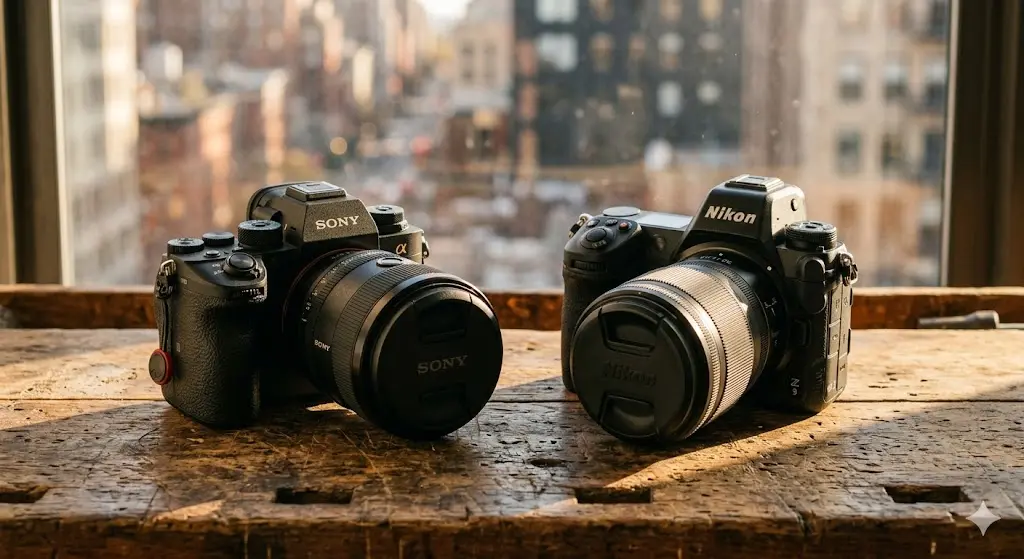
High-resolution photography demands cameras that resolve fine detail, handle dynamic range with precision, and deliver reliable autofocus in controlled conditions. The Sony A7R V (61MP) and Nikon Z8 (45.7MP) represent two of the finest high-resolution tools available in 2025. They appeal to the same photographers — landscape, architecture, studio, and commercial — but make different trade-offs. Here is a thorough comparison.
Sensor Resolution: 61MP vs 45.7MP
The A7R V’s 61MP BSI sensor has been the resolution benchmark for Sony since 2019. It delivers extraordinary fine detail — at 100% magnification you can read tiny text in a landscape scene, resolve individual grass blades, and capture skin pores in studio portraits. The pixel pitch is narrow, which means diffraction limits sharpness at f/16 and above. Optimal apertures run f/5.6–f/11 for landscape work.
The Nikon Z8 uses a 45.7MP BSI sensor. At any normal output size — web, social, even 24×36-inch prints — the resolution difference between 61MP and 45.7MP is visually negligible. The Nikon’s larger photosites (per the math of sensor area vs pixel count) give slightly better per-pixel noise performance and a marginally wider diffraction limit. At f/16, the Z8 retains edge acuity that the A7R V begins to lose.
| Spec | Sony A7R V | Nikon Z8 |
|---|---|---|
| Resolution | 61MP | 45.7MP |
| Sensor Format | Full-frame BSI Exmor R | Full-frame BSI Stacked |
| Pixel Size | 3.76μm | 4.34μm |
| ISO Range | 100-32000 (ext. 50-102400) | 64-25600 (ext. 32-102400) |
| Dynamic Range (ISO 64/100) | ~14.7 stops | ~14.6 stops |
| Base ISO | 100 | 64 |
The Nikon Z8 offers ISO 64 as its native base setting — one stop lower than the A7R V’s ISO 100. For long-exposure landscape photography, this extra stop provides additional headroom for slower shutter speeds in bright light without stacking ND filters.
Autofocus: Sony’s AI System vs Nikon’s 3D Tracking
Both cameras use advanced computational AF systems. The A7R V introduced Sony’s AI Processing Unit, dedicated to subject recognition separate from the main image processor. It identifies and tracks humans, animals, birds, insects, cars, trains, and airplanes.
The Nikon Z8 uses the same subject recognition AF as the Z9 — Nikon’s most sophisticated system. It tracks subjects across the full frame, delivers excellent human/animal recognition, and handles complex backgrounds well. Nikon’s 3D tracking mode in optical viewfinder use (via the EVF) is particularly effective for moving subjects.
Both systems are excellent for studio work — tracking a subject in controlled conditions is something either handles easily. The difference emerges in challenging natural environments: wildlife, sports, unpredictable movement. Here the Sony A7R V has a slight edge in animal and bird recognition, while the Nikon Z8 offers more predictable tracking behavior for human subjects in dynamic scenarios.
For landscape and architectural photography — the primary use case for these cameras — neither AF system is exercised heavily. Static subject AF is essentially identical between them.
Video: The Nikon Z8 Pulls Ahead
The Nikon Z8 shoots 8K/60p internally — a significant capability that the Sony A7R V cannot match. The A7R V shoots 8K/25p (limited) and 4K/60p as its practical video ceiling. For photographers who occasionally need high-frame-rate video or want to extract 8K stills from video, the Z8 offers substantially more.
| Video Feature | Sony A7R V | Nikon Z8 |
|---|---|---|
| Max 4K | 4K/60p | 4K/120p |
| Max 8K | 8K/25p (limited) | 8K/60p |
| Slow Motion (1080p) | 120fps | 240fps |
| RAW Video Output | 16-bit HDMI to recorder | 12-bit ProRes RAW via HDMI |
| Internal Log | S-Log3, HLG | N-Log, HLG |
If video is relevant to your work, the Nikon Z8 is a materially superior option. The A7R V was not designed as a hybrid video tool — it prioritizes stills performance above all.
Pixel Shift Multi Shooting
Both cameras offer Pixel Shift — sequential multi-exposure captures that combine into a single ultra-high-resolution file. The A7R V produces 240.8MP files via Pixel Shift Multi Shooting (16 frames). The Nikon Z8 reaches 185MP in its highest Pixel Shift mode.
These modes require a perfectly still subject and a fixed camera position. They are useful for art reproduction, architecture on calm days, and studio still life. Neither camera is practically superior to the other here — both produce files that exceed any current display or print demand.
Battery Life and Body Design
The Nikon Z8 uses the EN-EL15c battery (shared with the D850, Z7, Z7 II). It delivers around 340 shots per charge under CIPA conditions — similar to the A7R V’s NP-FZ100 battery (approximately 530 shots CIPA). The A7R V significantly outlasts the Z8 per charge for stills shooting.
The A7R V uses the Z8’s slightly larger NP-FZ100 battery in all A7-series bodies. Sony’s battery life advantage is meaningful for travel photographers who want fewer charge cycles per day.
The Z8 is slightly larger and heavier than the A7R V: 910g vs 723g with battery and card. Both use dual card slots — the Z8 uses CFexpress Type B and SD; the A7R V uses CFexpress Type A and SD.
Lens Ecosystem
Sony’s FE mount has the deepest native mirrorless high-resolution lens catalog: G Master primes in 24mm, 35mm, 50mm, 85mm, 100mm macro, and 135mm cover portrait and landscape work comprehensively. The 24-70mm GM II and 70-200mm GM II are professional standards.
Nikon’s Z mount is newer but growing rapidly. The Z 58mm f/0.95 S Noct, 50mm f/1.2 S, and 85mm f/1.2 S are exceptional performers. Nikon’s F-to-Z FTZ II adapter provides seamless compatibility with the vast F-mount lens catalog — giving Z8 shooters access to decades of Nikon glass with full AF functionality.
Who Should Choose Which Camera
- Maximum resolution for large prints: Sony A7R V — 61MP delivers more resolving power for billboard-scale output
- Landscape / long-exposure: Nikon Z8 — ISO 64 base and better high-aperture diffraction performance
- Studio commercial photography: Either — comparable performance; choose based on ecosystem
- Hybrid photographer who needs 4K/120p or 8K: Nikon Z8 — clearly superior video
- Wildlife/bird secondary use: Sony A7R V — superior subject-recognition AF for animals
- Battery life on location: Sony A7R V — ~530 shots vs ~340 shots per charge
Frequently Asked Questions
- Is 61MP noticeably better than 45.7MP?
- At normal viewing distances and output sizes up to 30×40 inches, the difference is marginal. 61MP becomes meaningful for extreme cropping, very large print output, or art reproduction work.
- Can the Nikon Z8 use Sony lenses?
- No. The Z mount and E mount are not compatible. Third-party adapters exist but compromise AF performance significantly.
- Is the Sony A7R V good for video?
- It shoots capable 4K/60p, but it is not a dedicated video tool. If video is important to your workflow, the A7S III, FX3, or Nikon Z8 are better choices.
- Which has better dynamic range?
- Both cameras measure at approximately 14.6-14.7 stops at base ISO. They are essentially equivalent in dynamic range for landscape and studio applications.
- Does the Sony A7R V have weather sealing?
- Yes. The A7R V has Sony’s top-tier weather sealing with extensive gaskets around buttons, dials, and port covers — comparable to professional sports cameras.