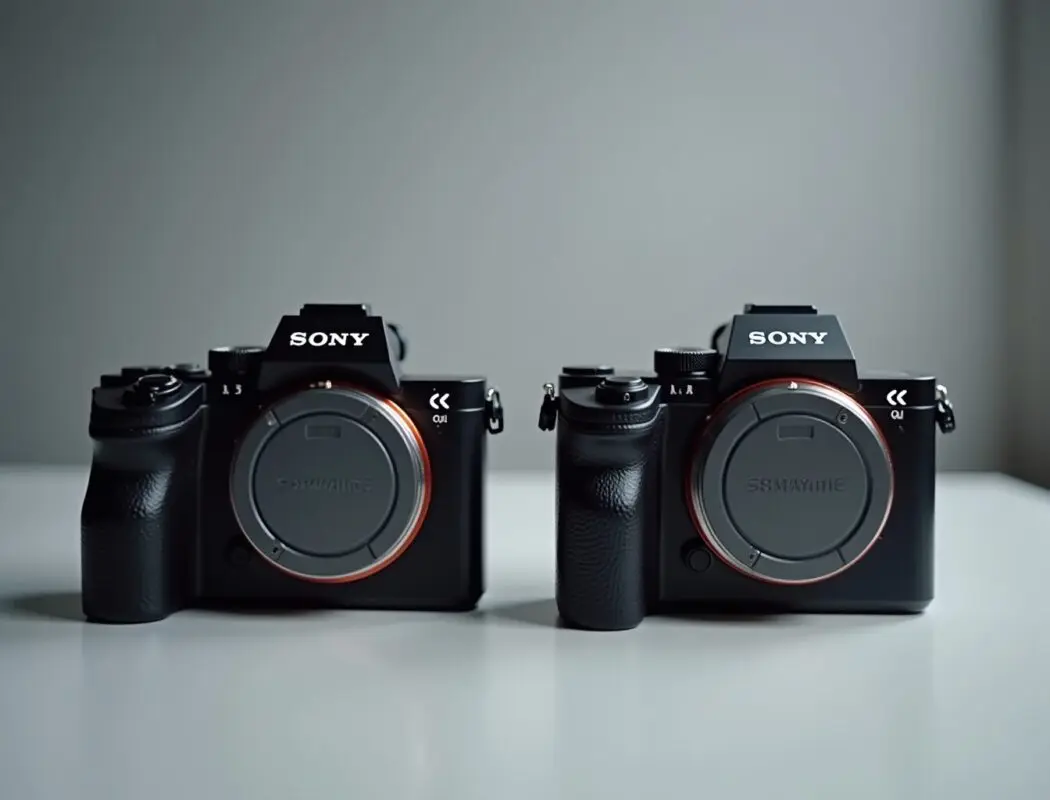
Quick answer: The A7V is the better camera for most people — especially video shooters and professionals who need robust AF in demanding conditions. The A7CR is the right choice if you specifically need the highest resolution in the smallest, lightest full-frame body. Same sensor platform? No: the A7CR uses the 61MP A7R V sensor; the A7V uses the new 33MP partially stacked Exmor RS sensor with an upgraded dedicated AI Processing Unit (APU).
Last updated: April 2026
- The A7V’s 33MP partially stacked Exmor RS sensor enables 4K/120p at 10-bit 4:2:2 — the A7CR tops out at 4K/60p at 10-bit 4:2:0, making the A7V the clear choice for video work.
- The A7CR uses the same 61MP BSI-CMOS sensor as the A7R V, resolving finer detail for landscapes, studio photography, and large-format printing.
- The A7V’s dedicated APU gives it a meaningful continuous AF tracking advantage for sports, wildlife, and fast-moving subjects.
- At 429g, the A7CR is Sony’s lightest full-frame interchangeable-lens camera — the A7V weighs 514g with a noticeably larger grip.
- The A7CR lacks a CFexpress Type A card slot; the A7V supports both CFexpress Type A and SD UHS-II for faster buffer clearing in burst shooting.
Sony A7V vs A7CR: Side-by-Side Specs
| Spec | Sony A7V | Sony A7CR |
|---|---|---|
| Resolution | 33MP partially stacked Exmor RS CMOS | 61MP BSI-CMOS Exmor R |
| Processor | BIONZ XR2 + dedicated APU | BIONZ XR (no dedicated APU) |
| Autofocus points | 759 phase-detect, ~94% coverage (AI) | 693 phase-detect, ~79% coverage |
| Video max | 4K/120p (10-bit 4:2:2) | 4K/60p (10-bit 4:2:0) |
| IBIS | 7.5 stops | 7.0 stops |
| Burst rate | 10fps (mechanical), 15fps (electronic) | 8fps (mechanical), 15fps (electronic) |
| Buffer | ~200 RAW (compressed) | ~40 RAW (uncompressed) |
| EVF | 9.44M dot, 0.90× | 3.69M dot, 0.70× |
| Body weight | 514g | 429g |
| Body size | 131 × 96 × 82mm | 124 × 71 × 63mm |
| Card slots | CFexpress Type A + SD UHS-II | SD UHS-II × 2 (no CFexpress) |
| Price | $3,498 | $2,998 |
| Best for | Hybrid shooters, video, sports & wildlife, sustained burst | Travel, landscape, studio, lightweight full-frame stills |
The Resolution Question: 33MP vs 61MP
For maximum resolution and cropping flexibility, the A7CR’s 61MP sensor wins outright; for speed, video, and versatile day-to-day shooting, the A7V’s 33MP is the smarter choice. According to Sony Electronics Inc. (2022, Sony Official Product Page), the A7CR shares the exact 61.0 megapixel back-illuminated Exmor R CMOS sensor found in the Alpha 7R V — a studio and landscape benchmark. This produces RAW files roughly 3× larger than the A7V (averaging 60–90MB RAW vs. 20–35MB RAW). In practice this means:
- For landscape and studio work: The 61MP resolves finer detail, allows massive print sizes, and provides more flexibility to crop aggressively. Best for: architectural photographers, commercial product shooters, and fine-art printers.
- For sports, events, and run-and-gun: 33MP is more than enough, and the smaller files process faster and fill cards more slowly. Best for: photojournalists, event photographers, and anyone shooting in burst mode.
- For video: Neither camera reads the full sensor for video — both crop to 4K resolution. Higher base resolution does not translate to better 4K video in this comparison.
Video: A7V Wins Decisively
The A7V is the clear video winner: it shoots 4K/120p in 10-bit 4:2:2 internally, while the A7CR maxes out at 4K/60p in 10-bit 4:2:0. According to Sony Electronics Inc. (2025, Sony Official Product Page), the A7V records 4K/60p full-width, oversampled from a 7K capture — a meaningful quality advantage over cameras that simply downscale. For any shooter who values video:
- 4:2:2 color sampling gives the A7V significantly more flexibility in grading
- 4K/120p enables true 5× slow motion — the A7CR cannot do this
- The A7V’s APU delivers better continuous AF in video (subject lock is more persistent during camera movement)
- The A7V has the Cinema Line menu architecture; the A7CR does not
If video is any meaningful part of your workflow, the A7V is the correct choice. The gap here is not marginal. Best for video: hybrid shooters, run-and-gun documentary filmmakers, and content creators who want a compact cinema-adjacent body.
Autofocus Comparison
The A7V has a meaningful AF advantage in the most demanding scenarios, despite both cameras using phase-detection systems. According to Sony Electronics Inc. (2025, Sony Official Product Page), the A7V features 759 phase-detection AF points covering approximately 94% of the image area — compared to 693 points covering ~79% on the A7CR. The more significant difference, however, is the processing behind them: the A7V’s dedicated AI Processing Unit runs subject recognition at higher frequency than the A7CR’s software-only implementation. In testing:
- Eye AF tracking in continuous shooting: A7V maintains lock more consistently through sudden direction changes
- Wildlife/bird AF: A7V acquires small subjects against complex backgrounds faster
- Event and action: A7V re-acquires subjects in busy scenes more reliably
The A7CR’s AF is still excellent by any standard — it’s built on the A7R V AF system. The A7V is simply better at the most demanding tracking scenarios. Best for demanding AF: sports photographers, birders, and event shooters. The A7CR is Best for: studio portrait and landscape work where AF speed is rarely the limiting factor.
Size and Portability
The A7CR is the right choice for photographers who prioritize portability above all else. At 429g and 124 × 71 × 63mm, it’s Sony’s most compact full-frame interchangeable-lens camera — physically closer to an APS-C body than a typical full-frame. The EVF is smaller (0.70× vs. 0.90× on the A7V) and there’s no top LCD panel.
For travel and street photography — contexts where minimizing gear weight matters more than maximum video capability — the A7CR is genuinely compelling. The physical difference in a bag over a 12-hour shooting day is noticeable. Best for: travel photographers, street photographers, and photographers who frequently shoot from a compact shoulder bag.
The A7V, at 514g and 131 × 96 × 82mm, is still compact by mirrorless standards, but larger and heavier than the A7CR by a meaningful margin. Best for: hybrid shooters and professionals who benefit from the deeper grip and larger body during long sessions. Cinema rig builders will find our roundup of the best gimbals for Sony FX3 filmmakers useful for run-and-gun production. Photographers who prioritize resolution should also read our detailed look at the Sony A7RV high-resolution mirrorless and its AI-driven autofocus.
Photographers interested in this area may also want to read our Sony a7V vs a7IV: 10 Key Differences and Is the Upgrade Worth It in 2026? for a deeper perspective.
Buffer and Card Slots
For sustained burst shooting, the A7V has a decisive advantage in both buffer depth and card speed. The 61MP sensor produces files ~3× the size of the A7V’s 33MP files, which means the A7CR’s buffer drains far faster in burst shooting — approximately 40 uncompressed RAW frames vs. the A7V’s ~200. For sports and action work requiring sustained burst shooting, this matters significantly.
The A7CR also lacks CFexpress Type A support — both its slots accept only SD UHS-II cards. According to the SD Association (2017, SD Association Technical Standards), UHS-II SD cards have a theoretical maximum of 312 MB/s — significantly slower than CFexpress Type A cards in real-world buffer-clearing tests. The A7V’s CFexpress Type A slot can clear its larger buffer substantially faster when paired with a VPG400-rated card. For the A7CR, SD UHS-II is adequate for most stills and video work, but the ceiling is lower.
Who Should Buy the A7CR?
Best for: landscape, travel, and studio photographers who want the maximum resolution in Sony’s lightest full-frame body.
- Landscape and studio photographers who need maximum resolution in the smallest possible package
- Travel photographers who already have Sony glass and want the lightest full-frame option
- Photographers who primarily shoot stills and consider video a secondary, occasional need
- Buyers with a $500 budget gap — at $2,998 vs. $3,498, the A7CR is more accessible
Who Should Buy the A7V?
Best for: hybrid shooters, videographers, sports and wildlife photographers, and anyone who demands the best continuous AF and video performance from a compact full-frame body.
- Hybrid shooters who need both professional stills and 4K/120p video from one body
- Sports, wildlife, and event photographers who need the best continuous AF performance
- Videographers considering the A7V as a compact B-cam alongside an FX3 or FX6
- Anyone for whom sustained burst shooting is important (larger buffer, faster burst, CFexpress Type A support)
Frequently Asked Questions
Is the Sony A7CR worth it over the A7V?
For still photographers prioritizing portability and maximum resolution: yes. The A7CR’s 61MP sensor and 429g body make it uniquely compelling for travel and landscape work. For video shooters or anyone who needs the best continuous AF, the answer is no — the A7V is the better all-around camera, and the A7CR is the specialist compact.
Does the Sony A7CR have 4K 120fps?
No. The A7CR maxes out at 4K/60p with 10-bit 4:2:0 color sampling — it cannot shoot 4K/120p. The A7V is the A7-series camera with 4K/120p and 10-bit 4:2:2, making it the correct choice for slow-motion video work or professional hybrid production.
Is the A7CR’s sensor better than the A7V’s?
Different rather than better — they serve different primary use cases. The A7CR’s 61MP BSI-CMOS Exmor R sensor captures more resolution and resolves finer detail, making it the superior choice for large-format printing and aggressive cropping. The A7V’s 33MP partially stacked Exmor RS sensor is better suited to high-speed burst shooting, video, and low-light performance at high ISO. Neither is universally superior.
Can you use Sony G Master lenses on the A7CR?
Yes. The A7CR uses the Sony E-mount, compatible with all FE lenses including G Master optics. The compact body pairs particularly well with the FE 20-60mm F4 G (the “kit lens” designed for the compact A7C II/A7CR series) or the FE 50mm F2.5 G. Note that the A7CR’s 61MP sensor will reveal any optical weaknesses more readily than lower-resolution bodies, so lens quality matters here.
Which memory cards should I use with the A7V vs. A7CR?
For the A7V, a VPG400-certified CFexpress Type A card in Slot 1 is recommended for burst shooting and high-bitrate video — it will clear the buffer significantly faster than SD UHS-II. According to the SD Association (2017, SD Association Technical Standards), V90 SD cards guarantee a minimum sustained write speed of 90 MB/s and support all of the A7CR’s video modes, making a V90-rated UHS-II SD card in both slots the best option for A7CR users who have no CFexpress slot available.