
Last updated: April 2026
Are you torn between the desire for premium features and the hesitance about the price tag associated with high-end cameras? The Sony RX100 VII may just be the solution you’ve been seeking.
Key Takeaways
- The Sony RX100 VII packs a 20.1 MP 1.0-type stacked CMOS sensor and a 24–200mm equivalent Zeiss zoom lens into a truly pocketable body.
- Its hybrid AF system — combining 357 phase-detection points with 425-point contrast detection — delivers autofocus speed and accuracy rare in the compact camera class.
- 20 fps blackout-free continuous shooting makes the RX100 VII one of the fastest compact cameras ever produced.
- 4K video recording with a dedicated 3.5mm microphone input elevates it well above typical point-and-shoot options for video creators.
- Battery life of approximately 240 shots per charge is the primary limitation — spare batteries are advisable for full-day shooting sessions.
Its reputation precedes it as a top-tier compact camera, but is it truly worth the investment? As we unpack the intricacies of its performance and features, you’ll gain a clearer understanding of whether this camera is the perfect match for your photography ambitions.
What Is the Sony RX100 VII?
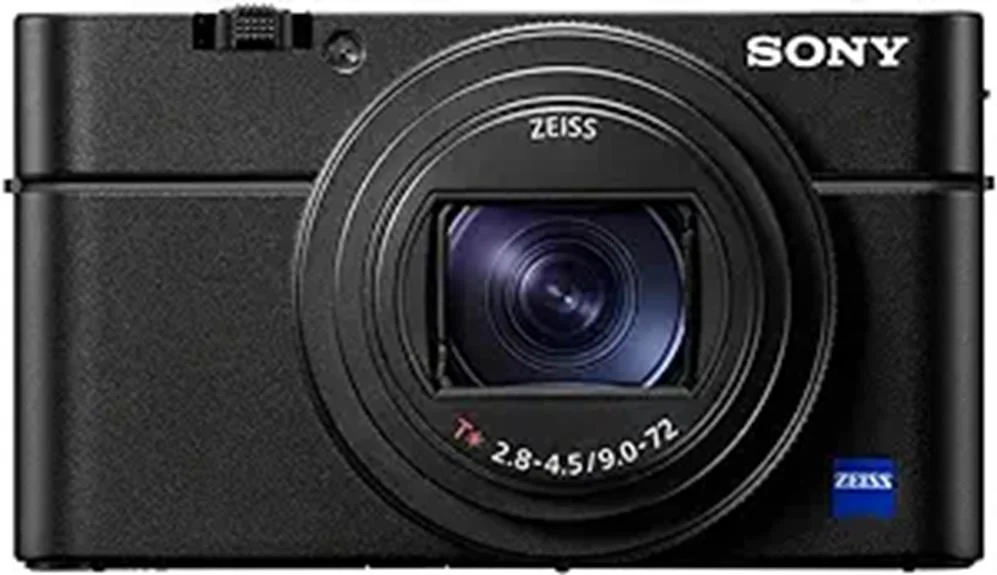
The Sony RX100 VII is Sony’s flagship 1.0-type compact camera, designed for advanced photographers who demand near-interchangeable-lens performance in a jacket-pocket body. It features a 20.1 MP 1.0-type stacked CMOS sensor — stacked CMOS architecture layers the sensor’s circuitry directly behind the pixel array, enabling significantly faster data readout and reduced rolling shutter distortion compared to conventional CMOS designs — paired with a Zeiss Vario Sonnar T* 24–200mm F2.8–F4.5 equivalent zoom lens that covers wide-angle to telephoto in a single unit.
The advanced autofocus system features 357-point focal plane Phase Detection AF (phase-detection autofocus uses paired pixel sets to detect subject distance by comparing two slightly offset images, enabling near-instantaneous focus acquisition without the “hunting” of contrast-only systems) and 425-point contrast detection AF, ensuring high-speed and accurate focusing, ideal for capturing fast-moving subjects.
Additionally, the camera’s 20 fps blackout-free shooting capability and Real-time Tracking for stills and movies — Real-time Tracking uses AI-based subject recognition to continuously lock onto and follow a subject, even when partially obscured — provide photographers with the tools needed to achieve outstanding results in dynamic shooting situations.
The Sony RX100 VII excels in delivering professional-grade performance in a compact form factor, making it a top choice for photography enthusiasts.
Best For: Travel photographers, street shooters, and content creators who need the best autofocus performance and a versatile focal range (24–200mm) in a camera that fits in a jacket pocket — without carrying a larger mirrorless system.
What Features and Controls Does the Sony RX100 VII Offer?
The Sony RX100 VII offers four primary physical and interface controls — customizable buttons, a touchscreen display, a pop-up electronic viewfinder (EVF), and a lens-mounted control ring — that together replicate much of the hands-on ergonomic experience of a larger interchangeable-lens camera in a compact body. These controls allow photographers to stay in the moment rather than navigating deep menus.
- Customizable Controls: Tailor the camera to your shooting style with customizable buttons for quick access to frequently used functions.
- Touchscreen Interface: Navigate menus and settings effortlessly with the responsive touchscreen display for smooth operation.
- Electronic Viewfinder (EVF): An Electronic Viewfinder (EVF) shows a live digital preview of the scene through the eyepiece, allowing accurate framing even in bright lighting conditions where an LCD screen becomes hard to read. The pop-up EVF on the RX100 VII deploys automatically when raised.
- Control Ring: Enjoy precise control over settings like aperture, shutter speed, exposure compensation, and zoom with the tactile and customizable control ring surrounding the lens barrel.
How Does the Sony RX100 VII Perform in the Field?
The Sony RX100 VII delivers exceptional real-world performance: its 20 fps blackout-free burst and hybrid AF system — combining 357 on-chip phase-detection points with 425 contrast-detection points — produce sharp, accurately focused images in fast-moving situations that most compact cameras simply cannot handle. Real-time Eye AF and Real-time Tracking maintain lock even when subjects turn or are briefly obscured.
With a 20.1 MP stacked CMOS sensor and a versatile 24–200mm full-frame equivalent f/2.8–f/4.5 lens, the RX100 VII delivers impressive image quality across its zoom range. The stacked sensor architecture enables the fast data readout needed to sustain 20 fps bursts and 4K video without overheating typical of conventional CMOS designs in compact bodies.
The RX100 VII excels in capturing dynamic scenes, making it ideal for a wide range of photography styles. Push the boundaries of your creativity with this compact powerhouse that combines cutting-edge technology with exceptional image quality.
Which Use Case Is the Sony RX100 VII Best Suited For?
The RX100 VII’s 24–200mm zoom range and advanced AF suit many genres, though its 1.0-type sensor means some use cases benefit more than others from its specific strengths. Use the table below to identify the best fit for your shooting style:
| Use Case | Suitability | Key Advantage | Main Limitation |
|---|---|---|---|
| Travel Photography | ★★★★★ Excellent | 24–200mm range in a pocket-sized body; discreet profile | ~240 shots per charge requires spare batteries on long days |
| Sports / Action | ★★★★☆ Very Good | 20 fps burst + Real-time Tracking AF | 1.0-type sensor offers less low-light headroom than larger-sensor sport bodies |
| Street Photography | ★★★★★ Excellent | Discreet, pocketable size; silent electronic shutter option | Grip surface can feel slippery when shooting quickly one-handed |
| 4K Video / Vlogging | ★★★★☆ Very Good | 4K recording + dedicated 3.5mm microphone input | No in-body image stabilization (IBIS — a sensor-shifting mechanism that counteracts camera shake by physically moving the image sensor in response to detected motion) for video; relies on electronic stabilization |
| Portrait | ★★★☆☆ Good | Real-time Eye AF; 200mm reach for natural compression | 1.0-type sensor limits background separation compared to APS-C or full-frame |
| Low-Light / Indoor | ★★★☆☆ Moderate | f/2.8 at wide end; stacked CMOS fast readout | Smaller sensor area is outperformed by APS-C or full-frame in dim conditions |
What Connectivity Options Does the Sony RX100 VII Support?
The Sony RX100 VII connects wirelessly to smartphones via both Wi-Fi and Bluetooth, and integrates with Sony’s Imaging Edge Mobile app for remote control and instant image transfer — making it well-suited for content creators who need to share images quickly without a computer. The following connectivity options expand the camera’s practical capabilities in the field:
- Wireless Connectivity: Utilize Wi-Fi for seamless smartphone connectivity and remote control capabilities.
- Geotagging with Bluetooth: Easily geotag images using Bluetooth technology for precise location information embedded in image metadata.
- Imaging Edge Mobile App: Access remote control features and streamline image transfer using the dedicated Sony app, available for iOS and Android. Best For: Content creators and travel photographers who need instant wireless image transfer to a smartphone for social sharing or cloud backup without a laptop.
- Limited Touchscreen Functionality: Though limited compared to dedicated touch-enabled cameras, the touchscreen allows for quick access to essential settings through an onscreen function menu and touch-to-focus during shooting.
How Long Does the Sony RX100 VII Battery Last?
The Sony RX100 VII’s NP-BX1 lithium-ion battery delivers approximately 240 shots per charge — adequate for casual outings, but short enough that photographers planning full-day sessions should carry at least one spare battery. USB charging via Micro USB is supported, making portable power banks a practical travel solution.
| Aspect | Details |
|---|---|
| Battery Type | NP-BX1 lithium-ion |
| Battery Life | Approximately 240 shots per charge |
| Charging Method | Micro USB |
| Power Options | USB charging, portable power banks |
| Battery Performance | Consider spare batteries for long shoots |
With the NP-BX1 lithium-ion battery offering around 240 shots per charge, it’s advisable to carry spare batteries or utilize USB charging for extended shooting sessions. Using portable power banks can also be a convenient option to keep your Sony RX100 VII powered up during travels or prolonged shooting scenarios.
Is the Sony RX100 VII Worth Buying?
Yes — the Sony RX100 VII is worth buying for photographers who need the best autofocus and imaging capability available in a camera that fits in a jacket pocket. Its 357-point phase-detection AF system, 20 fps burst speed, and 4K video with a microphone input place it in a category of its own among 1.0-type compact cameras, and no similarly sized competitor has matched its AF performance since its release.
The 20.1-megapixel stacked CMOS sensor paired with the 24–200mm f/2.8–f/4.5 equivalent lens delivers exceptional image quality and versatility. The RX100 VII’s impressive 20 fps continuous shooting speed, 4K video recording capabilities, and various high-speed shooting modes make it a powerhouse for both stills and videos.
Overall, the Sony RX100 VII offers a premium blend of cutting-edge technology, compact design, and superior performance, making it a worthwhile investment for those who demand top-notch features in a portable package. Best For: Photographers upgrading from a smartphone or entry-level compact who want the closest possible experience to a mirrorless camera without sacrificing portability.
What Memory Card Should I Use with the Sony RX100 VII?
The Sony RX100 VII requires a microSD card rated U3 (UHS Speed Class 3, or U3, guarantees a minimum sustained write speed of 30 MB/s — the threshold needed to record high-bitrate 4K video without dropped frames) or faster. According to the SD Association (2017, SD Speed Class and Video Speed Class Specifications), cards 64 GB and larger use the exFAT file system (exFAT — Extended File Allocation Table — is a file system format that supports files larger than 4 GB, enabling continuous video recording without automatic file splits), which enables seamless continuous recording without the 4 GB file-split limitation that affects cards 32 GB and smaller running FAT32 — making a 64 GB or larger microSD the recommended minimum for 4K video shooting sessions.
Not all U3-rated cards perform equally. The table below compares the three main microSD speed tiers relevant to the RX100 VII, based on SD Association (2017, SD Speed Class and Video Speed Class Specifications) standards:
| Speed Class | Min. Sustained Write | RX100 VII Suitability | Best For |
|---|---|---|---|
| U3 / V30 | 30 MB/s | ✓ Minimum requirement met | 4K/30p video; casual burst shooting; general everyday use |
| V60 | 60 MB/s | ✓✓ Comfortable headroom | Extended 4K sessions; sustained burst capture; added reliability margin |
| V90 | 90 MB/s | ✓✓✓ Maximum performance | Long-form 4K recording; professional use where buffer stalls are unacceptable |
Best For: A 64 GB U3 microSD (e.g., SanDisk Extreme or Sony SF-M series) covers all shooting modes on the RX100 VII. Larger capacities (128 GB or 256 GB) are advisable for full travel days or extended 4K recording sessions where card swaps are impractical.
Frequently Asked Questions: Sony RX100 VII
Is the Sony RX100 VII still worth buying in 2026?
Yes. As of 2026, the RX100 VII’s combination of a 20.1 MP stacked CMOS sensor, 357-point phase-detection AF, Real-time Eye AF, and 20 fps burst shooting remains class-leading among 1.0-type compact cameras. Newer compact cameras have emerged, but none have matched its autofocus-to-body-size ratio in this sensor class.
How fast can the Sony RX100 VII shoot continuously?
The Sony RX100 VII shoots at up to 20 frames per second (fps) with no viewfinder blackout. This is enabled by the stacked CMOS sensor’s fast readout architecture, which reduces rolling shutter and sustains high-speed burst capture with full AF and AE tracking active throughout.
Does the Sony RX100 VII record 4K video?
Yes. The Sony RX100 VII records 4K (3840×2160) video at up to 30 fps, and includes a 3.5mm microphone input — an uncommon feature in the compact camera segment that significantly improves audio quality for vloggers and video creators. High Frame Rate (HFR) slow-motion recording at up to 960 fps is also available at reduced resolution.
What size memory card should I use in the Sony RX100 VII?
Use a microSD card rated U3 (minimum 30 MB/s sustained write) or higher, and choose 64 GB or larger capacity. According to the SD Association (2017, SD Speed Class and Video Speed Class Specifications), 64 GB and larger cards use the exFAT file system, which avoids the 4 GB file-split limit imposed by FAT32 on smaller cards — essential for uninterrupted 4K video clips longer than a few minutes.
How does the Sony RX100 VII compare to shooting with a smartphone?
The RX100 VII meaningfully outperforms current smartphones in three key areas: optical zoom range (24–200mm equivalent versus typically 13–77mm on flagship phones), autofocus accuracy in complex scenes (357 dedicated phase-detection points versus software-based phone AF), and consistent image quality at telephoto lengths where phone sensors are small and digitally zoomed. Its 20 fps burst mode and dedicated 3.5mm audio input are also capabilities most smartphones cannot match natively.
| Feature | Sony RX100 VII | Flagship Smartphone (typical) |
|---|---|---|
| Optical Zoom Range | 24–200mm equivalent (8.3× optical) | Typically 13–77mm equivalent (multi-camera system) |
| Autofocus System | 357 phase-detection + 425 contrast-detection points; Real-time Eye AF | Software-based AI AF; no dedicated on-sensor phase-detection array |
| Burst Speed | 20 fps blackout-free with full AF/AE tracking | Up to 30 fps on some flagships, but typically with limited buffer depth |
| 4K Video | 4K/30p; dedicated 3.5mm microphone input | 4K/60p on many flagship models; no 3.5mm input on most |
| Sensor Size | 1.0-type (13.2 × 8.8 mm) | Approximately 1/1.3-type to 1.0-type (varies widely by model) |
| Telephoto Image Quality | Optical zoom maintains full sensor resolution at 200mm | Digital zoom beyond optical range degrades resolution significantly |
| Portability | Jacket-pocketable; dedicated physical controls | Thinner; always on your person; no separate carry required |