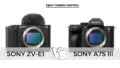
The Sony ZV-E1 and the Sony A7S III are two full-frame mirrorless cameras aimed at video creators, especially vloggers and content creators who need a high-quality and versatile camera for various situations and subjects.
They share the same 12MP BSI CMOS sensor and Bionz XR processor, which enable stunning 4K video quality in any light, with minimal noise and high dynamic range. They also share the same 5-axis IBIS (In-Body Image Stabilization) system, which provides up to 5.5 stops of stabilization for handheld shooting.
However, they have different designs, features, and prices that may affect their performance and suitability for different needs and preferences. In 2026, the gap between these cameras has widened significantly — the ZV-E1 has dropped over $700 from its launch price while both cameras have received substantial free firmware upgrades that change the calculus for buyers.
In this comparison, we will look at the main differences between these two cameras and help you decide which one is right for you in 2026.
2026 Price Comparison
Pricing is one of the most important factors in this comparison — and it has shifted considerably since both cameras launched. The ZV-E1 launched at $2,499 in April 2023 but has seen significant price drops, while the A7S III has held close to its original $3,498 launch price.
| Camera | Launch Price | 2026 Street Price (Body) |
|---|---|---|
| Sony ZV-E1 | $2,499 (Apr 2023) | ~$1,798–$1,998 |
| Sony A7S III | $3,498 (Oct 2020) | ~$3,498–$3,998 |
The price gap between these cameras now ranges from roughly $1,500 to $2,200 depending on the retailer and current sales. That is a substantial difference that should weigh heavily in your decision. Important note for 2026 buyers: Sony is widely expected to announce the A7S IV later in 2026 — possibly at NAB Show in April. If that announcement happens, the A7S III may see price reductions. Check current pricing before committing.
What’s New in 2026: Firmware Updates
One of the most compelling stories for both cameras in 2026 is how much Sony has improved them through free firmware updates. Both the ZV-E1 and A7S III are meaningfully better cameras today than they were at launch — and neither required a new body purchase to get there.
Sony ZV-E1 Firmware Updates
- v2.00 (March 2024) — Major Update: Added vertical shooting layout for social media content, Creators’ App (formerly Creators’ Cloud) integration for wireless transfer and remote control, improved live streaming capabilities, and enhanced USB streaming stability. This was a transformative update for solo content creators.
- v2.01 (May 2025): Security update removing WPA/WEP Wi-Fi support in favor of the more secure WPA2 and WPA3 protocols.
- v2.02 (November 2025): Fixed the battery level warning display bug, resolved USB streaming startup issues, and improved overall operational stability.
Critically, the 4K 120p and Full HD 240p high-frame-rate recording modes — originally planned as a paid upgrade in some regions — were made fully available via firmware. These capabilities are now standard on all ZV-E1 units worldwide.
Sony A7S III Firmware Updates
- v4.00 (April 2025): Added Log Shooting mode with the ability to display a LUT overlay on the monitor while shooting in S-Log (so you see a “normal-looking” image while recording flat log footage). Also added Camera Authenticity Solution — digital signatures for still images.
- v5.00 (February 2026) — Major Update: Significant autofocus overhaul borrowing AF logic from the newer A7 IV generation. Key additions include a new Spot XL AF area option covering a larger portion of the frame, the ability to save three custom AF area presets, native USB-C streaming support, Write Digital Signature function for movies, and improved dual-card capacity display during simultaneous recording.
The A7S III’s v5.00 firmware update is especially notable — it brings autofocus capabilities that were not available when the camera launched in 2020, effectively keeping it competitive with newer Sony cameras in a category where autofocus has historically been its weakest point for video.
Introduction to Both Cameras
The Sony ZV-E1 was announced in January 2023 as a full-frame mirrorless camera for video creators. It is part of Sony’s ZV series of cameras, which are designed to deliver high image quality and performance for vlogging and content creation.
The ZV-E1 is the most capable model in the ZV series, following the ZV-1F, the ZV-E10, and the ZV-E10 II, which are all compact cameras with fixed or kit lenses and smaller sensors. At its reduced 2026 street price, the ZV-E1 represents exceptional value for full-frame video performance.
The Sony A7S III was announced in July 2020 as a full-frame mirrorless camera for video professionals. It is part of Sony’s A7 series of cameras, designed to deliver high image quality and performance across various genres of photography and videography.
The A7S III is the third generation of Sony’s low-light specialist camera line, offering exceptional video quality and performance in challenging lighting conditions. Now five years into its life cycle, it remains the benchmark for cinema-grade low-light video — though its successor, the A7S IV, is expected in 2026.
10 Key Differences: Sony ZV-E1 vs Sony A7S III
1. Viewfinder
One of the most obvious differences between these two cameras is that the ZV-E1 does not have a viewfinder — only a rear LCD monitor.
This makes it more compact and lighter than the A7S III, but also less practical in bright sunlight or when precise framing is critical.
The A7S III has an electronic viewfinder (EVF) that is among the best on the market, with 9.44M dots of resolution, 0.9x magnification, a 25mm eyepoint, and a refresh rate up to 120fps. For professional shoots where you need to confirm critical focus in changing light, this is a meaningful advantage.
2. Rear Monitor
Both cameras have a flip-out touchscreen that can face forward for selfies and vlogs, but they differ in resolution and functionality.
The ZV-E1 has a lower-resolution screen (1.04M dots vs 1.44M dots), but it offers more touch-driven controls: automatic modes like My Image Style simplify settings such as white balance and exposure compensation (called color and brightness), and they can be adjusted directly via the touchscreen — ideal for solo creators.
The A7S III has a higher-resolution screen (1.44M dots) but fewer touch-adjustment modes. Its screen is optimized for monitoring and menu navigation rather than simplified solo-shooter controls.
3. Body Design
The ZV-E1 is more compact and lighter than the A7S III, aided by the absence of an EVF. Dimensions: 121 x 71.9 x 54.3 mm, weight 483g with battery.
The A7S III is larger and heavier: 128.9 x 96.9 x 80.8 mm and 699g with battery. It offers far more physical controls — an extra exposure dial, AF joystick, AF/MF switch, AF hold button, focus mode switch, top LCD panel, and headphone jack. For professional video crews where different operators may need to quickly adjust settings, those physical controls are valuable.
The ZV-E1, by contrast, has features tailored for solo creators: a tally lamp on the front indicating when the camera is recording, and a zoom rocker around the shutter button for Sony’s Super Resolution Zoom crop-in feature.
4. Connection Ports
Both cameras have USB-C (5Gbps), 3.5mm audio input and output, and digital audio (24-bit, 4 channels) via the multi-interface shoe.
They both also have an HDMI port, but the type differs significantly: the A7S III has a full-size HDMI port that outputs 4K 60p 10-bit 4:2:2, while the ZV-E1 has a micro HDMI port limited to 4K 30p 8-bit 4:2:0 output. The A7S III also has a flash sync port. Following the A7S III’s v5.00 firmware update (February 2026), both cameras now support native USB-C streaming.
5. Memory Card Slots
The A7S III has two memory card slots accepting either SDXC (UHS-II) or CFexpress Type A cards. This allows simultaneous backup recording or recording different formats on each card — essential for professional paid shoots where losing footage is not an option.
The ZV-E1 has a single SDXC (UHS-II) slot. For vloggers and content creators shooting primarily for online platforms, this is rarely a problem in practice. But for anyone shooting wedding, event, or commercial work, single-card recording is a real risk factor.
6. Video Resolution and Frame Rate
Both cameras can record up to 4K UHD (3840 x 2160) at up to 60p without crop, using the full sensor width. The A7S III can also record 4K at up to 120p with a small 1.1x crop factor.
The ZV-E1 can now record 4K UHD at up to 120p and Full HD at up to 240p — capabilities added via firmware update v2.00 in 2024. These modes are now fully available on all ZV-E1 units worldwide at no additional cost.
Both cameras also support Full HD recording at up to 120p without crop. The A7S III supports Full HD at up to 240p with a 1.1x crop. In terms of frame rate flexibility for slow-motion, these cameras are now largely equivalent — a gap that existed at the ZV-E1’s launch no longer matters.
7. Video Bit Depth and Color Space
Both cameras can record up to 10-bit 4:2:2 internally or externally, with S-Log2, S-Log3, and HLG HDR profiles. This is excellent for color grading flexibility.
The key difference: the A7S III supports BT.2020 color space internally and externally, while the ZV-E1 is limited to BT.709 color space. For professional cinema or broadcast work where wide color gamut is required, this matters. For most YouTube and social media creators, BT.709 is the standard delivery format anyway.
8. Video Codec and Format
Both cameras can record XAVC S or XAVC HS video with H.264 or H.265 codec. The A7S III also offers XAVC S-I recording with All-Intra compression — a significant advantage for editors who need the cleanest possible footage for heavy grading. All-I files are easier to edit and scrub through than the LongGOP compression used by XAVC S and XAVC HS, though they produce larger file sizes.
9. Video Autofocus and Stabilization
Both cameras have hybrid AF systems with 759 phase-detection points and 425 contrast-detection points covering nearly the entire sensor. Both support Eye AF and tracking for humans, animals, birds, and vehicles.
The ZV-E1 has an AI-powered Auto Framing mode that can crop and track subjects automatically — useful for solo shooting without a camera operator. This remains a ZV-E1 exclusive.
The A7S III received a major AF upgrade with firmware v5.00 (February 2026), adding a Spot XL AF area and the ability to store three custom AF area presets — features borrowed from the newer A7 IV generation. This significantly improves the A7S III’s autofocus flexibility for video, which had been a relative weakness.
Both cameras have 5-axis IBIS providing up to 5.5 stops of stabilization, plus digital stabilization modes for additional electronic correction.
10. Battery Life and Overheating
The A7S III uses the larger NP-FZ110 battery, offering up to 600 shots or approximately 95 minutes of continuous video. The ZV-E1 uses the NP-FZ100, good for up to 440 shots or around 95 minutes of video — though real-world recording time varies significantly based on settings and conditions.
The bigger difference is heat management. The A7S III can record unlimited 4K video at any frame rate without overheating at standard temperatures. The ZV-E1 can record up to 30 minutes of 4K at 30p or 60p before hitting thermal limits, and this threshold drops in warm environments. A high-temperature mode extends recording time but may affect image quality and long-term camera health.
For event videographers, documentary filmmakers, or anyone shooting long uninterrupted takes, the A7S III’s thermal headroom is a genuine operational advantage. For vloggers recording short clips throughout the day, the ZV-E1’s 30-minute limit rarely causes problems in practice.
Should You Wait for the A7S IV?
If you are leaning toward the A7S III, this is the most important question to consider in early 2026. The Sony A7S IV is widely expected to be announced this year — industry insiders and analysts including Tony Northrup of Camera Decision cite 2026 as the most likely year, with NAB Show in April as a potential announcement window.
Rumored specifications for the A7S IV include a new stacked sensor in the 20–24MP range, 6K video capability, improved IBIS, and next-generation autofocus. It is expected to share architecture with the FX3 II.
What does this mean for buyers right now?
- If the A7S IV launches in 2026: The A7S III will almost certainly drop in price — potentially significantly. This is a great outcome if you are patient and can wait until mid-to-late 2026 for pricing clarity.
- If you need a camera now: The A7S III remains an excellent camera, especially after the v5.00 firmware upgrade. Five years of real-world use and a massive user community means extensive support, tutorials, and proven reliability.
- If budget is a concern: The ZV-E1 at ~$1,798 body-only is not affected by A7S IV rumors and represents outstanding full-frame value today.
Our recommendation: if you are in the market for an A7S III today, wait until after NAB Show (April 2026) to see whether Sony makes an A7S IV announcement. A few weeks of patience could save you hundreds of dollars — either on a discounted A7S III or by getting the new model instead.
Quick Decision Guide: Which Camera Is Right for You?
| If you are… | Choose |
|---|---|
| Solo vlogger or YouTuber on a budget | ZV-E1 |
| Live streamer needing USB webcam mode | ZV-E1 (or A7S III after v5.00) |
| Run-and-gun creator who needs portability | ZV-E1 |
| Solo shooter needing AI Auto Framing | ZV-E1 |
| Professional videographer on paid shoots | A7S III |
| Shooter needing dual-card redundancy | A7S III |
| Low-light cinematographer with no overheating tolerance | A7S III |
| Shooter needing full-size HDMI or BT.2020 color space | A7S III |
| Bigger budget, undecided between the two | Consider the Sony FX3 (~$3,798) — a middle-ground cinema body |
| Patient buyer, leaning toward A7S III | Wait until after NAB Show April 2026 |
Conclusion
The Sony ZV-E1 and the Sony A7S III are both excellent full-frame mirrorless cameras for video creators — and in 2026, both are significantly better than they were at launch thanks to substantial free firmware updates from Sony.
The ZV-E1 is the better choice for solo creators, vloggers, and anyone who values portability, affordability, and AI-assisted shooting tools. At around $1,798 body-only, it delivers full-frame 4K 120p video, 10-bit 4:2:2 internal recording, and Sony’s best-in-class autofocus in a compact, lightweight package. Its v2.00 firmware update added vertical shooting, Creators’ App integration, and live streaming — making it a genuinely capable professional tool, not just a beginner option.
The A7S III is the better choice for professional videographers, cinematographers, and anyone shooting paid work where they cannot afford overheating, card failure, or any compromise in image quality. It offers unlimited 4K recording, dual card slots, full-size HDMI, All-Intra codecs, BT.2020 color space, and a world-class EVF. Its v5.00 firmware update closed the autofocus gap with newer Sony cameras, and the v4.00 Log LUT preview mode is a genuine workflow improvement for professional colorists.
The price gap of $1,500–$2,200 between these cameras should guide most buyers. If the ZV-E1’s capabilities meet your needs, the savings are substantial. If you genuinely need what the A7S III offers, it is worth every dollar — but given the expected A7S IV announcement in 2026, consider waiting until after NAB Show in April before buying.
Frequently Asked Questions
Is the ZV-E1 worth it over the A7S III?
For most content creators, yes — especially in 2026 when the ZV-E1 can be found for around $1,798 body-only. The ZV-E1 delivers the same 12MP full-frame sensor, 4K 120p recording (now available via firmware), 10-bit 4:2:2 internal video, and Sony’s excellent autofocus at roughly half the price of the A7S III. The A7S III is worth the premium if you need dual card slots, full-size HDMI, unlimited recording without overheating, All-Intra codec options, or BT.2020 color space for professional cinema work.
Does the ZV-E1 overheat?
Yes — the ZV-E1 has a 30-minute continuous recording limit for 4K video at standard temperatures, and this threshold can be lower in warm environments. Sony includes a high-temperature mode that extends recording time at the cost of potentially affecting image quality. For vloggers shooting short clips, this is rarely a practical issue. For event or documentary filmmakers shooting long uninterrupted takes, the A7S III’s unlimited recording is a meaningful advantage.
What’s the difference in 4K recording between the ZV-E1 and A7S III?
Both cameras record 4K UHD (3840 x 2160) at up to 60p without any crop. The A7S III adds 4K at up to 120p with a minor 1.1x crop, plus XAVC S-I All-Intra compression and BT.2020 color space. The ZV-E1 can also record 4K at 120p (added via firmware in 2024) but uses Long-GOP compression and is limited to BT.709 color space. For online content delivery, these differences are minimal. For professional cinema production requiring maximum post-production flexibility, the A7S III’s codec options are superior.
Is the A7S III still worth buying in 2026?
The A7S III is still an excellent camera in 2026, especially after its v5.00 firmware update added Spot XL autofocus, custom AF presets, and USB-C streaming. However, if you are planning to buy one, it is worth waiting until after NAB Show in April 2026 — the Sony A7S IV is widely expected to be announced around that time, which would likely result in a price reduction on the current A7S III. If you cannot wait, the A7S III remains fully capable and is well-supported by a large user community with extensive tutorials and resources.
Further Reading
(1) Sony ZV-E1 vs A7S III – The 10 Main Differences
(2) Sony ZV-E1 preview — Digital Photography Review
(3) Sony ZV-E1 vs Sony A7S III: Which is Better? | Tech Arena24