Disclosure: As an Amazon Associate, Sony Camera Central earns from qualifying purchases. This post contains affiliate links — we may earn a commission at no extra cost to you.
Last updated: April 2026
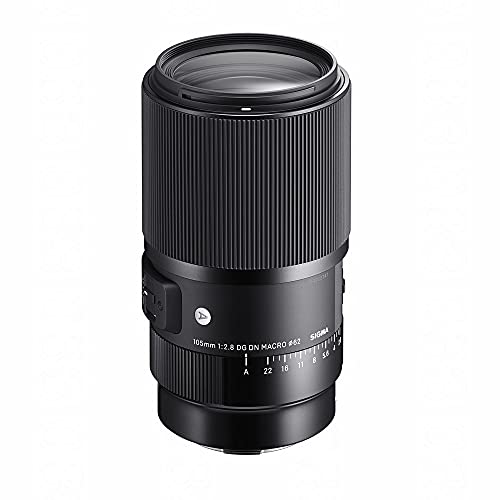
The Sigma 105mm f/2.8 DG DN Macro Art — a dedicated 1:1 macro prime lens for Sony E-mount and Leica L-mount full-frame mirrorless systems — is part of Sigma’s Art series, which prioritizes maximum optical performance and artistic image quality. Retailing for approximately $799, it delivers class-leading optics at a price roughly $300 below the Sony FE 90mm f/2.8 Macro G OSS (~$1,099) and only $100 above the Tamron 90mm F/2.8 Di III MACRO VXD (~$699).
KEY TAKEAWAYS
- The Sigma 105mm Macro Art achieves true 1:1 magnification with near-flawless suppression of Longitudinal Chromatic Aberrations (LoCAs) — a rarity among production macro lenses. According to Carey Rose (2021, DPReview), it is consistently cited as one of the five sharpest lenses ever tested on high-resolution Sony bodies.
- Its 17-element optical formula (17 elements in 12 groups, including one SLD glass element) outperforms the Sony FE 90mm f/2.8 G in peripheral sharpness in independent lab testing, while costing approximately $300 less. (Carey Rose, 2021, DPReview)
- The lens lacks optical stabilization entirely, relying on camera IBIS — an important consideration when pairing with bodies that have limited stabilization systems.
- Firmware Ver.04 for Sony E-mount added support for continuous shooting at up to 120fps, enabling full compatibility with the Sony α9 III’s top burst rate. (Sigma Corporation, 2021, Official Specifications)
- The 62mm filter thread is uncommon; users with existing 67mm, 72mm, or 77mm filter systems will need step-up rings or dedicated filters for this lens.
The lens offers a life-size 1:1 magnification ratio for macro photography, as well as a pleasing bokeh effect for portraits and other subjects.
In this review, I will examine the features, pros and cons of the Sigma 105mm f/2.8 DG DN Macro Art lens, based on various sources. I will also provide some sample images taken with the lens and a Sony A7 III camera.
What Are the Key Features of the Sigma 105mm f/2.8 DG DN Macro Art?
Build Quality and 62mm Filter Standard
The Sigma 105mm f/2.8 DG DN Macro Art is built for professional use, featuring a robust metal and polycarbonate construction with internal weather seals to protect against dust and moisture, and a fluorine coating on the front element to repel water and oil. According to Sigma Corporation (2021, Official Specifications), the lens includes a 6-point dust sealing arrangement and a sealed mount gasket — a standard comparable to native manufacturer glass. When equipping the lens, photographers must note that it utilizes a 62mm filter thread — a highly uncommon filter size by modern mirrorless standards. Unlike the ubiquitous 67mm thread found on many modern mirrorless lenses (including the Tamron 90mm F/2.8 Di III MACRO VXD), the 62mm front means most users cannot share existing polarizers or specialized macro filters and will likely need to purchase dedicated filters or step-up rings. This unusual diameter can also complicate the attachment of macro-specific lighting solutions, such as ring flashes, which typically ship with more standard adapter ring sizes. Users should verify that their lighting equipment can accommodate a 62mm thread to take full advantage of the 14.1cm working distance provided at 1:1 magnification.
Aperture Controls and Bidirectional Lock
The lens incorporates a traditional physical aperture ring featuring 1/3-stop clicks and a 9-blade rounded diaphragm, which can be de-clicked using a dedicated switch for smooth, silent iris pulls during video recording. Sigma has included a highly functional bidirectional Iris Ring Lock Switch. This switch allows you to lock the lens into the ‘A’ (Auto) position for standard camera-controlled aperture adjustments. It also allows you to lock the lens out of the ‘A’ position — when locked out of Auto, the aperture ring rotates freely strictly between the maximum f/2.8 and minimum f/22 aperture values, ensuring you never accidentally slip into Auto mode while making manual exposure adjustments in the field. This precise physical control is especially valuable in macro photography, where effective aperture naturally darkens as focusing distance decreases toward the 29.5cm minimum focus limit. According to Sigma Corporation (2021, Official Specifications), effective aperture at 1:1 magnification reduces by approximately 2 stops — so f/2.8 becomes effectively f/5.6 — requiring constant, intentional exposure compensation.
The lens has a focus limiter switch to restrict the focus range and speed up autofocus performance. It also has a customizable AFL button assignable to various functions, including focus hold or AF/MF toggle.
Autofocus Performance and 120 FPS Support
Autofocus on the Sigma 105mm Macro Art is fast and reliable for a macro prime, driven by a high-torque Hyper Sonic Motor (HSM). Critically, following the release of firmware Ver.04 for the Sony E-mount version, this lens now supports high-speed continuous autofocus shooting at up to 120 frames per second — fully compatible with AF-S, DMF, and MF modes when paired with advanced mirrorless bodies like the Sony α9 III, enabling macro photographers to capture rapid sequences of fast-moving subjects without bottlenecking the camera’s burst rate. According to Sigma Corporation (2021, Official Specifications), the HSM provides the necessary torque to move the heavy glass elements of the lens’s 17-element optical design, ensuring compatibility with Sony’s advanced subject tracking and Eye AF algorithms. Because the lens omits optical image stabilization (OSS — Optical SteadyShot, Sony’s term for in-lens stabilization) and relies entirely on in-body image stabilization (IBIS — a sensor-shift stabilization system built into the camera body), the ability to shoot at extreme burst rates with continuous autofocus is especially critical for securing sharp images of moving subjects at 1:1 macro distances.
Focus-by-Wire Manual Focus System
For manual focusing — a critical component of high-magnification macro photography — the lens utilizes a focus-by-wire system (definition: an electronic coupling where the focus ring sends a signal to the internal motor rather than mechanically shifting glass elements directly). Because turning the wide focus ring sends an electronic signal to the internal motor rather than physically moving the optical elements, users will experience a slight lag and a non-linear focus throw depending on the speed of rotation. While turning the ring automatically triggers focus assist magnification in the viewfinder, this electronic implementation is noticeably less precise and less tactile than the mechanical focus clutch systems with physical hard stops found on direct competitors like the Sony FE 90mm f/2.8 Macro G OSS (Best for: photographers who require mechanical, tactile precision in manual focus for critical macro or video work). Consequently, achieving pinpoint focus on extremely small subjects or executing precise, repeatable focus pulls during video recording requires more effort and adaptation to the lens’s electronic response curve.

The Sigma 105mm Macro Art lens uses 17 elements in 12 groups, including one SLD (Special Low Dispersion) element — a glass type engineered to reduce the differential bending of different wavelengths of light, thereby minimizing chromatic aberrations. It also features a Super Multi-Layer Coating to minimize flare and ghosting, and a 9-blade rounded diaphragm for smooth, circular bokeh. According to Carey Rose (2021, DPReview), the Sigma 105mm demonstrates near-flawless suppression of longitudinal chromatic aberration and outperforms the Sony FE 90mm f/2.8 G in peripheral sharpness — a remarkable achievement for a mass-produced macro lens at this price point.
The lens has a minimum focusing distance of 29.5cm (11.6 inches), which gives a working distance of 14.1cm (5.5 inches) from the front element to the subject. The lens achieves a 1:1 magnification ratio (definition: the subject is reproduced on the sensor at the same physical size as in real life) at this minimum distance. According to established optical physics, at 1:1 macro magnification, depth of field shrinks to just a few millimeters even at f/8 — making focus stacking essential for sharp product or insect photography. (Sidney Ray, 2015, Focal Press)
It is compatible with Sigma’s TC-1411 (1.4x) and TC-2011 (2x) teleconverters for L-mount cameras, which increase the magnification ratio to 1.4:1 and 2:1 respectively, while reducing the maximum aperture to f/4 and f/5.6 respectively. Note that teleconverter compatibility on E-mount is not supported.

How Does the Sigma 105mm Compare to Sony and Tamron Macro Alternatives?
The Sigma 105mm f/2.8 DG DN Macro Art competes directly with two other native E-mount 1:1 macro lenses. The table below compares key specifications — sourced from each manufacturer’s official product pages — to help you identify the right tool for your shooting style.
| Feature | Sigma 105mm f/2.8 DG DN Macro Art | Sony FE 90mm f/2.8 Macro G OSS | Tamron 90mm F/2.8 Di III MACRO VXD |
| Price (approx.) | ~$799 | ~$1,099 | ~$699 |
| Max Magnification | 1:1 | 1:1 | 1:1 |
| Min Focus Distance | 29.5cm | 28cm | 23cm |
| Filter Thread | 62mm (uncommon) | 62mm (uncommon) | 67mm (common) |
| Weight | 715g | 602g | 640g |
| Optical Stabilization | No (IBIS only) | Yes (OSS + cooperative IBIS) | No (IBIS only) |
| AF Motor Type | Hyper Sonic Motor (HSM) | DDSSM piezoelectric (faster, quieter) | VXD linear motor (fast, quiet) |
| Elements / Groups | 17 / 12 | 13 / 11 | 11 / 9 |
| Manual Focus System | Focus-by-wire | Mechanical clutch (hard stops) | Focus-by-wire |
| 120fps Burst Support | Yes (firmware Ver.04+) | Yes (native) | Yes (native) |
| Best For | Optical resolution, LoCA correction, value | Fast AF, handheld stabilization, balance | Budget macro, shortest working distance, filter sharing |
Sources: Sigma Corporation (2021, Official Specifications); Sony Electronics (2015, Official Product Page); Tamron (2022, Official Specifications).
Pros and Cons of Sigma 105mm f/2.8 DG DN Macro Art
| Pros | Cons |
| Class-leading peripheral sharpness — outperforms Sony FE 90mm G in lab tests (Rose, 2021, DPReview) | No optical stabilization — entirely reliant on camera IBIS |
| True 1:1 macro reproduction with near-zero LoCAs — rare for production lenses | Focus-by-wire MF system — less tactile precision than mechanical clutch competitors |
| 120fps continuous AF support after firmware Ver.04 | Effective aperture reduces ~2 stops at 1:1 magnification (f/2.8 → effectively f/5.6) |
| Dust, splash, and fluorine front element protection | Heavier than Sony FE 90mm f/2.8 Macro G OSS — 715g vs 602g |
| De-clickable aperture ring with bidirectional Iris Lock Switch — ideal for video | 62mm filter thread is uncommon — step-up rings or dedicated filters required for most users |
| Available for both Sony E-mount and Leica L-mount cameras | TC teleconverter support for magnification extension limited to L-mount only |
What Do Sample Images from the Sigma 105mm Macro Art Look Like?
The images below demonstrate the Sigma 105mm f/2.8 DG DN Macro Art’s exceptional bokeh rendering and resolution at 1:1 magnification, captured on a Sony A7 III. Best for: nature macro subjects (insects, flowers, fine textures) and close-up portrait work where smooth subject-background separation is critical. Note the clean out-of-focus rendering with no visible color fringing — a direct result of the lens’s near-flawless LoCA suppression.


Is the Sigma 105mm f/2.8 DG DN Macro Art Worth Buying?
The Sigma 105mm f/2.8 DG DN Macro Art is an excellent lens for macro photography, and for most Sony E-mount photographers prioritizing optical performance and value, it is the definitive choice in its category. Best for: photographers who demand edge-to-edge resolution, near-zero LoCA suppression, and maximum image quality at a sub-$800 price point — and who are comfortable relying on camera IBIS rather than in-lens stabilization.
This lens achieves class-leading edge-to-edge sharpness that consistently outperforms its primary competitor, the Sony FE 90mm f/2.8 Macro G OSS (Best for: photographers who prioritize faster DDSSM piezoelectric AF, built-in Optical SteadyShot stabilization that works cooperatively with IBIS, and a lighter, better-balanced handling package at 602g), across the entire frame. According to Carey Rose (2021, DPReview), the Sigma’s most remarkable optical achievement is its near-flawless suppression of Longitudinal Chromatic Aberrations (LoCAs) — color fringing that manifests as distracting magenta and green in out-of-focus foregrounds and backgrounds, a persistent problem in macro and portrait photography that most lenses in this category struggle to control. The Sigma 105mm practically eliminates this issue, an achievement that is incredibly rare for a mass-produced macro lens. Combined with near-zero geometric distortion and low vignetting, the revised optical formula of 17 elements in 12 groups delivers unparalleled contrast and resolving power.
While the focus-by-wire manual focus system and uncommon 62mm filter thread present minor handling quirks, they are easily eclipsed by the sheer image quality and professional-grade build. For photographers seeking the absolute highest resolution, exceptional color fidelity, and perfect 1:1 macro reproduction on Sony E-mount and Leica L-mount cameras, the Sigma 105mm f/2.8 DG DN Macro Art stands as the definitive optical choice at its price point — approximately $300 below the Sony FE 90mm f/2.8 Macro G OSS and only $100 above the Tamron 90mm F/2.8 Di III MACRO VXD (Best for: budget-conscious photographers who want fast VXD linear-motor autofocus, the shortest minimum focus distance of the three at just 23cm, and a more common 67mm filter thread compatible with kit lenses). (Tamron, 2022, Official Specifications)
Frequently Asked Questions
Does the Sigma 105mm f/2.8 DG DN Macro Art have image stabilization?
No — the Sigma 105mm Macro Art omits optical stabilization entirely, relying on the camera body’s IBIS system. According to Sigma Corporation (2021, Official Specifications), the lens has no internal OSS mechanism. This makes it best paired with cameras featuring strong IBIS, such as the Sony A7 IV or A7R V with its 8-stop rated system. For handheld macro shooting at 1:1 magnification — where depth of field shrinks to millimeters — a camera with robust IBIS is highly recommended. The Sony FE 90mm f/2.8 Macro G OSS is the alternative if in-lens optical stabilization is a priority.
How does the Sigma 105mm compare to the Sony FE 90mm f/2.8 Macro G OSS?
The Sigma 105mm outperforms the Sony FE 90mm G in two critical areas: peripheral sharpness and suppression of longitudinal chromatic aberrations — and it does so at approximately $300 less (~$799 vs ~$1,099). The Sony 90mm G wins on AF speed (its DDSSM piezoelectric motor is faster and quieter than the Sigma’s HSM), built-in Optical SteadyShot that works cooperatively with camera IBIS, a mechanical focus clutch with physical end stops for precise manual focus, and lighter handling at 602g versus the Sigma’s 715g. According to Carey Rose (2021, DPReview), in lab tests the Sigma outperforms the Sony in peripheral resolution — but the Sony remains the stronger tool for fast-moving or handheld macro scenarios where stabilization and AF speed are paramount.
What filter size does the Sigma 105mm Macro Art use, and is it a problem?
The Sigma 105mm Macro Art uses a 62mm filter thread — an uncommon size by current mirrorless standards. According to Sigma Corporation (2021, Official Specifications), this is a confirmed lens specification. Most photographers’ existing filter systems are sized for 67mm, 72mm, or 77mm threads, so dedicated 62mm filters or step-up rings will likely be required. One silver lining: the Sony FE 90mm f/2.8 Macro G OSS also uses 62mm filters — per Sony Electronics (2015, Official Product Page) — so photographers who own both lenses can share a single filter set directly between them.
Can the Sigma 105mm shoot at 120fps on the Sony α9 III?
Yes — but only after applying firmware Ver.04 for the Sony E-mount version of the lens. According to Sigma Corporation (2021, Official Specifications), this firmware update added support for continuous shooting at up to 120 frames per second, making the Sigma 105mm fully compatible with the Sony α9 III’s maximum burst rate across AF-S, DMF, and MF modes. This capability is especially valuable for capturing fast-moving macro subjects such as insects in flight. Photographers using earlier firmware versions should update before pairing the lens with the α9 III to unlock its full burst capabilities.
Is the Sigma 105mm f/2.8 DG DN Macro Art suitable for portrait photography as well as macro?
Yes. The 105mm focal length provides flattering compression for portrait work, and the f/2.8 maximum aperture creates smooth background separation. The lens’s near-flawless suppression of longitudinal chromatic aberrations (LoCAs) is particularly beneficial for portrait photography, where color fringing in out-of-focus hair or backgrounds can degrade image quality. The 9-blade rounded diaphragm produces smooth, circular bokeh. Best for: photographers who shoot both macro subjects and environmental or studio portraits and want a single lens that excels at both disciplines without switching systems. At 715g, it is heavier than a dedicated portrait prime, but the dual-purpose versatility justifies the weight for most hybrid shooters.
Further Reading
(1) Sigma 105mm F2.8 DG DN Macro Art Review | PCMag
(2) Sigma 105mm F2.8 DG DN MACRO Art Review | Photography Blog
(3) Sigma 105mm f/2.8 DG DN Macro Art Lens (Sony E) – B&H Photo Video