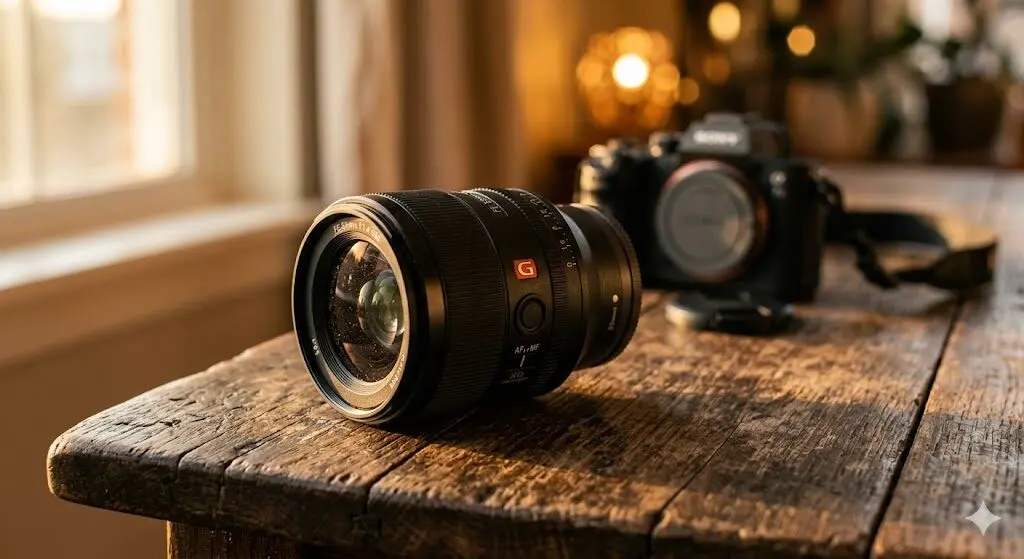
The Sony FE 35mm f/1.4 G Master (SEL35F14GM) launched in 2021 and remains one of the most significant prime lenses in the Sony E-mount lineup. As a 35mm for full-frame cameras, it occupies the most versatile focal length in photography—wide enough for environmental context, normal enough to feel natural to the eye, and at f/1.4, capable of producing subject separation that smaller aperture 35mm options can’t match. After extended use across street photography, portrait sessions, travel, and low-light documentary work, here’s the complete assessment.
Sony 35mm f/1.4 GM vs. Alternatives: Spec Comparison
| Lens | Aperture | Weight | Filter | Min Focus | Price |
|---|---|---|---|---|---|
| Sony FE 35mm f/1.4 G Master | f/1.4–f/16 | 524g | 67mm | 27cm | ~$1,399 |
| Sony FE 35mm f/1.8 | f/1.8–f/22 | 280g | 55mm | 22cm | ~$449 |
| Sigma 35mm f/1.4 DG DN Art | f/1.4–f/16 | 645g | 67mm | 30cm | ~$799 |
| Tamron 35mm f/1.4 SP (adapted) | f/1.4–f/22 | 815g | 72mm | 30cm | ~$499 |
| Voigtlander 35mm f/2 APO-LANTHAR | f/2–f/22 | 394g | 52mm | 35cm | ~$999 |
Build Quality and Handling
The 35mm G Master’s build is exactly what you’d expect from Sony’s flagship prime tier: magnesium alloy construction, full dust and moisture resistance, smooth focus ring with linear response, and an aperture ring with click/de-click switch. The de-click mode makes this lens excellent for video work—smooth, ramp-able aperture changes without audible clicks picked up by on-camera microphones.
At 524g, it’s lighter than the Sigma 35mm Art (645g) and significantly lighter than the A-mount Tamron equivalent. Balanced on an A7 V body, it feels right—not front-heavy, and comfortable for hours of handheld shooting. The metal hood locks securely with a quarter-turn and doesn’t rattle.
The AF/MF switch and two customizable hold buttons (programmable from the camera menu for functions like Eye AF lock or exposure preview) are positioned naturally for single-handed operation.
Image Quality: Sharpness
Center sharpness at f/1.4 is outstanding—immediately usable for portraiture with no need to stop down for acceptable results. At f/2 and beyond, it’s among the sharpest 35mm lenses for Sony at any price point. Corner sharpness at f/1.4 is good for a fast wide prime, though the extreme corners show characteristic field curvature that the Sigma Art controls slightly better.
On a 61MP A7R V file, the G Master resolves texture that lower-resolution alternatives simply can’t capture. This matters for landscape, product, and detail work where every megapixel is actually useful.
Minimum focus distance of 27cm (vs. 30cm on the Sigma) means you can get surprisingly close to small subjects—coffee details, rings, small items on a tabletop—without a macro lens. This versatility is one of the 35mm focal length’s practical advantages.
Bokeh and Rendering
The 35mm G Master’s background blur is smoother than competitors at this focal length. The out-of-focus rendering at f/1.4 shows the characteristic G Master “creaminess”—gradual transition from in-focus to blurred without the sudden busy transition visible in lower-tier optics. Bokeh circles at f/1.4 are near-perfectly round with minimal cat-eye distortion at the frame edges (the 11-blade aperture contributes to this).
Bokeh in a 35mm lens at f/1.4 is less dramatic than an 85mm at f/1.4—shorter focal lengths produce less depth-of-field separation at equivalent subject distances. But at close focus (50cm subject distance), the G Master produces pleasingly separated subjects against smooth backgrounds that justify the aperture premium over f/1.8 options.
Autofocus Performance
Sony’s XD Linear Motor system in the G Master series is genuinely the fastest and quietest AF available for Sony E-mount. During continuous AF-C portrait sessions, the 35mm G Master acquired and maintained focus through rapid movement, turned subjects, and brief occlusions without hesitation. Focus breathing (change in apparent focal length during focus travel) is extremely minimal—an important consideration for video shooters doing focus pulls.
In video mode with Sony’s Breathing Compensation feature (available on A7 V and A9 III bodies), focus breathing is essentially eliminated. This makes the G Master a legitimate cinema prime for productions that can’t afford dedicated cine-lens sets.
Chromatic Aberration and Distortion
Lateral chromatic aberration is well-controlled for a fast 35mm—high-contrast edges at f/1.4 show trace purple/green fringing in the extreme corners, easily removed in Lightroom’s automatic profile corrections. Longitudinal CA (color fringing in the depth-of-field transition zone) is minimal, which is where many fast lenses fail in close-focus portrait situations.
Distortion is slight barrel distortion at around 1%—noticeable in architecture with straight lines at the frame edge, unnoticeable in portraits and street photography. The in-camera correction profile handles it automatically for JPEG and Sony’s own software. Lightroom’s lens profile corrects it in one click for RAW.
Is It Worth the Price Over the 35mm f/1.8?
The Sony FE 35mm f/1.8 ($449) is an excellent lens—compact, light, fast AF, and optically very good. The 35mm f/1.4 GM ($1,399) offers:
- 1-stop wider aperture (f/1.4 vs f/1.8): meaningful for low-light shooting and subject separation
- Better corner sharpness and edge rendering at equivalent apertures
- Smoother, creamier bokeh with less swirling in background specular highlights
- Aperture ring (de-clickable) for video work
- Custom hold buttons
- Significantly heavier (524g vs 280g) and larger
For dedicated 35mm work—environmental portraits, documentary, travel—the G Master is the professional choice. For photographers who use 35mm occasionally alongside other focal lengths, the f/1.8 is excellent value and arguably a better compact travel lens.
Sigma 35mm f/1.4 DG DN Art vs. Sony G Master
The Sigma Art is $600 cheaper and delivers comparable center sharpness. It’s heavier (645g vs 524g) and slower to autofocus (noticeable in demanding continuous tracking scenarios). The Sony G Master edges ahead in: AF speed and silence, minimum focus distance, overall rendering smoothness, and build quality feel. For photographers primarily shooting stills without demanding tracking requirements, the Sigma Art is a compelling value alternative. For video hybrid or demanding sports/event work, the G Master’s AF advantage justifies the price.
Frequently Asked Questions
Is the Sony 35mm f/1.4 G Master good for video?
Yes—it’s one of Sony’s best video primes. The de-clickable aperture ring, minimal focus breathing, near-silent XD Linear Motor AF, and Breathing Compensation compatibility make it a legitimate cinema-grade lens for corporate video, short film, and documentary production.
Does the Sony 35mm f/1.4 GM work well on APS-C cameras?
Yes. On an A6700 or ZV-E10 II, it delivers a ~52mm equivalent field of view—a natural “standard” lens perspective. The full-frame image circle means no vignetting or edge quality loss on APS-C. It’s heavier than dedicated APS-C options but optically excellent.
What’s the Sony 35mm f/1.4 G Master’s minimum focus distance?
27cm (0.27m), which produces a maximum magnification of 0.23×. Not a macro lens, but capable of close-focus detail shots of small objects—significantly closer than many competing 35mm designs.
Should I buy the Sony 35mm f/1.4 GM or wait for an update?
The current GM version (2021) remains one of the sharpest 35mm lenses for E-mount. Sony releases GM II updates roughly 3–4 years after the original, so a theoretical GM II might arrive in 2024–2025. The current version is not optically outdated—it resolves well on the highest-resolution Sony sensors available today.
The Sony FE 35mm f/1.4 G Master earns its premium position in the lineup. For photographers who treat 35mm as their primary focal length and need professional-grade optical performance with Sony’s best autofocus, it’s the definitive choice in the E-mount ecosystem.