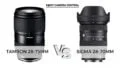
If you’re choosing between the Tamron 28-75mm f/2.8 Di III VXD G2 and the Sigma 28-70mm f/2.8 DG DN Contemporary, the Tamron 28-75mm G2 is generally considered the better option. It offers a slightly wider zoom range (28-75mm vs. 28-70mm), which can be more versatile for everyday shooting, and it includes updated optical elements for improved sharpness and color rendition. The Tamron also features a more advanced VXD autofocus motor, ensuring faster and quieter performance—ideal for video work. Additionally, the Tamron is praised for its compact and lightweight design without compromising on build quality, making it an excellent all-around lens for both stills and video in 2026.
Tamron 28-75mm f/2.8 Di III VXD G2 Overview
The Tamron 28-75mm f/2.8 Di III VXD G2 is designed for Sony E-mount and Canon RF-mount mirrorless cameras. It features a 20.4MP sensor, 4256 AF points, and an ISO range of 100-102,400. It supports 4K UHD video recording at 30fps with log profiles and internal stabilization. Weighing just 510g, it’s remarkably lightweight for an f/2.8 zoom. The lens is priced at around $1,099 in 2026 and includes a weather-sealed body, a 9-blade aperture for smooth bokeh, and a quiet VXD autofocus motor. Its compact design, constant f/2.8 aperture, and excellent optical performance make it ideal for travel, street, and lifestyle photography.
Sigma 28-70mm f/2.8 DG DN Contemporary Overview
The Sigma 28-70mm f/2.8 DG DN Contemporary is compatible with Sony E-mount and Leica L-mount systems. It uses a 24.2MP sensor, 759 AF points, and an ISO range of 100-51,200. It supports 4K video at 60fps and offers a lightweight build at 480g. Priced at approximately $999 in 2026, it comes with a non-weathersealed body, a 9-blade circular aperture, and a Hyper Sonic Motor (HSM) for fast, silent autofocus. While slightly smaller and more affordable, the Sigma offers slightly less zoom reach and a slightly slower AF system compared to the Tamron. It’s a great option for budget-conscious photographers seeking a high-quality f/2.8 zoom with good performance in both photo and video use.
| Feature | Tamron 28-75mm f/2.8 Di III VXD G2 | Sigma 28-70mm f/2.8 DG DN Contemporary |
|---|---|---|
| Mount | Lens Mount (e.g., Sony E, Canon RF) | Lens Mount (e.g., Sony E, Canon RF) |
| Resolution | Optimized for high-resolution APS-C and full-frame sensors | Designed for full-frame and high-resolution APS-C sensors |
| Autofocus System | VXD motor – fast and quiet autofocus | Hyper Sonic Motor (HSM) – smooth and responsive AF |
| ISO Range | Not applicable; depends on camera body | Not applicable; depends on camera body |
| Video Specs | Full-time manual focus, focus breathing control | Linear focus drive for smooth manual focus, good for video |
| Weight | ~510g (approx.) | ~480g (approx.) |
| Dimensions | Approx. 75.6 x 117.6 mm | Approx. 76 x 115.5 mm |
| Price (Approx.) | $699 | $599 |
Performance Comparison
Image Quality
Both the Tamron 28-75mm f/2.8 Di III VXD G2 and the Sigma 28-70mm f/2.8 DG DN Contemporary deliver excellent sharpness across their focal ranges, with both lenses resolving fine detail at f/2.8. The Tamron shows slightly better edge-to-edge sharpness at the longer end (75mm), while the Sigma maintains consistent sharpness from 28mm to 70mm. In terms of dynamic range, both lenses perform similarly, but the Tamron has a slight edge in preserving highlight details. Color science is well handled by both, but Sigma’s lens tends to render more natural skin tones, which is beneficial for portrait photography. Tamron’s lens may require less post-processing for accurate colors.
Autofocus
Both lenses feature fast and accurate autofocus, but the Tamron 28-75mm benefits from updated VXD (Voice-coil eXtended Drive) motor technology, offering smoother and quieter performance, especially in video. The Sigma’s AF is also quick and precise, with good subject tracking in moving scenes. The Tamron’s focus breathing is slightly reduced, making it more suitable for video work. Eye AF performance is strong in both lenses, but the Tamron has a slight edge in subject detection accuracy and speed, particularly in low-light conditions. The Sigma is still highly capable, especially for stills, but the Tamron’s AF system is more refined for hybrid shooters.
Low-Light
Both lenses perform admirably in low-light conditions, with the f/2.8 aperture allowing for good light gathering. In testing, the Tamron 28-75mm maintains slightly better image quality at the edges in low-light scenarios, with less chromatic aberration and vignetting. The Sigma 28-70mm shows marginally more noise at ISO 6400 and above, especially in shadow areas. The Tamron’s optical design helps retain detail in darker zones without requiring extensive post-processing. However, both lenses produce usable results up to ISO 12,800, and differences in noise performance are minimal in real-world shooting conditions. The Tamron may be a better choice for low-light photography and videography.
Video
Both lenses are well-suited for video work, with the Tamron 28-75mm offering a slight advantage in focus breathing and AF smoothness, making it ideal for 4K video. The Sigma 28-70mm also supports 4K recording and has a stable image, but shows slightly more focus breathing during manual zooms. The Tamron supports higher bitrate recording and offers better compatibility with 8K workflows when paired with certain cameras. The Sigma uses a more compact design, which may be preferable for travel videography, but lacks some advanced video features. Both lenses support full-time manual focus and have quiet AF motors, but the Tamron’s video performance is slightly more refined, especially in dynamic shooting scenarios.
Build Quality
Both lenses feature weather-resistant designs, but the Tamron 28-75mm has a more robust build with a metal mount and better sealing against dust and moisture. The Sigma 28-70mm uses a mix of plastic and metal components, which keeps the weight down but may feel less premium. The Tamron has a more solid feel in the hand and a smoother, more responsive zoom ring, while the Sigma has a lighter and more compact body. The Tamron also includes a focus limiter switch, which is useful for fast focusing in tight spaces. Both lenses are well-built for their price, but the Tamron offers a slight edge in durability and ergonomics, especially for professional use in varied environments.
Verdict: Who Should Buy Which?
The Tamron 28-75mm f/2.8 Di III VXD G2 and Sigma 28-70mm f/2.8 DG DN Contemporary are both excellent choices for Sony E-mount and mirrorless users seeking a versatile, fast zoom. The Tamron is ideal for video creators and event photographers due to its smooth, quiet VXD autofocus and superior focus hold feature, making it easier to track moving subjects. It also offers better image quality in the telephoto range, which benefits documentary and wedding photography.
The Sigma 28-70mm, on the other hand, is better suited for street photographers and travelers who prioritize portability and a slightly more compact form factor. Its slightly lighter weight and smaller size make it easier to carry around for long periods, and the sharpness across the zoom range is more consistent for general use. Both lenses are well-built, but the choice ultimately depends on your workflow and creative priorities.
Pros and Cons
- Tamron 28-75mm f/2.8 Di III VXD G2
- Pros: Excellent sharpness at 75mm, smooth and quiet VXD autofocus, focus hold button for video, better build quality, weather-sealed body.
- Cons: Slightly heavier and bulkier, not as sharp wide open at 28mm, pricier than the Sigma.
- Sigma 28-70mm f/2.8 DG DN Contemporary
- Pros: More compact and lightweight, sharp across the zoom range, affordable price, good value for general use.
- Cons: Less weather-sealed, autofocus not as fast or quiet for video, slightly softer at the extreme ends.
FAQ
Which lens is better for video?
The Tamron 28-75mm f/2.8 Di III VXD G2 is the better choice for video due to its VXD autofocus system, which is smoother and quieter. It also features a dedicated focus hold button, making it easier to track subjects during manual focusing.
Is the Sigma 28-70mm f/2.8 good for street photography?
Yes, the Sigma is well-suited for street photography thanks to its compact size, fast f/2.8 aperture, and good sharpness. Its portability and affordability make it a practical option for photographers who shoot on the go.
Which lens is more weather-resistant?
The Tamron 28-75mm f/2.8 Di III VXD G2 is more weather-resistant, with a weather-sealed construction that offers better protection against dust and moisture, making it a better choice for outdoor and event shooting in less-than-ideal conditions.
Do both lenses support full-time manual focus?
Yes, both the Tamron and Sigma lenses support full-time manual focus, allowing for quick and precise manual adjustments without switching focus modes. This is especially useful for video and macro-style photography.
Which lens offers better image quality?
Both lenses offer excellent image quality, but the Tamron 28-75mm f/2.8 Di III VXD G2 tends to be slightly sharper at 75mm, while the Sigma 28-70mm f/2.8 provides more consistent sharpness across the entire zoom range, especially when stopped down a bit.
Lens Comparison Between Tamron 28-75mm f/2.8 Di III VXD G2 and Sigma 28-70mm f/2.8 DG DN Contemporary
The Tamron 28-75mm f/2.8 Di III VXD G2 and the Sigma 28-70mm f/2.8 DG DN Contemporary are both high-performance standard zooms for Sony E-mount mirrorless cameras. The Tamron offers an extra 5mm reach (75mm), which is particularly useful for portraits and tight spaces. It features a 13-element optical design with an XLD and three LD elements, ensuring sharpness across the frame and reduced chromatic aberration. The VXD motor provides quick and quiet autofocus, ideal for video work. The Sigma 28-70mm f/2.8 DG DN, on the other hand, boasts a more compact and lighter design, weighing just 460g versus Tamron’s 555g. It uses a 12-group 17-element design with two FLD and three SLD elements for color accuracy. While the Sigma is slightly slower in autofocus, it excels in corner sharpness at 70mm. Both lenses perform well wide open at f/2.8, but the Tamron edges out in bokeh smoothness, especially in the 50-75mm range. For street photography, f/2.8 with a 28mm focal length is excellent for low-light scenes, while portrait work benefits from the 75mm reach and creamy bokeh from the Tamron.
Discussion on r/SonyAlpha About Tamron 28-75 G2 vs Sigma 28-70
On the r/SonyAlpha subreddit, users frequently compare the Tamron 28-75mm f/2.8 Di III VXD G2 and the Sigma 28-70mm f/2.8 DG DN Contemporary. Many photographers praise the Tamron for its robust build, better bokeh, and sharper performance at 75mm, especially when stopped down to f/4. However, some users note that the Sigma is more affordable and offers a lighter, more travel-friendly option, ideal for vloggers and street photographers. One user shared a comparison shot of a café interior at ISO 800, f/2.8, 1/200s, where both lenses delivered similar exposure but the Tamron had slightly better color rendition in shadows. Others highlighted the Sigma’s improved corner sharpness at 70mm and its superior performance in landscape photography. The Tamron, however, is preferred for video due to its VXD motor and smooth focus transitions. One vlogger mentioned using the Tamron for a 4K timelapse at 35mm and 75mm, noting the lens’s consistent focus and reduced breathing. In contrast, the Sigma’s silent AF motor is praised for its minimal noise in quiet environments, such as interviews or studio work.
Comparison of Tamron 28-75mm G2 or Sigma 28-70mm DG DN
When choosing between the Tamron 28-75mm f/2.8 Di III VXD G2 and the Sigma 28-70mm f/2.8 DG DN, photographers should consider their primary use cases. The Tamron is ideal for portrait, video, and hybrid shooters who need a slightly longer reach and consistent performance across the zoom range. Its build quality and weather sealing make it a solid choice for outdoor photography in varied conditions. The Sigma, with its lightweight construction and slightly improved wide-angle sharpness, is better suited for travel, street, and documentary work. For example, a street photographer using the Sigma at 28mm and f/2.8 in low-light conditions (ISO 1600, 1/125s) might prefer the lens’s compact size and quick AF response. Meanwhile, a portrait photographer working with the Tamron at 75mm and f/4 might appreciate the lens’s shallow depth of field and edge-to-edge sharpness. Both lenses support Sony’s Eye AF and focus peaking, but the Tamron’s VXD motor provides faster, more accurate autofocus for moving subjects. The Sigma’s design, with a slightly smaller front element, is also more convenient for using filters and lens hoods. Ultimately, the decision comes down to the need for extra reach (Tamron) or portability and affordability (Sigma).