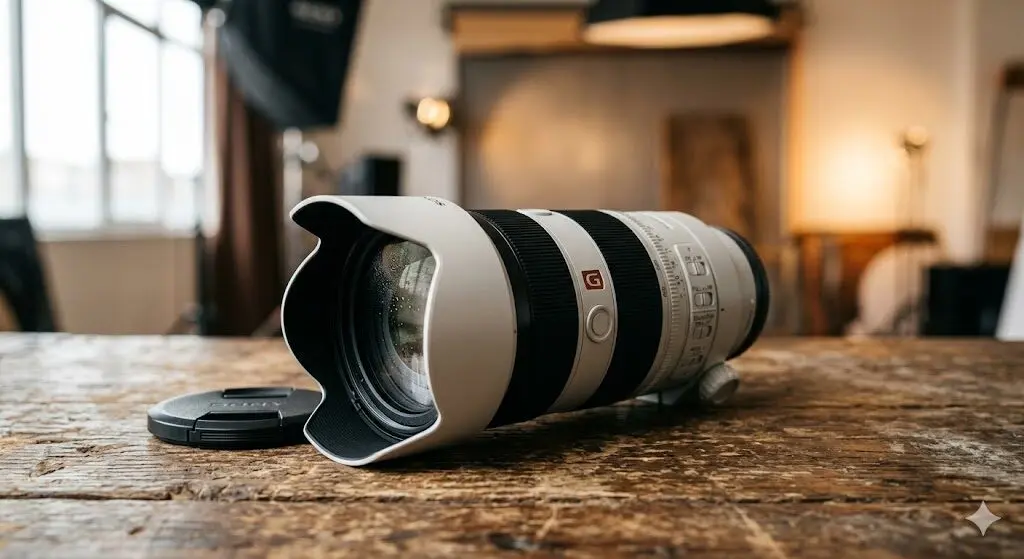
The Sony FE 70-200mm f/2.8 G Master II (SEL70200GM2) arrived in 2021 and immediately became the definitive telephoto zoom for Sony Alpha shooters. Compared to the original 70-200 GM, it shed 435 grams while improving sharpness, AF speed, and close-focus performance. At $2,800 it demands serious budget allocation — but for photographers who work events, sports, wildlife, or portrait sessions regularly, it pays dividends every time it goes on the camera.
The Weight Transformation: 1,480g to 1,045g
A 435-gram reduction in a telephoto zoom is not incremental — it is transformational. The original 70-200 GM at 1,480g required significant handheld strength for all-day use. The GM II at 1,045g sits in a different category: manageable for extended handheld sessions, reasonable for travel when paired with a compact body like the A7C II, and genuinely usable for backpacking landscape photographers who need telephoto reach.
Sony achieved this through a complete optical redesign with fewer, more efficient elements and the elimination of the tripod collar foot in the base version (available as an optional add-on). The lens handles and balances well on every A7-series body.
Optical Quality at f/2.8
The GM II is sharper than the original at every focal length and aperture. At 200mm f/2.8 — the demanding combination — center sharpness is exceptional and corner sharpness is very good: meaningfully better than the original GM, which struggled with some field curvature at the long end.
- 70mm f/2.8: Excellent across the frame
- 100mm f/2.8: Outstanding — possibly the sharpest point in the zoom range
- 135mm f/2.8: Excellent
- 200mm f/2.8: Very good center, good corners — improved significantly over original
Bokeh is creamy and predictable — the 11-blade rounded aperture produces clean circular highlights across the focal range. At 200mm f/2.8 with a subject at 3 meters and a distant background, the separation is extraordinary. This is the lens for compressed portrait work, headshots with environmental context, and stage photography where depth of field isolation is the goal.
Autofocus: Dual XD Linear Motors
Like the 24-70 GM II, the 70-200 GM II uses dual XD linear motors for near-instant AF acquisition. The difference from the original GM is most noticeable in video: smooth, silent tracking without hunting. For sports and events, the first lock-on speed is faster and tracking through crowds or complex backgrounds is more reliable.
On the Sony A9 III at 120fps or A7 V at 10fps burst, the 70-200 GM II never limits the camera’s AF or burst performance. It acquires focus fast enough to stay ahead of the fastest continuous shooting modes Sony offers.
Close-Focus Improvement: 0.25x Magnification
The GM II achieves 0.25x maximum magnification at its minimum focus distance of 40cm. The original managed 0.13x. This improvement means the GM II can focus on subjects closer than arm’s length at 200mm — useful for informal portraits, detail shots, and flower photography at telephoto range. It is not a macro lens, but the improvement is genuinely useful in practice.
Built-In Stabilization and IBIS Coordination
The GM II has its own optical stabilization (OSS) system that coordinates with Sony’s IBIS (in-body image stabilization) on A7-series bodies. On the A7 V, this combination delivers up to 7.5 stops of stabilization compensation — enough to handhold at 200mm with 1/15s shutter speeds in still-subject scenarios. For video work, the combination provides smooth handheld footage at telephoto focal lengths.
70-200 GM II vs Sigma 70-200mm f/2.8 DG DN OS Sports
| Feature | Sony 70-200 GM II | Sigma 70-200mm f/2.8 DG DN OS |
|---|---|---|
| Weight | 1,045g | 1,340g |
| Sharpness (center) | Excellent | Excellent |
| AF Speed | Fastest (XD III) | Very fast (HLA) |
| Min Focus Distance | 40cm (0.25x) | 50cm (0.19x) |
| Filter Size | 77mm | 82mm |
| Weather Sealing | Excellent | Excellent |
| Price (2025) | ~$2,800 | ~$1,500 |
The Sigma 70-200 is an excellent lens that undercuts the Sony on price. Its sharpness is competitive. Where the Sony pulls ahead: lighter body (295g lighter), faster AF tracking in continuous shooting, and better AF silence in video mode. For stills sports and portrait work, either is excellent. For video tracking and handheld use, the Sony GM II’s weight advantage and AF behavior justify the premium for working professionals.
Real-World Performance
Stage and Concert: At 200mm f/2.8 in low-light stage environments, the GM II’s optical quality and IBIS coordination allow lower ISOs at equivalent shutter speeds. The silent AF lets you shoot without distraction to performers or nearby audience members.
Wedding: The 70-200 GM II is the second body lens for most wedding photographers who run the standard zoom counterpart as their primary. The 70mm starting point covers mid-range candids; 200mm f/2.8 compresses a b
Wildlife in Accessible Parks: 200mm is limited for serious wildlife photography (most wildlife photographers want 400mm+), but for garden birds, domestic animals, and accessible wildlife in open spaces, 200mm f/2.8 delivers excellent results with Sony’s animal eye tracking.
Verdict
The best telephoto zoom for Sony Alpha. The GM II improved every relevant parameter over the original: lighter, sharper, faster AF, closer focus, better video performance. At $2,800 it is a professional investment, but for photographers who regularly need f/2.8 telephoto coverage, no E-mount zoom delivers a better total package.
Frequently Asked Questions
- Is the Sony 70-200 GM II worth upgrading from the original?
- For video shooters and anyone who found the original too heavy, yes. The 435g weight reduction and clickless aperture upgrade make a real operational difference. For stills-only shooters satisfied with the original’s AF performance, the improvement is measurable but less urgent.
- Does the 70-200 GM II have a tripod collar?
- A tripod collar is not included in the standard package. Sony sells the ALC-SH168 lens foot separately. This is a cost-saving measure — most handheld photographers never need it.
- Can I use the 70-200 GM II on the Sony A6700?
- Yes. On APS-C it covers a 105-300mm equivalent range. The lens is fully functional and produces excellent images. It is over-engineered for APS-C use but works perfectly.
- How does the 70-200 GM II compare with Tamron’s 70-180mm f/2.8?
- The Tamron 70-180mm f/2.8 (~$700) is exceptional value but reaches only 180mm and lacks the close-focus improvement of the GM II. For budget-conscious photographers who primarily shoot portraits and events, the Tamron is compelling.
- Is the 70-200 GM II good for astrophotography?
- At 200mm f/2.8 it is used for Milky Way detail shots and tight constellation framing. Coma performance is very good at f/2.8 (better than most zooms), making it a capable astro lens.