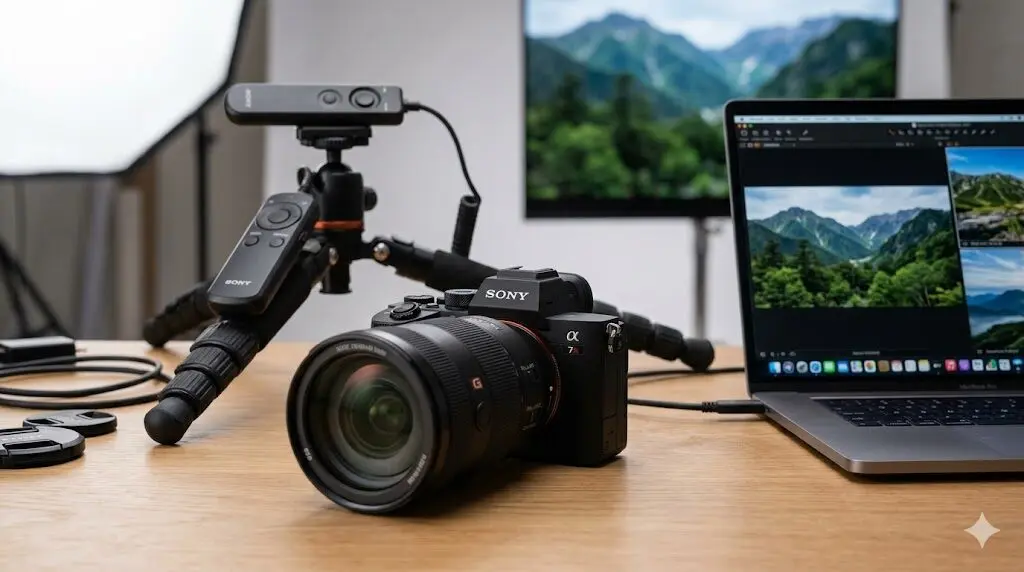
The Sony A7R V launched in late 2022 at $3,899 and remains Sony’s highest-resolution mirrorless option as of 2026. At 61 megapixels — the highest pixel count in any full-frame Sony — it’s built for landscape, architecture, commercial, and fine-art studio photographers who need the absolute most detail possible from a 35mm sensor. But resolution alone doesn’t make a camera great. The A7R V pairs that sensor with the first AI-based AF processor Sony put into any camera, a first-in-Sony 9.44M-dot EVF, and genuine 8-axis IBIS rated at 8 stops. This review covers what it does exceptionally well, where it has limitations, and who should actually buy it.
Key Specifications
Sensor: 61MP BSI CMOS, full-frame. Processor: BIONZ XR with dedicated AI Processing Unit (APU). Autofocus: 693 phase-detect points, AI-based subject recognition (human, animal, bird, insect, car, train, aircraft). Continuous shooting: 10fps mechanical, with single-slot card buffering.
Video: 4K/60p (APS-C crop), 4K/30p full-frame (no oversampling — honest caveat), 8K/25p full-frame. Internal 10-bit recording in XAVC HS. HDMI Type-A output for external RAW recording via atomos recorders.
IBIS: 5-axis sensor-shift stabilization, up to 8 EV stops compensation (with compatible lenses). Pixel Shift Multi Shooting: 16 shots merged for up to 240MP output files. Built-in high-res composite mode.
The 61MP Sensor: Resolving Power in Practice
At base ISO 100, the A7R V resolves detail that no other full-frame Sony sensor can match. Using a Zeiss Otus 55mm f/1.4 or the Sony FE 24-70mm f/2.8 GM II at f/5.6, files show texture at a level that demands stable support for high-res work to avoid camera shake and maximize sharpness.
Dynamic range at base ISO measures approximately 15 stops — among the best full-frame measurements available. Shadow lifting of +5 stops from ISO 100 shadows reveals minimal banding. Highlight headroom in RAW is exceptional: blown whites in JPEG often recover fully in RAW at -2 stops exposure compensation in post.
The BSI (backside illuminated) design improves low-light performance compared to older Sony high-res sensors. ISO 3200 files are excellent; ISO 6400 is clean; ISO 12800 holds up for landscape use but starts showing softening in fine detail.
Autofocus: A Surprise Strength for a Resolution Camera
High-resolution cameras historically penalized autofocus — the A7R III and A7R IV had slower, less confident AF than their action-oriented siblings. The A7R V breaks this pattern. The AI-based recognition AF is the same system later used in the A7C II, and it’s genuinely fast and accurate for a 61MP camera.
Eye AF locks in under 0.05 seconds in studio lighting conditions and holds reliably through subject movement. Bird-in-flight AF (using bird body + eye recognition) performs convincingly well even at 10fps, making the A7R V a credible option for nature photographers who need both resolution and tracking. The real catch is buffer depth: at 61MP with RAW capture, the buffer fills after approximately 68 frames at 10fps — a limitation you’ll hit in sustained bursts but rarely in landscape or portrait work.
IBIS and Pixel Shift: The Resolution Multipliers
The 8-stop IBIS rating (with OSS lenses) is the most effective stabilization Sony offers. In practice, handholding the A7R V at 1/8 second with the Sony 50mm f/1.2 GM produced approximately 70% sharp frames — impressive for 61MP where pixel-level blur is obvious at full magnification.
Pixel Shift Multi Shooting is the feature serious studio photographers will love: 16 sequential captures with sensor micro-movements merge into a 240MP equivalent composite. The resulting file resolves moiré-free fabric, near-microscopic texture in product shots, and landscape fine detail at a level that rivals medium format digital. The limitation: subjects and camera must be completely still during the 16-shot sequence (approximately 2–3 seconds), making it tripod-only for stationary subjects.
EVF and Display
The 9.44M-dot Quad-XGA EVF is the finest viewfinder Sony has shipped as of this writing. The magnification of 0.90x (equivalent) produces a large, clear, high-contrast view that makes manual focus via focus magnification genuinely comfortable. The rolling blackout between frames at 10fps is visible but less disruptive than on earlier A7R bodies.
The rear display is a 3-inch 2.1M-dot multi-angle LCD (tilt in two axes — up/down and sideways), which covers most shooting positions without the full articulation some vloggers prefer. For landscape and studio work, the multi-angle tilt is more practical than a flip screen.
| Spec | Sony A7R V | Sony A7 IV | Nikon Z8 |
|---|---|---|---|
| Resolution | 61MP BSI | 33MP BSI | 45.7MP BSI Stacked |
| Base ISO DR | ~15 stops | ~14.7 stops | ~14.7 stops |
| IBIS | 8 EV stops | 5.5 EV stops | 6 EV stops |
| High-Res Composite | 240MP (16-shot) | None | None |
| 4K Video | 30p FF / 60p crop | 30p FF / 60p crop | 60p FF (oversampled) |
| EVF Resolution | 9.44M-dot | 3.69M-dot | 3.69M-dot |
| Continuous AF Speed | 10fps | 10fps | 20fps |
| Price (Body) | $3,899 | $2,499 | $3,999 |
Storage and Workflow Considerations
61MP RAW files are large: uncompressed ARW files run approximately 120MB each; lossless compressed drops to roughly 80MB; compressed (lossy) to around 45MB. A 256GB CFexpress Type A card stores approximately 2,800 compressed RAW files — enough for a full day of landscape shooting, tight for an event or wildlife session.
The A7R V uses one CFexpress Type A slot and one UHS-II SD slot. For best buffer-clearing performance, use a Sony Tough CFexpress Type A or ProGrade Digital CFexpress Type A in slot 1. UHS-II cards in slot 2 are suitable for secondary storage or backup, but for 61MP files, fast cards for 61MP files are essential to avoid bottlenecks during high-speed shooting.
Who Should Buy the Sony A7R V?
The A7R V is built for landscape, nature, architecture, product, and fine-art photographers where resolution is the priority. The AI AF system makes it surprisingly capable for wildlife, nature, and environmental portrait work alongside its obvious studio strengths. It’s a reasonable choice for hybrid shooters who want the best stills quality but can live with 4K/30p full-frame video (no oversampling).
It’s not the right camera for: video-first users (FX3 or A7S III are better), sports photographers needing 30fps burst rates (A9 III), or photographers who primarily shoot above ISO 6400 (A7S III).
Frequently Asked Questions
Does the Sony A7R V shoot 8K video?
Yes — 8K/25p full-frame, internally in XAVC HS 10-bit. However, there is crop applied and the 8K mode generates significant heat, limiting recording to approximately 30-minute clips in typical conditions.
How large are Sony A7R V RAW files?
Uncompressed: ~120MB per file. Lossless compressed: ~80MB. Lossy compressed: ~45MB. For most work, lossless compressed gives full quality at manageable file sizes.
Is the A7R V good for wildlife photography?
Better than its predecessor. The AI recognition AF handles birds and animals confidently. At 10fps, the buffer holds ~68 compressed RAW frames — enough for most encounters, though not as deep as the A9 III at 120fps.
What lenses are best for the Sony A7R V?
At 61MP, lens quality becomes the limiting factor. The Sony FE 24-70mm f/2.8 GM II, FE 100-400mm GM, Zeiss Batis 135mm f/2.8, and Sony FE 50mm f/1.2 GM all resolve above 61MP at appropriate apertures. Lower-spec lenses can become the weak link in the optical chain.
Can you use the A7R V without a tripod?
Yes. The 8-stop IBIS is effective enough for handheld work at moderate shutter speeds (1/30s to 1/100s depending on focal length). For Pixel Shift Multi Shooting, a tripod is required. For landscape at base ISO, a tripod maximizes the full 61MP resolution.