Why I Reached for This Lens
The first time I put the Sony FE 90mm f/2.8 Macro G OSS on my a7 III and pointed it at a plate of tofu, I understood something that longer lenses and crop sensors had kept hidden from me. The working distance — roughly 28 centimeters at 1:1 — let me frame tight enough to show the crystalline surface of the curd while still keeping a strip of kombu and a pinch of pink salt in the frame. That first shot came in at f/3.2, ISO 3200, in flat afternoon light through a kitchen window. I’ve shot nearly 200 frames with this lens on food since then, and those numbers barely moved.
Lesson 1: Shoot f/3.2, Not f/8
The instinct with a macro lens is to close down. More depth of field, sharper edge to edge. Every macro tutorial I read in my early years pushed f/8 or f/11 for “crisp subjects.” On a flat plane — a coin, a postage stamp — that advice holds. On a food plate, it kills the image.
Food scenes have depth. When I shot this plate of fried tofu topped with katsuobushi, the subject occupied maybe 40mm of real-world depth from the nearest edge to the farthest bonito flake. At f/3.2, that zone reads as acceptably sharp while the ceramic rim behind it softens into a clean blur. At f/8, the soy sauce bottle, the counter edge, the background noise — all of it would compete with the subject for attention. The median aperture across my 200 frames is f/3.2 for exactly that reason: enough depth of field to keep the most important elements readable, narrow enough to separate the subject from everything else.

Lesson 2: Use the Working Distance
A 90mm macro gives you more physical room between the glass and your subject than a 50mm or 60mm would at the same magnification. At 1:2 reproduction ratio — roughly where I shoot most plated food — I’m sitting about 35–40 centimeters from the subject. That matters in two ways.
First, I don’t shadow my own scene. Lean a 50mm macro over a plate and your lens hood blocks the window light. With the 90mm I work from a higher angle, further back, and the natural side light arrives unobstructed. Second, the distance lets me include prep context — the cutting board, the knife, the condiment bottles — without the converging verticals you’d get pulling a wider lens in close.

The frame below is from five years later — 2023, the same lens on an a7C II. I dropped to f/2.8 here: one of the rare times I went wider than f/3.2, specifically to put the knife blade edge on a hair-thin plane while everything around it fell off completely.

Lesson 3: Let ISO Ride
My median ISO across this lens and these scenes is 3200. The full range runs from ISO 100 on rare outdoor setups to ISO 12800. I shoot available light almost exclusively indoors, and I don’t diffuse or bounce — I use whatever the room gives me.
The reason I let ISO climb rather than adding light or slowing the shutter: at macro distances, any camera movement amplifies. OSS helps but doesn’t eliminate it. My floor when I’m handholding close up is 1/80 — I’d rather push to ISO 2000 and shoot at 1/100 than slow down and lose sharpness on the focal plane. On the a7 III sensor, ISO 2000–3200 is functionally clean. The grilled salmon frames below were shot at ISO 2000 and ISO 2500, and shadow detail holds throughout.


Lesson 4: Decide What Reads Sharp Before You Focus
With a macro lens at f/3.2, the depth of field on a dinner plate is a few millimeters in real space. That means I need to decide — before I raise the camera — which surface carries the story. On a prep shot it might be the ingredient at the center of the board. On a plated dish it’s usually the front edge of the main element.
On a cutting board with green beans, tofu, and a knife all at slightly different heights, I chose the leading edge of the tofu block as my lock point. The beans in front stayed in the zone; the knife fell into soft focus just behind. The condiment bottles in the background resolved as recognizable shapes — you read them as soy sauce and sesame seeds without them demanding attention.

Lesson 5: Light Moves Across Texture — Find the Angle
What makes close-up food photography work photographically isn’t the dish; it’s light moving across surface texture. Porous, rough, or fibrous surfaces need light that skims in at a low angle. Smooth, reflective surfaces need diffused light that won’t blow hot spots.
Pan-fried tofu has a golden crust with genuine micro-relief. Katsuobushi has a threadlike, almost translucent structure. Both came alive when I shifted the frame slightly so the window light caught the surface at about 30 degrees to the plate rather than flat overhead. You can see the fried crust shadowing itself in the frame below — that self-shadowing is the texture becoming visible.

For the overhead below I moved directly above the plate. Straight-down kills the raking texture but rewards flat layouts with map-like clarity — every element reads at equal visual weight, which works when color contrast carries the composition.

Lesson 6: ISO 5000 Is Not a Failure
ISO 5000 still surprises people when I mention it. The tamagoyaki frame below is the highest in this set — ISO 5000, f/3.2, available light from a small window late in the afternoon. On the a7 III that is well inside the range where luminance noise is fine-grained and color noise is controlled. The egg’s layered surface structure is still legible. The bonito flakes still separate from the background.
The alternative would have been a tripod, a slower shutter, or supplemental light. All of those would have meant a different shot, taken differently. ISO 5000 bought me a quick handheld frame before the scene was cleared.

The Same Subject, Two Framings
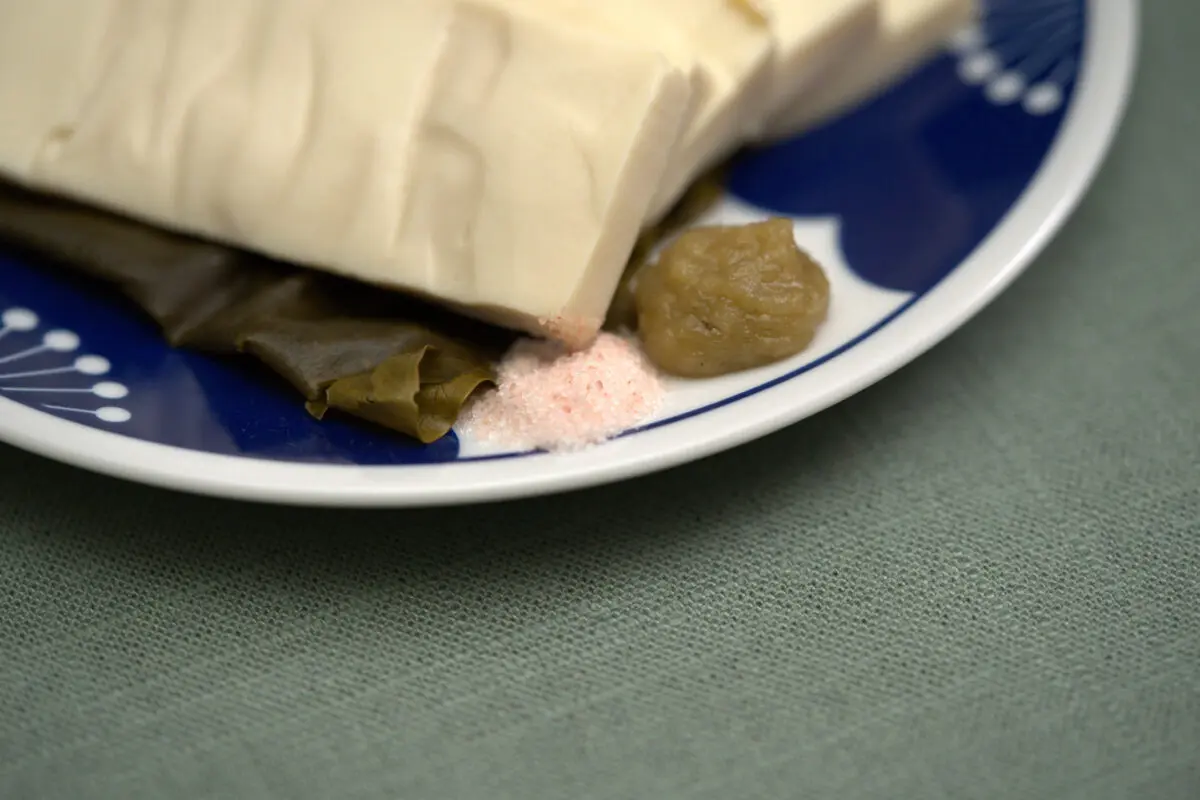
After I’ve locked the main shots I’ll often return to a stripped-back version of the same subject — fewer elements, tighter edit. These two frames came minutes apart from the same plate. The first included full context: four elements, the blue rim visible. The second pared down to essential shapes — a white rectangle, a dark ribbon of seaweed, a spot of pale green paste, a pinch of pink salt. Same light, same ISO, different decisions about what to include.


The 90mm macro earns its place not because it makes subjects appear bigger, but because the combination of working distance, the f/3.2 sweet spot, and the sensor latitude to ride ISO freely lets you shoot food exactly as it sits — no continuous lighting, no diffusers, no tripod required. Those ISO 3200 frames from 2018 still hold up in 2025. That’s the case for this lens.