Aperture First, Everything Else Follows
My landscape aperture choices live at two extreme ends of the scale, and understanding why tells you most of what you need to know about how I work. I shoot everything from f2.8 to f22 depending on the scene — not as a compromise but as a deliberate decision.
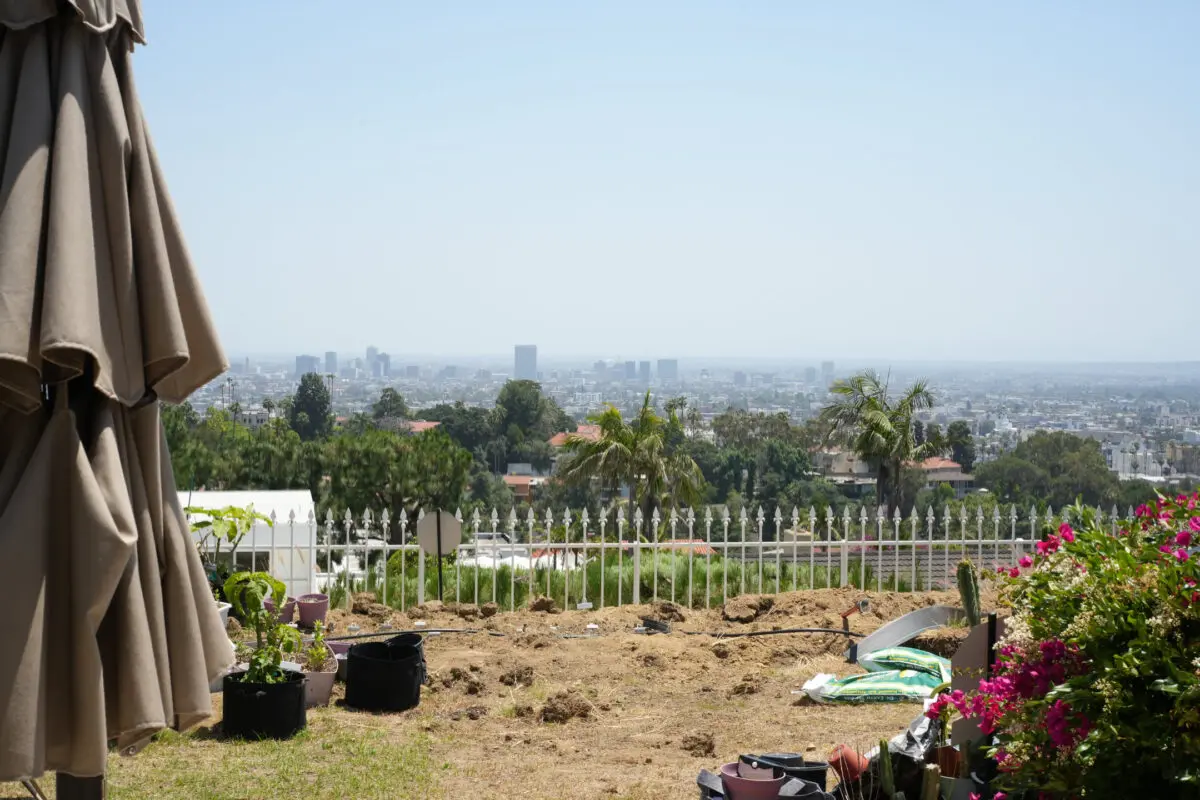
When I’m on a hillside with a hard foreground edge — soil, a fence line, planted containers — I go to f16. On a 50mm at that aperture, hyperfocal distance reaches from about three feet to infinity. I focus one-third into the frame and walk away from the focus ring. ISO 400 was plenty in June midday light.
At golden hour the calculation reverses. Here’s a church steeple from 2018 at f4.5. The sky is one plane. I don’t need depth — I need shutter speed and light collection, so I open up and let ISO climb to 2000. The silhouette does the compositional work; the aperture just lets me keep it sharp without motion blur in the handheld shot.

Night Sky: ISO 6400 Is Not a Compromise
I shoot night sky at f2.8 and ISO 6400 almost without exception on my a7 bodies. That isn’t a fallback — it’s the target combination. The BSI sensors in the a7 III and IV hold detail at 6400 in a way that lets me expose Orion’s nebula at 180mm without turning pinpoint stars into smeared streaks. Shutter speed is what you protect when you lock in this combination; the sensor handles the noise.

City nights follow the same aperture logic. Christmas Eve 2024, I was shooting above downtown from an elevated vantage at 70mm. The ambient light was generous but I still needed f2.8 and ISO 6400 to keep any slight hand-camera movement from softening the frame at that focal length.

Focal Length Shapes What the Story Is About
I carry a 12–600mm range for landscape work and each end tells a fundamentally different story. At 400mm from a high angle, a coastal bay becomes about layers — sandbar, breakwater, haze, harbor, columned structure. Telephoto compression flattens atmospheric perspective into something almost painted. The flat blue-grey midday haze that would ruin a wide shot becomes the visual texture that holds the frame together at long glass.

Pull back to 28mm over a rugged coastline and the story flips. Now the viewer feels the height and the scale. The sea stacks, the turquoise coves, the ridgeline stretching away — wide angle creates immersion, not description. Clear summer light meant ISO 100 and f4; no push needed.

At 142mm that same December night, the Los Angeles skyline compresses into stacked profiles. Same vantage as the city-wide shot, same settings — different focal length, completely different mood. Length isolates. Width contextualizes. Knowing which story you’re after before you raise the camera determines everything.

Ultra-Wide for the Milky Way — and the 500 Rule
For the Milky Way, I go to 17mm. The reason is simple math: the 500 Rule puts maximum shutter speed before star trailing at roughly 500 divided by focal length. At 17mm that’s 29 seconds. At 50mm it drops to 10. Since f2.8 and ISO 6400 are locked in, focal length is the only variable I have — and I need every second of shutter time I can get without Earth’s rotation smearing the galactic core.

Reading Bad Light — and Moving On
Not every session delivers. This December overcast yielded a nearly featureless grey sky with flecks that might be snowflakes or might be sensor artifacts at ISO 6400. f2.8, 70mm — I was hoping the overcast would break into something. It didn’t. The lesson isn’t a technique; it’s a discipline. Stop chasing a frame that isn’t there and look for the next position.

Two days earlier, haze over the same city softened into something workable. Medium telephoto at 150mm, f5, ISO 250 in full daylight — atmospheric haze stops being a problem when you compress it into a color wash rather than try to shoot through it cleanly.

The Starburst: f22, Hard Edge, Direct Sun
Sunstarburst is the one situation where I deliberately set f22. The small aperture diffracts light around the lens blade edges to produce those sharp radiating spikes. Pair that with a 12mm ultra-wide for clean geometry, position the sun at a hard architectural edge (here, a rooftop corner), and shoot ISO 100 — midday sun doesn’t need help. The wider the lens, the tighter the spikes. The harder the edge, the cleaner the alignment.

Earn the Vantage Point
Most of my strongest landscape frames come from elevation — a hillside, a rooftop, height I had to actually get to. The higher the position, the more the scene resolves into readable layers. This 100mm panoramic over Los Angeles at f10, ISO 100 pulls every residential block, every palm-lined corridor, and the downtown cluster into a single coherent frame that would read as chaos from street level.

If six years of Sony landscape work has taught me one thing, it’s that every number in the EXIF has a reason. f16 for hyperfocal depth. f2.8 for night. f22 for starbursts. ISO 6400 when the scene demands it, ISO 100 when it doesn’t. The exposure triangle isn’t a constraint — it’s the conversation between what the light is doing and what the story needs.