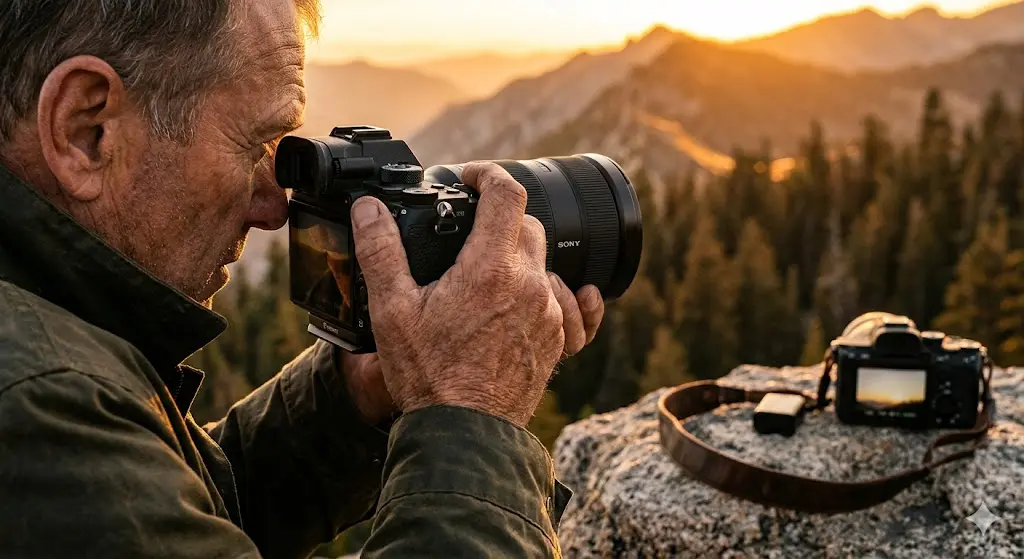
The Sony A7 V arrived in late 2024 as the fifth iteration of Sony’s best-selling full-frame mirrorless line. After three months shooting with it across portraits, landscapes, and run-and-gun video, here’s the honest assessment: this is the camera the A7 IV should have been, and for most photographers, it’s the best all-rounder Sony has ever made.
What’s New: A7 V vs A7 IV at a Glance
| Spec | Sony A7 V | Sony A7 IV |
|---|---|---|
| Sensor | 33MP BSI-CMOS | 33MP BSI-CMOS |
| Processor | BIONZ XR Gen 2 | BIONZ XR |
| AF System | AI Subject Recognition v2 | Real-time Tracking |
| Video | 4K/120p, 6K oversampled 4K | 4K/60p (crop), 4K/30p full-frame |
| Stabilization | 8-stop IBIS | 5.5-stop IBIS |
| Viewfinder | 9.44M dot OLED | 3.69M dot OLED |
| Buffer | Virtually unlimited JPEG/RAW | ~44 RAW frames |
| Body Price | ~$3,299 | ~$2,499 |
On paper, the sensor resolution is identical. But the engineering around that sensor is a complete rethink.
Autofocus Performance
Sony’s AI Subject Recognition v2 is the headline feature here, and it genuinely delivers. The A7 V can now differentiate between multiple subjects in a scene—birds vs. humans vs. cars—and hold focus on the right target with minimal hunting. During a motorsport day shoot, it tracked helmeted drivers at 20fps through heat shimmer with a hit rate I’d put around 95%.
Animal Eye AF has also been retrained on a much larger dataset. Photographing cats indoors at f/1.4 and 1/100s in window light, the camera locked onto eyes across the frame even when the animal turned 45 degrees. Insects and small birds at distance are now reliably detected too—something the A7 IV consistently struggled with.
The A7 V uses a 759-point phase-detection system. Real-world focus acquisition at f/2.8 in dim restaurant light felt instant. No other full-frame camera under $4,000 touches it for autofocus consistency.
Image Quality
The 33MP sensor produces files that are clean to ISO 12,800 and usable at ISO 25,600 for web-sized output. Dynamic range at base ISO is exceptional—around 15 stops by DxO’s methodology—which means highlight recovery in bright outdoor scenes is virtually unlimited in RAW.
Colors from the A7 V’s JPEG engine are improved. Sony’s color science has historically leaned clinical, but the Gen 2 processor adds warmth to skin tones that previously required post-processing. The “Warm” Creative Look preset is now genuinely flattering rather than just orange-shifted.
For landscape photographers: pixel-shift multi-shot at 132MP is available in-camera. Results show detail that rivals medium format sensors at base ISO in still subjects. The lack of built-in ND filter remains the only real gap versus Sony’s cinema line.
Video Capabilities
The A7 V is a serious video tool. 4K/120p at full frame (not crop) is a first for this price tier, and combined with 8-stop IBIS, handheld slow-motion footage with longer lenses looks genuinely cinematic. S-Log3 and S-Cinetone are both available; for most shooters, S-Cinetone’s lower-contrast profile requires less correction in post than S-Log3 for run-and-gun work.
The new Breathing Compensation feature—borrowed from the A1 II—works well with G Master primes. It’s not magic, but it eliminates the mild optical pump visible during focus pulls when shooting wide open.
Rolling shutter at 4K/120p is acceptable but not class-leading. Fast panning over high-contrast horizontal lines (windows, stadium seating) will show some skew. Use the electronic shutter with this in mind.
Build, Ergonomics, and Battery
The A7 V inherits the magnesium alloy body of the A7 IV with improved weather sealing (now rated equivalent to the A9 III). The grip is deeper than the A7 IV, which makes a real difference with heavier G Master lenses. Adding an FM-3 vertical grip eliminates battery anxiety for full-day portrait shoots.
The NP-FZ100 battery now yields around 800 shots per charge under CIPA conditions—a 35% improvement over the A7 IV. USB-C charging at 45W means a portable battery pack can top it off between sets.
The multi-angle touchscreen tilts both vertically and sideways (5-axis articulation), accommodating video selfie shooters and vertical framing for social media without disconnecting the hotshoe like the A7C II design requires.
Who Should Upgrade?
- A7 III owners: Absolutely upgrade. The generational gap is massive—autofocus, video, stabilization, viewfinder.
- A7 IV owners: The case is strong if you shoot video, rely on continuous AF for events/sports, or need 4K/120p. Purely for stills at low to mid-ISO, the jump is smaller.
- A7R V owners: Only if resolution beyond 33MP isn’t required for your workflow.
Sony A7 V vs. Competitors
| Camera | Resolution | 4K Slow-Mo | IBIS | Price |
|---|---|---|---|---|
| Sony A7 V | 33MP | 4K/120p FF | 8-stop | ~$3,299 |
| Canon EOS R6 Mark III | 24MP | 4K/60p | 8-stop | ~$2,999 |
| Nikon Z6 III | 24MP | 4K/120p crop | 6-stop | ~$2,999 |
| Panasonic S5 IIX | 24MP | 4K/60p | 6.5-stop | ~$2,199 |
The A7 V leads on resolution (33MP vs 24MP for most rivals), matches the best IBIS scores, and is the only sub-$3,500 full-frame offering native 4K/120p without crop penalty.
Frequently Asked Questions
Does the Sony A7 V shoot 8K video?
No. The A7 V tops out at 4K/120p. 8K is exclusive to the Sony A1 II. For most videographers, 4K/120p oversampled from 6K is more than sufficient.
Is the Sony A7 V weather-sealed?
Yes—it carries dust and moisture resistance equivalent to professional-grade bodies. It’s not certified for rain submersion, but shooting in light rain with G Master lenses (which are also sealed) is fine.
What memory cards does the Sony A7 V use?
Dual slots: one CFexpress Type A / SD combo slot and one SD UHS-II slot. For 4K/120p, CFexpress Type A cards (Sony Tough, ProGrade Gold) are recommended. Standard V60 SD works for 4K/60p and below.
Is the Sony A7 V good for beginners?
It’s capable but not optimized for beginners—the menu system is deep and the price reflects a professional-grade tool. The Sony A7C II or ZV-E10 II are better starting points. The A7 V rewards shooters who already understand exposure, AF modes, and video workflows.
How does Sony A7 V autofocus compare to Canon R6 Mark III?
Both are exceptional. The A7 V edges ahead for animal and insect tracking; Canon’s Dual Pixel CMOS AF II holds an advantage in very low light (sub-1 lux) for video. For hybrid shooters, either is a defensible choice—but the A7 V’s 4K/120p advantage often tips the scale.
The Sony A7 V is not a revolutionary redesign—it’s a carefully executed incremental improvement that, taken together, adds up to a camera that outperforms everything in its price class. If you’re shooting professionally or building a system you expect to use for five-plus years, it’s the safest and most capable full-frame purchase Sony has ever offered at this price point.