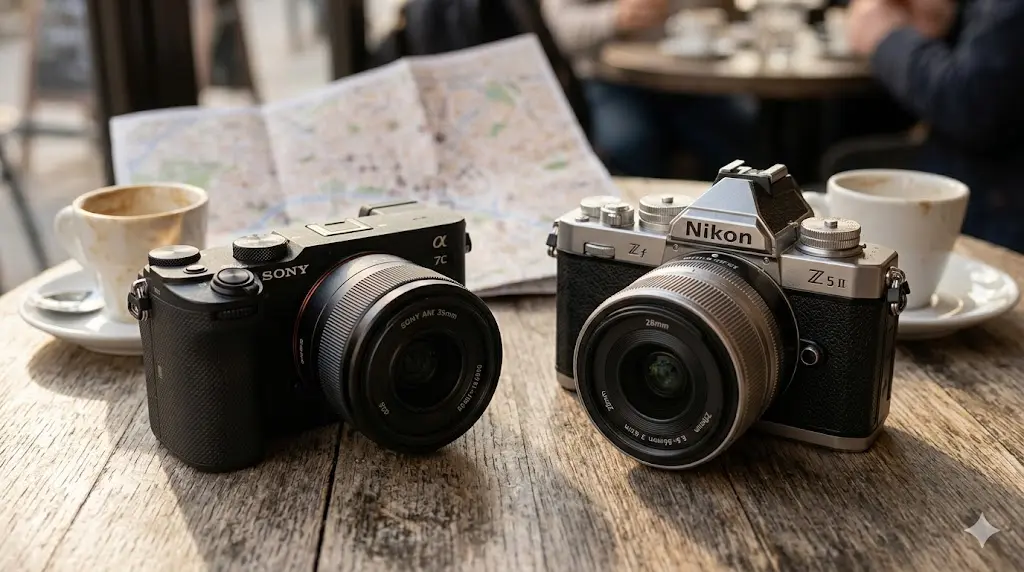
The Sony A7C II and Nikon Z5 II represent two distinct approaches to affordable full-frame mirrorless for travel and hybrid photography. Both target photographers who want full-frame capability without the weight and price of flagship bodies. After shooting both side by side on an extensive trip, here’s the full picture.
Sony A7C II vs Nikon Z5 II: Full Spec Comparison
| Spec | Sony A7C II | Nikon Z5 II |
|---|---|---|
| Sensor | 33MP BSI-CMOS FF | 24MP BSI-CMOS FF |
| Processor | BIONZ XR | EXPEED 7 |
| AF Points | 759-point PDAF | 273-point PDAF |
| Subject Recognition | AI (Human/Animal/Bird/Insect/Vehicle) | AI (Human/Animal/Vehicle) |
| Max Burst | 15fps (e-shutter) | 14fps (e-shutter) |
| 4K Video | 4K/30p FF / 4K/60p crop | 4K/30p (oversampled), 4K/60p crop |
| IBIS | 7-stop | 7.5-stop |
| Viewfinder | 2.36M dot EVF (side-mounted) | 3.69M dot EVF (center) |
| Screen | Fully articulating touchscreen | Tilt-only touchscreen |
| Weather Sealing | Dust and moisture resistant | Dust and moisture resistant |
| Battery Life | ~560 shots | ~470 shots |
| Body Weight | 514g | 590g |
| Price | ~$2,499 | ~$1,999 |
Image Quality
The Sony A7C II’s 33MP sensor provides meaningfully more resolution than the Nikon Z5 II’s 24MP—especially visible when cropping travel images (landscapes, street scenes where subjects are in the distance). Sony’s BSI sensor produces excellent dynamic range at base ISO, and the 33MP file provides more flexibility for large prints and aggressive crops.
The Nikon Z5 II’s 24MP sensor, however, is excellent in its own right. High ISO performance is comparable between the two cameras up to ISO 6,400. At ISO 12,800+, the Sony A7C II maintains slightly cleaner files, though the gap narrows when the additional Nikon megapixels are considered—a 24MP clean file often outpractically a 33MP noisy one at equivalent print sizes.
Color science is a matter of preference. Sony’s BIONZ XR engine produces accurate, neutral files that grade very well. Nikon’s EXPEED 7 delivers warmer, more saturated JPEGs out of camera—pleasing for travel photography that doesn’t need extensive editing. For photographers who shoot JPEG directly, the Nikon’s default output is arguably more immediately attractive.
Autofocus Performance
Sony wins this category clearly. The A7C II’s AI Subject Recognition with 759-point phase detection is faster, more reliable in low-contrast scenes, and tracks more subject categories than the Nikon. Eye AF on the Sony acquires faster and holds lock through more challenging scenarios—subjects at distance, harsh backlighting, fast-moving subjects.
The Nikon Z5 II is not a poor AF camera—it’s significantly better than its predecessor and handles the vast majority of travel photography scenarios competently. Portrait eye AF works reliably in decent light. The gap becomes more apparent in dynamic situations: children playing, wildlife, street action. Sony’s AI tracking holds subjects through partial occlusion and direction changes more consistently.
For travel photographers who primarily shoot static scenes, architecture, food, and landscapes, the AF gap is largely irrelevant. For those who shoot moving subjects regularly, the Sony advantage is meaningful.
Video Capabilities
Both cameras offer 4K video with oversampled full-frame 4K/30p. The Sony A7C II adds S-Log3 and S-Cinetone for professional color grading, and 4K/60p in crop mode. The Nikon Z5 II offers N-Log and 4K/60p in crop mode as well.
Sony’s video AF is noticeably smoother for vlogging and talking-head content—AF transitions are gradual and natural, and the fully articulating screen is a significant ergonomic advantage for solo video content creators. The A7C II’s flip-out screen makes selfie-style recording comfortable; the Nikon’s tilt screen doesn’t fold forward for front-facing recording.
For serious videographers, the Sony A7C II is clearly the stronger platform. For photographers who occasionally record clips on travel, both are adequate.
Viewfinder and Screen
The Nikon’s center-mounted 3.69M dot viewfinder is sharper and more natural to use than the Sony A7C II’s side-mounted 2.36M dot EVF. The rangefinder-style EVF on the Sony is a deliberate design choice to keep the body compact, but photographers used to center-mounted viewfinders will need an adjustment period.
The Sony’s fully articulating touchscreen is the clear ergonomic winner over the Nikon’s tilt screen for vlogging, low-angle landscape shooting, and any situation where you need to see the screen from unconventional angles. For travel photography where flexibility matters, the fully articulating screen is genuinely useful daily.
Lens Ecosystem Comparison
| Category | Sony FE Mount | Nikon Z Mount |
|---|---|---|
| Total native lenses | 70+ FE lenses | 40+ Z lenses |
| Third-party support | Sigma, Tamron, Samyang, Voigtlander, Tokina | Sigma, Tamron, Viltrox, Cosina |
| Budget primes | Sony FE 28mm f/2 (~$299), FE 50mm f/1.8 (~$249) | Nikon Z 40mm f/2 (~$297), Z 28mm f/2.8 (~$299) |
| Travel zoom | Sony FE 28-60mm f/4-5.6 (~$299) | Nikon Z 24-50mm f/4-6.3 (~$299) |
| G Master / S-line equiv. | G Master lineup (premium) | S-Line (premium) |
Sony’s FE mount ecosystem is more mature with more first and third-party options at every price point. For budget-conscious travelers, there are more affordable FE primes available. Nikon’s Z mount is growing rapidly and has excellent S-Line prime options, but the total selection is smaller.
Travel Usability: Battery, Connectivity, Size
The Sony A7C II is lighter (514g vs 590g body only) and more compact, fitting in smaller travel bags alongside a compact prime. Battery life gives Sony the edge at ~560 shots vs Nikon’s ~470. Both charge via USB-C.
Nikon’s connectivity for sharing images to phone and tablet is simpler—the Nikon SnapBridge app has been updated to perform reliably. Sony’s Creators’ App (formerly Imaging Edge Mobile) also works well, though the initial pairing process is marginally more complex.
Which Should You Buy?
- Buy the Sony A7C II if: You shoot video regularly or vlog; you need the best available autofocus for moving subjects; you’re investing in the Sony ecosystem for the long term; you need the fully articulating screen for solo shooting.
- Buy the Nikon Z5 II if: You’re primarily a stills photographer; you prefer a center-mounted EVF; you’re already invested in Nikon glass; the $500 price difference matters to your budget; you find Nikon’s JPEG color output more appealing.
Frequently Asked Questions
Is the Sony A7C II worth $500 more than the Nikon Z5 II?
For video-focused users and those who need the best autofocus, yes. For primarily stills-oriented travel photographers who shoot at their own pace, the Nikon Z5 II delivers comparable image quality at a meaningfully lower price point.
Which has better low-light performance: Sony A7C II or Nikon Z5 II?
Both use BSI full-frame sensors with similar low-light performance. The Sony has a slight technical edge at high ISO due to its processor, but for practical shooting up to ISO 6,400, both produce excellent results.
Can I use Sony lenses on the Nikon Z5 II?
No native adapter exists from FE to Z mount. Adapters exist but sacrifice autofocus performance. If you own Sony FE lenses, the A7C II is the logical choice to protect that investment.
Which camera has a better screen for vlogging?
The Sony A7C II’s fully articulating flip-out screen wins for selfie-angle vlogging. The Nikon’s tilt screen does not fold forward for front-facing recording, which is a significant limitation for solo content creators.
Both cameras represent excellent value in the travel full-frame space. The Sony A7C II earns its higher price with superior autofocus, better video capability, and the flexible fully articulating screen. The Nikon Z5 II is an outstanding camera for the price, particularly for photographers who prioritize the optical viewfinder experience and primarily shoot stills.