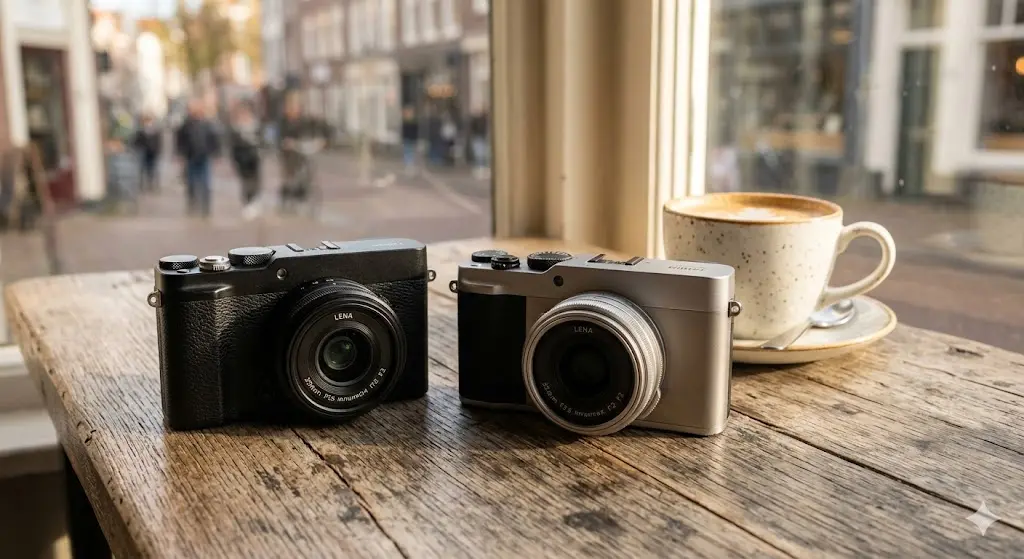
The Sony ZV-1 II ($749) and Canon PowerShot G7X Mark III ($749) are both 1-inch sensor compact cameras designed explicitly for vloggers and content creators. They launch at the same price, target the same audience, and compete directly on every practical feature that matters for YouTube, Instagram, and social media production. This comparison breaks down where each camera excels and makes a clear recommendation based on your primary use case.
Sensor and Image Quality
Both cameras use a 20MP 1-inch sensor — the standard for this camera class. The sensors produce comparable image quality in good light: clean, detailed images through ISO 1600, with acceptable noise management through ISO 3200. High ISO performance (above ISO 6400) degrades on both cameras similarly, as the physics of 1-inch sensors impose a ceiling.
The practical image quality difference comes from lens rendering and color science. Canon’s G7X Mark III uses a 24-100mm f/1.8-2.8 lens — excellent reach and a bright f/1.8 maximum aperture at wide end. The Sony ZV-1 II uses an 18-50mm f/1.8-4 lens — wider at 18mm but only 50mm maximum reach at a darker f/4 maximum aperture at telephoto. Color science: Canon’s JPEG output is widely regarded as accurate with natural skin tones; Sony’s ZV-1 II produces clean but slightly cooler JPEGs out of camera that respond well to standard warm-up adjustments in post.
Lens Comparison: Sony’s Wide vs Canon’s Reach
This is the central practical difference. The Canon G7X Mark III’s 24-100mm lens (f/1.8-2.8) covers a wider zoom range — from standard vlog wide angle to 100mm telephoto. The 100mm reach enables compressed portrait looks, tabletop product shots at slight distance, and outdoor B-roll at moderate telephoto. The bright f/1.8-2.8 throughout most of the range maintains strong bokeh.
The Sony ZV-1 II’s 18-50mm f/1.8-4 is notably wider at 18mm — capturing more scene in tight spaces, small rooms, and urban environments. The 50mm maximum reach limits you to standard field of view at the long end, which feels limiting for anything requiring subject reach or compression. The f/4 at 50mm produces minimal bokeh at telephoto distances.
Recommendation by use case: Choose the ZV-1 II lens for primarily indoor or tight-space vlogging where wide angle matters most. Choose the G7X III lens for travel and versatile shooting where 100mm reach and a brighter telephoto are operationally valuable.
Video Specifications
Both cameras shoot 4K/30p and 1080/60p as their primary video modes. The Canon G7X Mark III adds a feature the Sony lacks: 1080/120fps slow motion — enabling 5x slow motion clips at 24fps from Full HD. This is a meaningful creative tool for beauty, food, and lifestyle content where slow motion enhances visual storytelling.
The Sony ZV-1 II offers 10-bit video recording — a significant technical advantage for colorists. The Canon G7X Mark III tops out at 8-bit internally. For content that goes directly to YouTube or social media with minimal grading, this distinction doesn’t matter. For content that will be color corrected or graded for cinematic looks, 10-bit provides substantially more flexibility. Most vloggers uploading without aggressive grading won’t notice or utilize this difference in daily shooting.
| Spec | Sony ZV-1 II ($749) | Canon G7X Mark III ($749) |
|---|---|---|
| Sensor | 20MP 1-inch BSI CMOS | 20.1MP 1-inch BSI CMOS |
| Lens Range | 18-50mm f/1.8-4 | 24-100mm f/1.8-2.8 |
| 4K Max Frame Rate | 4K/30p | 4K/30p |
| 1080p Slow Motion | 1080/60p | 1080/120p (5x slow motion) |
| Internal Bit Depth | 10-bit (4:2:0) | 8-bit |
| Log Video | S-Log2, S-Log3 | Canon Log |
| LCD Type | Fully articulating (flip-out) | Fully articulating (flip-up) |
| Built-in ND Filter | No | Yes (3-stop ND) |
| 3.5mm Mic Input | Yes | Yes |
| IBIS | Optical SteadyShot + digital | Optical + digital hybrid |
| Subject Recognition AF | Human Eye AF (Real-time) | Human Eye/Face detection |
| Livestream Direct | Yes (via Creators’ App) | Yes (via Camera Connect app) |
| Battery Life (video) | ~75 min 4K | ~60 min 4K |
| Price | $749 | $749 |
Built-in ND Filter: Canon’s Underrated Win
The Canon G7X Mark III includes a built-in 3-stop neutral density filter — a feature the ZV-1 II lacks. For outdoor vlogging on bright days, an ND filter allows proper exposure at wider apertures (for better bokeh) without overexposing. Without ND, shooting in full sun at f/1.8 requires very fast shutter speeds that deviate from the 180-degree shutter rule preferred for natural motion blur in video. Canon’s built-in ND handles this natively; ZV-1 II users need to attach an external variable ND filter (additional accessory cost and complication).
For serious outdoor creators who frequently shoot in bright conditions, the built-in ND filter is a genuine daily quality-of-life improvement. It’s one of the most underappreciated features on the G7X Mark III.
Autofocus Comparison
The Sony ZV-1 II’s Real-time Eye AF and tracking system is faster and more reliable than the Canon G7X Mark III’s face/eye detection. Sony’s system locks more quickly and holds through subject movement more confidently. For solo vloggers shooting themselves while walking, the Sony AF maintains focus through more challenging scenarios. Canon’s AF performs well for static and slow-moving talking-head content but struggles more with dynamic motion and off-center framing.
Which Camera Should You Choose?
Choose the Sony ZV-1 II if: you shoot primarily indoors or in tight spaces where 18mm ultra-wide is important, you want 10-bit video for color grading projects, you need the best possible face/eye AF tracking for solo filming while moving, or content creator-specific shortcuts (Background Defocus button, Product Showcase mode) appeal to your workflow.
Choose the Canon G7X Mark III if: you need 100mm reach for travel and versatile outdoor shooting, the built-in ND filter for outdoor bright-day shooting is important to your workflow, you want 1080/120p slow motion for lifestyle and beauty content, or Canon’s color science better matches your editing preference.
Frequently Asked Questions
Is the Sony ZV-1 II better than the Canon G7X Mark III?
Neither is categorically better — they’re differently focused. ZV-1 II wins on AF tracking, 10-bit video, and ultra-wide 18mm. G7X III wins on telephoto reach (100mm), built-in ND filter, and 1080/120p slow motion. Choose based on which feature set matches your specific shooting style.
Which is better for travel vlogging: ZV-1 II or G7X Mark III?
The Canon G7X Mark III’s 24-100mm range is more versatile for travel — you get both wide establishing shots and compressed telephoto for crowd scenes, food close-ups, and architecture. The Sony’s 50mm maximum reach is limiting for travel situations where subject distance varies widely.
Do both cameras work as webcams?
Yes. Both support USB-C connection as a webcam source for Zoom, Teams, and OBS. Both also support direct RTMP streaming via their respective smartphone apps. The Sony Creators’ App is generally regarded as more polished for remote control and streaming setup.
What is the recording limit on these cameras?
Both cameras have approximately 29-minute clip recording limits due to file system constraints (EU tax regulations previously drove this; current models extend recording on a per-clip basis). Battery life is typically the more limiting factor at ~60-75 minutes of 4K recording. Both can continue recording with a fresh battery or USB power delivery in some shooting modes.
Is the Sony ZV-1 II good for photography (stills)?
Yes, for casual and social media photography. The 20MP 1-inch sensor produces clean stills through ISO 1600 with fast Eye AF for portraits. For serious photography requiring deep depth of field control, zoom versatility, or high-ISO performance, both cameras are limited by their compact 1-inch sensor format.