
Disclosure: As an Amazon Associate, Sony Camera Central earns from qualifying purchases. This post contains affiliate links — we may earn a commission at no extra cost to you.
Last updated: April 2026
The visual below illustrates the Sony ZV-E1 full-frame mirrorless camera in its compact black body design. 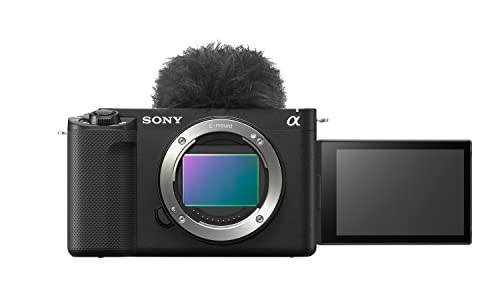
Sony ZV-E1: The Most Versatile and Refined Full-Frame Mirrorless Camera for Video Performance and Ease of Use
The Sony ZV-E1 (Best for: Vloggers and Content Creators) is a full-frame mirrorless camera aimed at video creators, especially vloggers and content creators who need a high-quality and versatile camera for various situations and subjects. It packs the sensor and IBIS (In-Body Image Stabilization) from the Sony A7S III (Best for: Video Professionals) into a smaller body with no viewfinder but a bunch of features designed to make filming easier, especially if you’re a team of one.
KEY TAKEAWAYS
- Compact full-frame design with 5-axis IBIS (In-Body Image Stabilization) for smooth handheld video capture
- AI-powered Auto Framing automatically crops and tracks subjects, ideal for solo creators
- 10-bit 4K UHD video at up to 60fps with S-Cinetone color grading and S-Log3 profiles for professional post-production
- Flip-out touchscreen with built-in directional microphone eliminates need for external audio setup in many scenarios
- Lightweight and portable design makes it the smallest full-frame mirrorless option, perfect for travel vlogging
This mirrorless camera also offers a simple control layout, and AI smarts that make life easy for modest crews, and hint at how cameras are likely to evolve. In this review, we will look at the main features, pros and cons of this camera.
As shown in the following camera gallery, the ZV-E1 features a slim profile and vlogger-focused ergonomics.


Introduction
The Sony ZV-E1 was announced in January 2023 as a full-frame mirrorless camera for video creators. It is part of Sony’s ZV series of cameras, which are designed to deliver high image quality and performance for vlogging and content creation. This is the most capable and expensive model in the series, following the ZV-1F, the ZV-10, and the ZV-11, which are all compact cameras with fixed lenses and smaller sensors.
The ZV-E1 is essentially a stripped-down version of the Sony A7S III (Best for: Video Professionals), which is Sony’s flagship full-frame camera for video professionals. The ZV-E1 uses the same 12MP BSI CMOS sensor and Bionz XR processor as the A7S III, which enable stunning 4K video quality in any light, with minimal noise and high dynamic range.
It also inherits the 5-axis IBIS system from the A7S III, which provides up to 5.5 stops of stabilization for handheld shooting. For context, other full-frame Sony models like the Sony α7R V and Sony A1 II feature IBIS systems rated at 8 and 8.5 stops respectively, demonstrating Sony’s commitment to advanced stabilization across its lineup.
However, the ZV-E1 also sacrifices some features from the A7S III to achieve a smaller size and lower price. The ZV-E1 has no viewfinder, no mechanical shutter, no dual card slots, no top LCD panel, no joystick control, no headphone jack and no full-size HDMI port.
It also has a lower-resolution rear LCD screen (1.04M dots vs 1.44M dots), a lower-capacity battery (NP-FZ100 vs NP-FZ110), and a lower frame rate for 4K video (60fps vs 120fps).
The Sony ZV-E1 also adds some features that are tailored for vlogging and content creation. It has a flip-out touchscreen that can face forward for selfies and vlogs, a built-in directional microphone that can capture clear audio without an external mic, an AI-powered Auto Framing mode that can crop and track subjects automatically, a Cinematic Vlog mode that can record widescreen videos with S-Cinetone color profile, and a USB-C port that can be used for power delivery or webcam streaming.
Sony ZV-E1 vs. Comparable Full-Frame Mirrorless Cameras
| CRITERIA | Sony ZV-E1 | Sony A7C | Sony A7S III |
| Target User | Vloggers & Content Creators | All-Around Photographers | Video Professionals |
| Sensor Resolution | 12 MP | 24.2 MP | 12 MP |
| Viewfinder | None | Yes (EVF) | Yes (EVF) |
| IBIS | 5-Axis, 5.5 stops | 5-Axis | 5-Axis, 5.5 stops |
| Card Slots | 1 (SD UHS-II) | 1 (SD UHS-II) | 2 (XQD/CFexpress) |
| 4K Video Max | 60fps | 30fps | 120fps |
| Display Type | Flip-Out Touchscreen | Fixed Touchscreen | Fixed Touchscreen |
| Video Color Depth | 10-bit | 8-bit | 10-bit |
Features
| FEATURE | Sony ZV-E1 |
| Full frame | Yes |
| Sensor Resolution | 12 MP |
| Sensor Type | BSI CMOS |
| Sensor Size | Full-Frame |
| Image Stabilization | 5-Axis IBIS |
| Autofocus | Hybrid AF with 759 phase-detection points and 425 contrast-detection points |
| Video Resolution | Up to 4K UHD at 60fps or Full HD at 240fps |
| Video Format | XAVC S or XAVC HS with H.264 or H.265 codec |
| Video Bit Depth | Up to 10-bit internal or external |
| Video Color Space | Up to BT.2020 internal or external |
| Video Log Profile | S-Log2 or S-Log3 |
| Video HDR Profile | HLG |
| Audio Input | Built-in directional microphone or external microphone via 3.5mm jack |
| Audio Output | None |
| Display Size | 3 inches |
| Display Resolution | 1.04 million dots |
| Display Type | Flip-out touchscreen LCD |
| Viewfinder Type | None |
| Connectivity | Bluetooth, Wi-Fi, micro HDMI, USB-C, Microphone (3.5mm) |
| Memory Card Slots | 1 |
| Memory Card Format | SDXC (UHS-II) |
| Battery Type | Sony NP-FZ100 |
| Battery Life | Up to 440 shots or 95 minutes of video recording |
| Dimensions | 2.8 by 4.8 by 2.1 inches |
| Weight | 1.1 lb |
| Weather Sealing | Yes |
Recommended Memory Cards for Sony ZV-E1 Video Recording
For optimal video performance on the ZV-E1, SD card selection is critical. According to SD Association specifications (2017), V90 SD cards guarantee a minimum sustained write speed of 90 MB/s, making them suitable for all video codecs including XAVC S-I 4K All-Intra. V60 cards with 60 MB/s sustained write are sufficient for XAVC HS 4K using H.265 codec, which requires only ~200 Mbps throughput. For continuous recording without file splitting, use 64GB or larger cards that support exFAT format rather than the 4GB FAT32 limit on smaller cards.
The ZV-E1 pictured here demonstrates the compact form factor paired with a flip-out touchscreen for hands-free recording.


Pros and Cons
Pros
- Tiny full-frame camera with stabilized sensor
- Widescreen cinematic vlog mode
- S-Cinetone and S-Log3 picture profiles
- Great-looking 10-bit 4K60 video
- Excellent stabilization system
- Quality in-camera audio
- AI-powered Auto Framing mode
- USB-C power delivery and webcam streaming
Cons
- No viewfinder
- No mechanical shutter
- Single SD card slot
- Fragile micro HDMI port
- Can overheat at 4K60
- Not a great camera for photos

Frequently Asked Questions
Is the Sony ZV-E1 good for photography?
The ZV-E1 is primarily optimized for video work rather than photography. While its 12MP BSI CMOS sensor is capable of producing quality stills, the lack of a viewfinder, no mechanical shutter, and lower resolution may limit its appeal for serious photographers. Those interested in a deeper look at its performance should read our in-depth hands-on review.
What memory cards should I use with the Sony ZV-E1?
The ZV-E1 uses a single SDXC UHS-II card slot. For 4K video, Sony recommends V90 SD cards that guarantee at least 90 MB/s sustained write speed. This ensures reliable recording at all video bitrates. V60 cards are sufficient for XAVC HS 4K codecs but may struggle with higher bitrate formats. Always use 64GB or larger cards to avoid the 4GB FAT32 file size limitation.
How does the Sony ZV-E1 compare to the Sony A7S III?
The ZV-E1 shares the same 12MP sensor and 5-axis IBIS as the A7S III but sacrifices features to reduce size and cost. The A7S III offers a viewfinder, dual XQD/CFexpress card slots, 4K 120fps video, a mechanical shutter, headphone jack, and full-size HDMI. The A7S III is better for professional productions, while the ZV-E1 is optimized for solo content creators and vloggers.
Can the Sony ZV-E1 handle continuous 4K recording?
The ZV-E1 can record 4K at up to 60fps, but users report potential thermal issues during extended sessions at this bitrate. Using a V90 SD card and allowing brief cooling breaks helps minimize thermal throttling. Full HD recording at 240fps is possible but requires careful thermal management. It’s advisable to plan for battery swaps rather than extended continuous recording at maximum bitrates.
Does the ZV-E1 include a headphone jack?
No, the ZV-E1 does not include a headphone jack or audio output. However, it features a built-in directional microphone for capturing quality sound without external equipment, and you can connect an external microphone via the 3.5mm input jack. For monitoring audio while recording, you would need to use external devices or rely on the built-in microphone preview.
Conclusion
The Sony ZV-E1 is a full-frame mirrorless camera that delivers fantastic results for videos and vlogs thanks to a stabilized sensor, S-Cinetone color, and a number of AI-powered features to assist creators operating without the benefit of a crew.
It is the most capable and expensive model in Sony’s ZV series of cameras, which are designed to deliver high image quality and performance for vlogging and content creation. It is also the smallest and lightest full-frame camera on the market, making it ideal for handheld shooting and travel.
However, the ZV-E1 is not a perfect camera for everyone. It is not a great camera for photos, as it has no viewfinder, no mechanical shutter, and a low-resolution sensor compared to more traditional full-frame models. It is also not a great camera for heavy video production, as it has a single SD card slot, a fragile micro HDMI port, and can overheat at sustained 4K60 recording.
It is also more expensive than some other full-frame cameras that offer more features and versatility, such as the Sony A7C (Best for: All-Around Full-Frame Photography).
If you are looking for a full-frame mirrorless camera that offers excellent image quality and performance for videos and vlogs, with a simple control layout and AI smarts that make life easy for modest crews, then the Sony ZV-E1 may be the best choice for you.
On the other hand, if you are looking for a full-frame mirrorless camera that offers more features and versatility for photos and videos, with a viewfinder, a mechanical shutter, dual card slots, and better cooling system, then the Sony ZV-E1 may not be the best choice for you.
Further Reading:
(2) Sony ZV-E1 review: vlogging on steroids | TechRadar
(3) Sony ZV-E1 review: pint-sized vlogging powerhouse
(4) Sony ZV-E1 review | Cameralabs
(5) Sony ZV-E1 Review | Trusted Reviews