
Disclosure: As an Amazon Associate, Sony Camera Central earns from qualifying purchases. This post contains affiliate links — we may earn a commission at no extra cost to you.
Last updated: April 2026
If you are a Sony E mount user, you may be wondering what are the best Sigma lenses for your camera. Sigma is a well-known and reputable brand that offers a wide range of high-quality lenses for various camera systems, including Sony E mount.
🔑 Key Takeaways
- Sigma organizes its Sony E mount lineup into three lines: Contemporary (compact, affordable), Art (maximum optical performance), and Sports (weather-sealed, fast AF) — each targeting a distinct shooting style and budget.
- The most critical selection factors are focal length, maximum aperture, and whether you need full-frame (FE) or APS-C-only coverage.
- Sigma Art lenses rival or outperform Sony G Master glass in many independent optical tests — often at 30–50% lower cost.
- Third-party lenses including Sigma are firmware-limited to 15fps burst on Sony Alpha sport bodies; native Sony G Master lenses access the full 30fps capability (Sigma Corporation, 2023).
- Top picks by use case: Sigma 24-70mm f/2.8 Art (versatility), 85mm f/1.4 Art (portraits), 35mm f/1.4 Art (street/documentary), 16mm f/1.4 DC DN Contemporary (APS-C wide-angle/astrophotography).
Sigma lenses are known for their sharpness, contrast, color rendition, and bokeh, as well as their affordable prices compared to some other brands.
However, with so many Sigma lenses available for Sony E mount, it can be hard to choose the right one for your needs and preferences. That’s why we have created this guide to help you find the best Sigma lens for Sony E mount based on your shooting style, budget, and expectations.
We cover this topic in more detail in our guide on understanding sigma lens sony mount: a beginner's guide.
What is Sony E Mount?

Sony E mount is a lens mount standard developed by Sony for its mirrorless cameras, defined by an 18mm flange focal distance — one of the shortest among major mirrorless systems. This compact throat-to-sensor gap is the engineering foundation that makes the entire E mount ecosystem possible: it enables slimmer, lighter lenses and broad compatibility with third-party glass via inexpensive adapters. According to Sidney Ray (2015, Focal Press), Sony APS-C (Advanced Photo System type-C) E mount cameras apply a 1.5x crop factor, meaning a 50mm lens delivers the same field of view as a 75mm lens on a full-frame body — a critical detail when selecting Sigma glass for your specific body.
Sony E mount cameras can be divided into two categories: full-frame and APS-C. Full-frame cameras have a larger sensor size of 36 x 24 mm, which offers better image quality, low-light performance, dynamic range, and depth of field control.
APS-C cameras have a smaller sensor size of 23.5 x 15.6 mm, which offers more reach, faster frame rates, and lower cost.
Sony E mount lenses can also be divided into two categories: FE (Full-frame E-mount) and E. FE lenses are designed for full-frame cameras and cover the entire sensor area. E lenses are designed for APS-C cameras and cover only a smaller portion of the sensor area.
However, both FE and E lenses can be used on any Sony E mount camera, with some limitations. FE lenses can be used on APS-C cameras with a 1.5x crop factor, which means that the effective focal length and field of view will be multiplied by 1.5x. For example, a 50mm FE lens will act like a 75mm lens on an APS-C camera.
E lenses can be used on full-frame cameras with either a crop mode or a full-frame mode. In crop mode, the camera will use only the center part of the sensor that matches the APS-C size, which will result in lower resolution and narrower field of view. In full-frame mode, the camera will use the entire sensor area, but the image will have severe vignetting or dark corners.
What are Sigma Lenses?

Sigma lenses are optics produced by Sigma Corporation, a Japanese manufacturer and one of the world’s leading third-party lens makers alongside Tamron and Tokina. Unlike older Sigma designs that required DSLR-to-mirrorless adapters, the current DG DN (for full-frame mirrorless) and DC DN (for APS-C mirrorless) lines are engineered natively for Sony E mount — no adapter or optical compromises needed.
Sigma lenses are categorized into three lines: Contemporary, Art, and Sports.
- Contemporary lenses are designed to balance performance, size, weight, and price. They are suitable for everyday photography and travel.
- Art lenses are designed to deliver high-level artistic quality and expression. They are suitable for portraits, landscapes, architecture, and other creative genres. According to DPReview (2021), Sigma Art series lenses demonstrate near-flawless suppression of longitudinal chromatic aberration — a rarity among production lenses at any price point.
- Sports lenses are designed to offer fast autofocus, optical stabilization, and weather resistance. They are suitable for wildlife, action, and sports photography.
Sigma also offers a unique service called Mount Conversion Service, which allows users to change the mount of their Sigma lenses to another camera system.
For example, if you have a Sigma lens with Canon EF mount and you want to switch to Sony E mount, you can send your lens to Sigma and they will convert it for you for a fee.
How to Choose the Best Sigma Lens for Sony E Mount?
To choose the best Sigma lens for Sony E mount, you need to consider several factors such as:
Focal Length
Focal length is the single most important factor when choosing a Sigma lens for Sony E mount — it determines how much of the scene you capture and how large your subject appears in the frame. Measured in millimeters (mm), focal lengths range from ultra-wide-angle (less than 24mm) to super-telephoto (more than 300mm).
Generally speaking, wide-angle lenses are good for landscapes, architecture, interiors, and group shots. Normal lenses (around 50mm) are good for general-purpose photography and street photography. Telephoto lenses are good for portraits, wildlife, sports, and distant subjects.
Aperture
Aperture controls two things simultaneously: how much light the lens admits, and how shallow your depth of field appears. It is measured in f-numbers (f/1.4, f/2.8, f/4, etc.) and ranges from very large (f/1.4) to very small (f/22). Larger apertures are good for low-light situations and creating shallow depth of field effects. Smaller apertures are good for bright situations and creating deep depth of field effects.
Zoom or Prime
A zoom lens is versatile but a prime lens is sharper — understanding that trade-off is the key to this decision. A zoom lens changes its focal length by zooming in or out; a prime lens has a fixed focal length and cannot zoom.
Zoom lenses are more versatile and convenient, but they are also larger, heavier, more expensive, and less sharp than prime lenses. While prime lenses are more compact and lightweight, cheaper, and sharper than zoom lenses, but they are also less flexible and require more lens changes.
Image Quality
Image quality is determined by a lens’s optical formula and construction — not just its price tier. Key attributes include sharpness, contrast, color rendition, distortion, chromatic aberration, vignetting, flare, and coma.
Higher-end lenses have better image quality than lower-end lenses, but they are also more expensive and heavier. You can also check online reviews and sample images to compare the image quality of different lenses.
Autofocus
For Sony E mount users, autofocus performance on Sigma lenses depends on both the lens motor type and how deeply the lens firmware integrates with Sony’s camera system. Native DG DN and DC DN Sigma lenses communicate directly with Sony bodies and support features such as eye-tracking and real-time subject recognition. However, according to Sigma Corporation (2023), third-party lenses including Sigma are firmware-limited to 15fps burst on Sony Alpha sport bodies; native Sony G Master lenses can use the full 30fps capability — an important consideration for sports and wildlife shooters.
Newer lenses have better autofocus than older lenses, but they may also have compatibility issues with some camera bodies. You can also check online reviews and videos to compare the autofocus performance of different lenses.
Stabilization
Most current Sigma DG DN and DC DN lenses for Sony E mount omit optical stabilization (OS), relying instead on the camera body’s IBIS (In-Body Image Stabilization) system. This is a deliberate design choice that keeps the lenses lighter and less expensive; Sony’s IBIS implementation on bodies like the A7 V (rated 7.5 stops) is robust enough to compensate in most shooting situations.
Optical stabilization (OS) is built into the lens and it works by shifting the lens elements to counteract the camera movement. Digital stabilization (IS) is built into the camera body and it works by cropping the image sensor to create a virtual shift.
OS is more effective and reliable than IS, but it is also more expensive and heavier. Some lenses and cameras have both optical and digital stabilization, which can work together to provide even better results.
Build Quality
Sigma Art and Sports lenses for Sony E mount feature robust all-metal construction with dust and splash sealing at the lens mount — build quality that competes directly with native Sony G Master glass. Contemporary lenses are somewhat lighter and use more polycarbonate, making them a better match for compact APS-C bodies. Key factors across all lines include materials, weather sealing depth, and the quality of the bayonet mount.
Higher-end lenses have better build quality than lower-end lenses, but they are also more expensive and heavier. You can also check online reviews and videos to compare the build quality of different lenses.
Best Sigma Lenses for Sony E Mount
Based on the factors above, here are some of the best Sigma lenses for Sony E mount that we recommend. The table below summarizes the key specs and best-fit use cases at a glance:
| Lens | Line | Focal Length | Max Aperture | Sensor Coverage | Best For | Approx. Price |
|---|---|---|---|---|---|---|
| Sigma 24-70mm f/2.8 DG DN | Art | 24–70mm | f/2.8 (constant) | Full-frame & APS-C | Travel, events, hybrid shooters | ~$1,099 |
| Sigma 35mm f/1.4 DG DN | Art | 35mm | f/1.4 | Full-frame & APS-C | Street, documentary, low-light | ~$799 |
| Sigma 16mm f/1.4 DC DN | Contemporary | 16mm (24mm equiv.) | f/1.4 | APS-C only | Astrophotography, landscapes, video | ~$399 |
| Sigma 85mm f/1.4 DG DN | Art | 85mm | f/1.4 | Full-frame & APS-C | Portraits, weddings, fashion | ~$719 |
Sigma 24-70mm f/2.8 DG DN Art
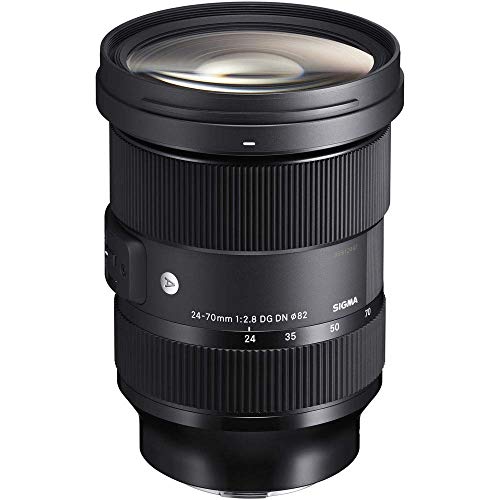
Best for: Travel photographers, event shooters, and hybrid photo/video creators who need one versatile lens that covers wide-angle through short telephoto.
The Sigma 24-70mm f/2.8 DG DN Art is one of the best standard zoom lenses for Sony E mount. It covers a versatile focal range from wide-angle to portrait-length and has a constant f/2.8 aperture that provides excellent low-light performance and depth of field control.
It delivers superb image quality with high sharpness, contrast, color rendition, and bokeh. It also has fast and accurate autofocus with eye-tracking support and optical stabilization with up to four stops of compensation.
This lens is compatible with both full-frame and APS-C Sony E mount cameras. It has a sleek and sturdy design with weather sealing and a brass bayonet mount. It also has a customizable AFL button and a zoom lock switch for convenience.
The Sigma 24-70mm f/2.8 DG DN Art is an ideal choice for anyone who wants a high-performance and versatile zoom lens for their Sony E mount camera.
Sigma 35mm f/1.4 DG DN Art

Best for: Street photographers, documentary shooters, and videographers who want a fast prime with a natural, human-eye perspective and strong low-light capability.
The Sigma 35mm f/1.4 DG DN Art is one of the best prime lenses for Sony E mount. It has a popular focal length that is suitable for various genres such as street photography, landscapes, portraits, weddings, and events.
It has a large f/1.4 aperture that provides outstanding low-light performance and shallow depth of field effects. It delivers exceptional image quality with high sharpness, contrast, color rendition, and bokeh. It also has fast and accurate autofocus with eye-tracking support.
It is compatible with both full-frame and APS-C Sony E mount cameras. It has a sleek and sturdy design with weather sealing and a brass bayonet mount. It also has an aperture ring with click or de-click options and a customizable AFL button.
The Sigma 35mm f/1.4 DG DN Art is an excellent choice for anyone who wants a high-quality and fast prime lens for their Sony E mount camera.
Sigma 16mm f/1.4 DC DN Contemporary

Best for: APS-C Sony camera owners (a6700, ZV-E10, etc.) who shoot landscapes, astrophotography, architecture, or wide-angle video — and want excellent low-light performance at an affordable price point.
The Sigma 16mm f/1.4 DC DN Contemporary is one of the best wide-angle prime lenses for Sony E mount APS-C cameras. It has a popular focal length that is suitable for various genres such as landscapes, architecture, interiors, and astrophotography.
It has a large f/1.4 aperture that provides outstanding low-light performance and shallow depth of field effects. It delivers exceptional image quality with high sharpness, contrast, color rendition, and bokeh. It also has fast and accurate autofocus with eye-tracking support.
This lens is compatible with APS-C Sony E mount cameras. It has a sleek and sturdy design with a metal bayonet mount. It also has an aperture ring with click or de-click options and a customizable AFL button.
The Sigma 16mm f/1.4 DC DN Contemporary is an excellent choice for anyone who wants a high-quality and fast wide-angle prime lens for their Sony E mount APS-C camera.
Sigma 85mm f/1.4 DG DN Art

Best for: Portrait photographers, wedding and event shooters, and fashion photographers who want flattering subject compression, creamy bokeh, and razor-sharp rendering at a price well below comparable Sony G Master glass.
The Sigma 85mm f/1.4 DG DN Art is one of the best portrait lenses for Sony E mount. It has a classic focal length that is suitable for various genres such as portraits, weddings, events, and fashion. It has a large f/1.4 aperture that provides outstanding low-light performance and shallow depth of field effects.
It delivers exceptional image quality with high sharpness, contrast, color rendition, and bokeh. It also has fast and accurate autofocus with eye-tracking support and optical stabilization with up to four stops of compensation.
It is compatible with both full-frame and APS-C Sony E mount cameras. It has a sleek and sturdy design with weather sealing and a brass bayonet mount. It also has an aperture ring with click or de-click options and a customizable AFL button.
The Sigma 85mm f/1.4 DG DN Art is a great choice for anyone who wants a high-quality and fast portrait lens for their Sony E mount camera.
Conclusion
A good Sigma lens can make a big difference in your Sony E mount camera’s performance and image quality. By choosing a lens that suits your needs and expectations, you can enhance your shooting experience and creativity.
Depending on your budget, preferences, and needs, you can choose from the three lenses we recommended above: the Sigma 24-70mm f/2.8 DG DN Art, the Sigma 16mm f/1.4 DC DN Contemporary, or the Sigma 85mm f/1.4 DG DN Art. All of them are compatible with the Sony E mount system and can deliver excellent results.
If you want to learn more about how to choose the best Sigma lenses for your Sony E mount camera or other cameras, you can check out these resources:
Sony E-mount lenses – SIGMA Corporation
Sony E-Mount & A-Mount Lenses | SIGMA Photo – SIGMA Corporation of America
Sigma FE Fullframe E-mount Lenses – Portrait Photographers Miami l …
Remember, the best Sigma lens for your Sony E mount camera is the one that meets your needs and expectations. We hope this article has helped you make an informed decision and improve your photography skills.
Further Reading
(1) Sigma Lenses for Sony E Mount – KEH Camera
Frequently Asked Questions: Sigma Lenses for Sony E Mount
Are Sigma DG DN and DC DN lenses fully compatible with Sony E mount cameras?
Yes. Sigma’s current DG DN (full-frame mirrorless) and DC DN (APS-C mirrorless) lenses are engineered natively for Sony E mount — no adapter is required. They communicate directly with Sony bodies and support key features including real-time eye-tracking AF, aperture control via the camera body, and EXIF data recording. Older Sigma lenses with DSLR mounts (e.g., EF, SA) require a third-party adapter and may have limited AF functionality.
What is the difference between Sigma Art, Contemporary, and Sports lenses?
Sigma Art lenses prioritize maximum optical performance — the sharpest glass, best aberration control, and widest apertures — making them ideal for portrait, landscape, and studio work. Contemporary lenses balance optical quality with smaller size and lower weight, suited for travel and everyday use. Sports lenses are built for reliability in harsh conditions, featuring robust weather sealing, fast AF motors, and optical stabilization for wildlife, action, and outdoor photography.
Do Sigma lenses support Sony’s autofocus features like eye-tracking and subject recognition?
Yes, current Sigma DG DN and DC DN lenses support Sony’s real-time eye-tracking and subject recognition AF on compatible Sony bodies. However, there is one notable limitation: according to Sigma Corporation (2023), third-party lenses including Sigma are firmware-limited to 15fps continuous burst on Sony Alpha sport bodies (such as the a9 III), while native Sony G Master lenses can access the full 30fps capability. For non-sport bodies this limitation does not apply.
Which Sigma lens is best for a beginner with a Sony APS-C camera?
The Sigma 16mm f/1.4 DC DN Contemporary is widely considered the best entry point for APS-C Sony users (such as the a6700 or ZV-E10). It delivers a 24mm full-frame equivalent field of view, an ultra-bright f/1.4 aperture for low-light and indoor shooting, and excellent optical quality — all for approximately $399. It is purpose-built for APS-C and represents outstanding value at its price tier.
How do Sigma Art lenses compare in price to Sony G Master lenses?
Sigma Art lenses typically cost 30–50% less than their Sony G Master counterparts for comparable focal lengths and apertures. For example, according to Sigma Corporation (2023), the Sigma 50mm F1.4 DG DN Art retails for approximately $849 — roughly $450 less than the Sony FE 50mm f/1.4 GM. In independent optical testing, Sigma Art lenses frequently match or exceed G Master performance in sharpness and chromatic aberration control, making them a strong value choice for photographers on a budget.