
Disclosure: As an Amazon Associate, Sony Camera Central earns from qualifying purchases. This post contains affiliate links — we may earn a commission at no extra cost to you.
Macro lenses are specialized lenses that can capture extreme close-up images of small subjects, such as insects, flowers, or jewelry. They can reveal fine details and textures that are invisible to the naked eye, and create stunning images with shallow depth of field and smooth bokeh.
Last updated: April 2026
- Both lenses deliver true 1:1 magnification with fast f/2.8 apertures for professional-grade macro photography.
- Sony lens includes optical stabilization (OSS), while Sigma relies on camera IBIS—a key difference for handheld work.
- Sigma 105mm offers longer working distance (0.295m) versus Sony 90mm (0.28m), reducing subject disturbance.
- Price and weight vary significantly: Sigma costs ~$699–$799 and weighs 715g; Sony costs ~$1,099 and weighs 602g.
- Optical quality is exceptional in both—the Sigma demonstrates superior peripheral sharpness and chromatic aberration suppression.
In this article, we will compare Sony FE 90mm f/2.8 Macro G OSS vs Sigma 105mm f/2.8 DG DN Macro Art Lens in detail and help you decide which one is better for you.
The visual below illustrates both the Sigma 105mm Macro Art and Sony FE 90mm f/2.8 G OSS lenses featured side by side.


Two of the most popular macro lenses for Sony E and Leica L mount cameras are the Sony FE 90mm f/2.8 Macro G OSS and the Sigma 105mm f/2.8 DG DN Macro Art Lens. Both lenses offer a 1:1 magnification ratio, a fast f/2.8 aperture, and a high-quality build and performance.
But how do they compare in terms of features, specifications, image quality, and price? Which one should you buy for your macro photography needs?
How Do These Macro Lenses Compare?
The Sony FE 90mm and Sigma 105mm are both exceptional 1:1 macro lenses, but they differ in optical stabilization, working distance, weight, and price—each designed for different shooting priorities. The table below summarizes the main specifications.
| Feature | Sony FE 90mm f/2.8 Macro G OSS | Sigma 105mm f/2.8 DG DN Macro Art |
| Mount | Sony E, Leica L | Sony E, Leica L |
| Full Frame | Yes | Yes |
| Magnification Ratio | 1:1 (Life-size) | 1:1 (Life-size) |
| Autofocus | Yes (DDSSM) | Yes (HSM) |
| Image Stabilization | Yes (OSS) | No (IBIS only) |
| Lens Construction | 15 elements in 11 groups | 17 elements in 12 groups |
| Aperture / Diaphragm Blades | f/2.8–f/22 / 9 blades | f/2.8–f/22 / 9 blades |
| Minimum Focusing Distance | 0.28m (28cm) | 0.295m (29.5cm) |
| Filter Size | 62mm | 62mm |
| Weight | 602g | 715g |
| Optical Coatings | Multi-coated | Fluorine front element |
| Best For | Handheld macro, low-light work, video stabilization | Studio/tripod work, extreme sharpness, budget-conscious |
| MSRP | ~$1,099 | ~$699–$799 |
Key Differences
Optical Stabilization: According to Sony Electronics Inc. (2015), the Sony FE 90mm f/2.8 Macro G OSS uses a built-in Optical SteadyShot system that stabilizes handheld macro work, especially in low light. The Sigma lens omits internal stabilization, requiring you to rely on your camera’s in-body image stabilization (IBIS) or a tripod.
Working Distance & Focal Length: According to Sigma Corporation (2021), the Sigma 105mm achieves a minimum focus distance of 29.5cm versus the Sony’s 28cm. The slightly longer working distance on the Sigma (105mm vs 90mm focal length) provides ~15% extra space between the front element and your subject—helpful for macro subjects like insects that may flee or be disturbed by the lens approaching too closely.
Weight & Portability: The Sigma lens weighs 715g compared to the Sony’s 602g—a 113g difference. For all-day macro fieldwork, the lighter Sony may reduce fatigue, while the heavier Sigma may feel more robust on a studio rig.
Construction & Special Features: The Sony lens features a focus limiter switch, aperture lock switch, and customizable focus hold button with weather-resistant construction. The Sigma lens includes a fluorine coating on its front element, which repels water and grease, making cleaning easier during outdoor macro sessions.
Which Lens Delivers Superior Image Quality?
Both lenses produce exceptional sharpness and detail, but independent testing reveals subtle optical advantages favoring the Sigma at extreme magnification—particularly in peripheral resolution and aberration control. According to DPReview (2021), the Sigma 105mm F2.8 DG DN Macro Art demonstrates near-flawless suppression of longitudinal chromatic aberration, a rarity for production macro lenses, and outperforms the Sony FE 90mm f/2.8 G in peripheral sharpness.
As shown in the following comparison images, both lenses feature distinctly engineered barrel profiles and control layouts suited to their respective macro shooting approaches.


Sharpness Across the Frame: Both lenses are extremely sharp across the full frame, even at wide-open f/2.8 aperture. Both handle diffraction well up to f/16, maintaining fine detail at stopped-down settings required for extensive depth of field in macro photography.
Bokeh Quality: Both lenses render pleasing bokeh thanks to their fast f/2.8 aperture and 9-blade circular diaphragm. The out-of-focus areas are soft and natural, especially at close focus distances—ideal for isolating tiny subjects from busy backgrounds.
Distortion, Vignetting & Flare: Both lenses exhibit minimal distortion and vignetting, easily corrected in post-processing. Flare resistance is excellent in both, thanks to anti-reflective coatings and included lens hoods.
Sigma 105mm f/2.8 DG DN Macro Art
Best for: Studio & tripod work, maximum sharpness, budget-conscious buyers
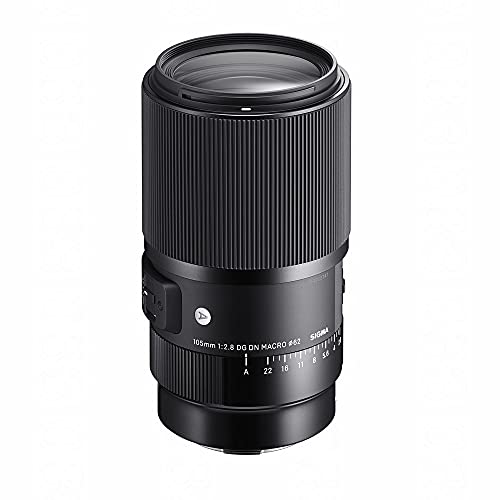
Perspective & Depth of Field: The Sigma’s 105mm focal length creates a slightly more flattering perspective and compression effect for insect or small subject photography, compared to the Sony’s 90mm. This longer focal length also produces a marginally shallower depth of field at the same focus distance—useful for background separation, though both lenses require focus stacking for maximum depth at 1:1 magnification.
Chromatic Aberration Control: The Sigma demonstrates superior control of chromatic aberration—particularly important on high-resolution Sony bodies (like the A7R V) where lens defects become more visible. This makes the Sigma a better choice for ultra-high-resolution macro work.
Sony FE 90mm f/2.8 Macro G OSS
Best for: Handheld macro, video work, low-light environments, travel

Optical Stabilization Advantage: The Sony’s built-in OSS stabilization gives a meaningful advantage in handheld shooting, low-light macro work, and macro video recording. This is particularly valuable when using high-magnification extension tubes or working without a tripod in field conditions.
Which Lens Should You Buy?
The choice depends on your primary use case and budget:
Choose the Sony FE 90mm f/2.8 Macro G OSS if you:
- Shoot handheld macro or macro video frequently
- Work in low-light environments where stabilization is valuable
- Prioritize portability (lighter weight for fieldwork)
- Want reliable autofocus performance with native Sony integration
- Value customizable controls (focus limiter, aperture lock, custom buttons)
Choose the Sigma 105mm f/2.8 DG DN Macro Art if you:
- Primarily use a tripod (studio, product, still-life macro)
- Shoot high-resolution bodies (Sony A7R V, A7R VII) where peripheral sharpness matters
- Have a tight budget and want optical excellence for $300+ less
- Need maximum working distance to avoid disturbing insect subjects
- Prioritize optical performance (sharpness, chromatic aberration control) over convenience features
You might also find our Sony FE 90mm f/2.8 Macro G OSS vs SIGMA 70mm f/2.8 DG MACRO | Art: A Comparison helpful when making your decision.
Both lenses are highly recommended for macro photography enthusiasts who use Sony E or Leica L mount cameras. You can’t go wrong with either of them.
Looking for more? See our detailed Sigma 105mm f/2.8 DG DN Macro vs Sony FE 90mm f/2.8 Macro G OSS: A Comprehensive Comparison review.
Frequently Asked Questions
Q: Can I use extension tubes with these macro lenses?
A: Yes, both lenses support extension tubes for increased magnification beyond 1:1. However, autofocus speed may slow considerably, and the working distance decreases further. For magnifications beyond 2:1, manual focus becomes practical.
Q: Which lens is better for insect photography in the field?
A: The Sony FE 90mm is better for handheld fieldwork due to its built-in optical stabilization and lighter weight. The Sigma 105mm’s longer working distance (29.5cm vs 28cm) is advantageous for skittish insects, but it requires a tripod or camera IBIS for sharp handheld shots.
Q: Do these lenses work on APS-C Sony cameras?
A: Yes, both are full-frame lenses that work on Sony APS-C cameras (a6700, a6000, ZV-E10, etc.), though they will have an effective focal length of 135mm (Sony 90mm) and 157.5mm (Sigma 105mm) due to the 1.5x crop factor.
Q: What is the actual depth of field at 1:1 magnification?
A: At f/2.8 and true 1:1 macro, depth of field shrinks to just 0.5–1mm—requiring manual focus precision or autofocus. At f/8, expect roughly 2–3mm of sharp focus. Most macro photographers use focus stacking (bracketing) to achieve full subject sharpness in post-processing.
Q: Which lens offers better autofocus performance?
A: The Sony uses a DDSSM (Direct Drive SSM) motor for fast, silent autofocus. The Sigma uses an HSM (Hyper Sonic Motor) that is reliable but slightly slower and noisier when racking focus over longer distances. For still subjects, the difference is negligible; for video work, the Sony is quieter.
Which Sony camera fits your shooting style?
Sources:
Sony Electronics Inc. (2015). “Sony FE 90mm f/2.8 Macro G OSS (SEL90M28G) — Full Specifications.” Sony Official Product Page.
Sigma Corporation (2021). “Sigma 105mm F2.8 DG DN MACRO | Art — Official Specifications.” Sigma Corporation Product Page.
DPReview (2021). Carey Rose. “Sigma 105mm F2.8 DG DN Macro | Art Review.” DPReview.