
Disclosure: As an Amazon Associate, Sony Camera Central earns from qualifying purchases. This post contains affiliate links — we may earn a commission at no extra cost to you.
Last updated: April 2026
If you are looking for a wide-angle zoom lens for your Sony E-mount APS-C mirrorless camera, you might be interested in the Tamron 11-20mm f/2.8 Di III-A VC RXD lens — a dedicated APS-C ultra-wide zoom and the world’s first 11-20mm f/2.8 constant-aperture zoom built natively for Sony E-mount mirrorless cameras. Best for: landscape, architecture, interior, and astrophotography photographers shooting on Sony APS-C.
- World’s first: The Tamron 11-20mm f/2.8 Di III-A VC RXD is the first 11-20mm f/2.8 zoom lens designed specifically for APS-C mirrorless cameras.
- Effective range: On Sony APS-C bodies, the 1.5× crop factor produces a 16.5–30mm full-frame equivalent — spanning ultra-wide to moderate wide-angle perspectives.
- Constant f/2.8 aperture: The aperture stays fixed at f/2.8 throughout the entire zoom range, providing consistent exposure and creative control in low-light situations.
- Compact and light: At just 335g with a 67mm filter thread, it is one of the lightest f/2.8 wide-angle zooms available for Sony E-mount APS-C.
- Key trade-offs: No optical image stabilization and noticeable barrel distortion at 11mm are the primary drawbacks to weigh before buying.
This lens claims to be the world’s first 11-20mm f/2.8 zoom lens for APS-C cameras, offering a versatile range of perspectives equivalent to 16.5–30mm in full-frame terms. According to Sidney Ray (2015, Focal Press), Sony APS-C cameras use a 1.5× crop factor relative to full-frame, meaning the 11mm wide end becomes approximately a 16.5mm full-frame equivalent, while the 20mm tele end delivers roughly a 30mm field of view.
It also boasts a fast and constant f/2.8 aperture, which enables better low-light performance, shallow depth of field, and astrophotography potential.
But how does it perform in terms of image quality, build quality, autofocus, and value? Let’s take a look at some of the pros and cons of this lens based on various reviews and sample images.
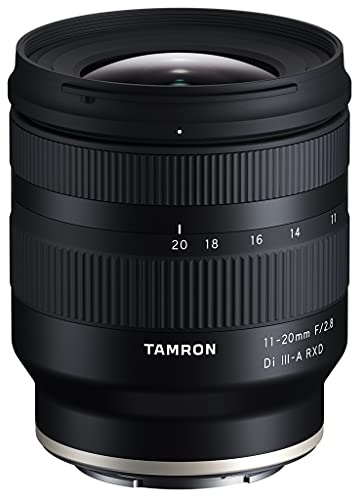
What Are the Pros and Cons of the Tamron 11-20mm f/2.8 Di III-A VC RXD?
The Tamron 11-20mm f/2.8 Di III-A VC RXD excels in optical sharpness, build quality, and aperture speed — but it trades off optical image stabilization and can exhibit barrel distortion at its widest setting. Here is the full breakdown.
Pros
- Compact and lightweight: The Tamron 11-20mm f/2.8 is surprisingly small and light for a lens with such a wide and fast aperture range. It weighs only 335g and has a 67mm filter thread, making it easy to carry around and use with standard filters.
- Fast and constant f/2.8 aperture: It offers a bright maximum aperture that stays constant throughout the zoom range, unlike some other wide-angle zooms that have variable apertures. This gives you more creative control over depth of field and exposure, as well as better performance in low-light situations.
- Impressive overall performance: It delivers sharp and detailed images across the frame and throughout the zoom range, with minimal distortion, chromatic aberration, vignetting, or flare. The lens also has a fast and quiet autofocus system that works well with Sony’s eye and face detection features. The lens also features weather-seals and a fluorine coating to protect it from dust, moisture, and fingerprints.
Cons
- Heavy distortion at 11mm: The Tamron 11-20mm f/2.8 exhibits noticeable barrel distortion at the widest end of the zoom range, which can be corrected in post-processing or by using the lens profile in-camera or in software. However, some users might prefer a more rectilinear rendering of straight lines and edges at this focal length.
- No optical stabilizer: It does not have an optical image stabilizer built into the lens, which means you will have to rely on your camera’s in-body stabilization (if available) or use a tripod to avoid camera shake at slower shutter speeds. This might be an issue for some users who want to shoot handheld video or stills in low-light conditions or at longer focal lengths.
- Pretty pricey: It is not a cheap lens. It is more expensive than some other wide-angle zoom options for Sony E-mount APS-C cameras, such as the Sony E 10-18mm F4 OSS (Best for: video shooters and travelers who prioritize built-in optical stabilization in a lighter package) or the Sigma 10-20mm F3.5 EX DC HSM (Best for: budget-conscious photographers comfortable with a slightly slower maximum aperture). However, the Tamron lens does offer a faster aperture and better build quality than these alternatives.
How Does the Tamron 11-20mm Compare to Alternatives?
The Tamron 11-20mm f/2.8 Di III-A VC RXD wins on aperture speed and weather sealing, while the Sony E 10-18mm F4 OSS leads on weight and built-in stabilization. The table below outlines the key differences side by side.
| Lens | Focal Length (APS-C) | FF Equivalent* | Max Aperture | Optical Stabilization | Weather Sealed | Weight | Filter Thread | Best For |
|---|---|---|---|---|---|---|---|---|
| Tamron 11-20mm f/2.8 Di III-A VC RXD | 11–20mm | ~16.5–30mm | f/2.8 (constant) | No | Yes | 335g | 67mm | Landscape, architecture, astrophotography |
| Sony E 10-18mm F4 OSS | 10–18mm | ~15–27mm | f/4 (constant) | Yes (OSS) | No | 225g | 62mm | Handheld video, travel, lightweight kits |
| Sigma 10-20mm F3.5 EX DC HSM | 10–20mm | ~15–30mm | f/3.5 (constant) | No | No | ~520g | 82mm | Budget-focused wide-angle shooting |
*Full-frame equivalent focal lengths calculated using Sony APS-C’s 1.5× crop factor (Sidney Ray, 2015, Focal Press).
Should You Buy the Tamron 11-20mm f/2.8 Di III-A VC RXD?
Yes — the Tamron 11-20mm f/2.8 Di III-A VC RXD is a simply superb ultra-wide zoom lens for Sony E-mount APS-C mirrorless cameras, and it earns that recommendation by combining a versatile zoom range with a fast and constant aperture, delivering excellent image quality, autofocus performance, and weather resistance in a package that weighs just 335g.
It is compact and lightweight enough to carry around for landscape, architecture, interior, or astrophotography purposes.
The only drawbacks are the lack of optical stabilization and the noticeable distortion at 11mm, which might not bother some users but could be deal-breakers for others. The price is also on the high side compared to some competitors, but you do get what you pay for in terms of quality and features.
Further Reading
(1) Tamron 11-20mm f/2.8 Di III-A RXD review | Digital Camera World
(2) Tamron 11-20mm F2.8 Di III-A RXD Review | PCMag
(3) Tamron 11-20mm F2.8 Di III-A RXD sample gallery
(4) Tamron 11-20mm f/2.8 Di III-A RXD Lens (Sony E) – B&H Photo Video
Frequently Asked Questions
Does the Tamron 11-20mm f/2.8 Di III-A VC RXD have image stabilization?
No. The Tamron 11-20mm f/2.8 Di III-A VC RXD does not include optical image stabilization (OIS). You will need to rely on your Sony camera’s in-body image stabilization (IBIS) — available on bodies such as the Sony a6700 — or use a tripod when shooting at slower shutter speeds.
What is the full-frame equivalent focal range of the Tamron 11-20mm on a Sony APS-C camera?
On any Sony APS-C mirrorless camera, the Tamron 11-20mm f/2.8 covers a full-frame equivalent range of approximately 16.5–30mm. This is a direct result of the 1.5× crop factor that all Sony APS-C sensors apply to lens focal lengths (Sidney Ray, 2015, Focal Press).
How does the Tamron 11-20mm f/2.8 compare to the Sony E 10-18mm F4 OSS?
The Tamron 11-20mm f/2.8 is the better choice for low-light stills and astrophotography thanks to its faster f/2.8 aperture and weather sealing. The Sony E 10-18mm F4 OSS is the better choice for handheld video or travel photography, as it is lighter (225g vs 335g) and includes built-in optical stabilization. See the comparison table above for a full side-by-side breakdown.
Is the Tamron 11-20mm f/2.8 suitable for astrophotography?
Yes. The constant f/2.8 aperture and ultra-wide focal range make the Tamron 11-20mm an effective option for astrophotography on Sony APS-C cameras. The 11mm wide end maximizes the sky coverage in each frame, while the fast aperture collects significantly more light than f/4 alternatives at the same ISO and shutter speed settings.
Which Sony APS-C cameras is the Tamron 11-20mm f/2.8 Di III-A VC RXD compatible with?
The lens is designed for Sony E-mount APS-C mirrorless cameras, including the Sony a6700, a6600, a6500, a6400, a6300, and ZV-E10. It can be physically mounted on full-frame Sony E-mount bodies, but the camera will automatically engage APS-C crop mode, narrowing the effective field of view.