
Disclosure: As an Amazon Associate, Sony Camera Central earns from qualifying purchases. This post contains affiliate links — we may earn a commission at no extra cost to you.
These lenses are two superzoom lenses for Sony E-mount mirrorless cameras with full-frame coverage. In this comparison, we will look at the main features, and pros and cons of Tamron 28-200mm f/2.8-5.6 Di III RXD vs Sony FE 24-240mm f/3.5-6.3 OSS, based on various sources¹²³. So keep reading!
Last updated: April 2026
KEY TAKEAWAYS
- Aperture & Speed: Tamron 28-200mm has a faster f/2.8 maximum aperture for better low-light performance; Sony 24-240mm offers longer reach (24–240mm vs 28–200mm).
- Image Stabilization: Sony FE 24-240mm includes optical stabilization (OSS); Tamron 28-200mm lacks this, but is lighter and more portable.
- Durability: Tamron features weather sealing; Sony does not, giving the Tamron an edge for outdoor and travel photography.
- Best Use Case: Choose Tamron for compact travel and fast aperture; choose Sony for extended telephoto range and stabilized video.

Tamron 28-200mm f/2.8-5.6 Di III RXD (Best for: Travel, fast aperture work, weather-sealed durability) and Sony FE 24-240mm f/3.5-6.3 OSS (Best for: Extended telephoto reach, stabilized shooting, all-in-one versatility) offer a versatile focal length range that covers wide-angle to telephoto perspectives, suitable for a variety of scenes and subjects.
However, they have different aperture ratings, optical designs, autofocus systems and features that may affect their performance and suitability for different needs and preferences.
Introduction
The Tamron 28-200mm f/2.8-5.6 Di III RXD was announced in June 2020 as a compact, lightweight and travel-friendly superzoom lens for Sony E-mount cameras. It is part of Tamron’s Di III series of lenses, which are designed specifically for mirrorless cameras with full-frame sensors.
This lens has a mixture of versatility and speed that makes it an ideal choice for photographing beautiful vistas, distinctive architecture, notable street scenes and more. It has a relatively fast maximum aperture that provides consistent exposure and depth of field control throughout the zoom range.
The visual below illustrates the Sony FE 24-240mm f/3.5-6.3 OSS, a full-frame superzoom offering a 10x zoom range with built-in optical stabilization.
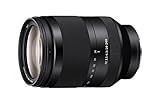
The Sony FE 24-240mm f/3.5-6.3 OSS was announced in February 2015 as a superzoom lens for Sony E-mount cameras with full-frame or APS-C sensors. It has a longer zoom range than the Tamron 28-200mm, covering a wider angle of view at the short end (24mm vs 28mm) and a more powerful telephoto reach at the long end (240mm vs 200mm). It also has optical image stabilization (OSS) to reduce camera shake and blur. It is part of Sony’s G series of lenses, which are designed to deliver high image quality and performance.
Features
| Feature | Tamron 28-200mm | Sony FE 24-240mm |
| Mount | Sony E (FE) | Sony E (FE) |
| Full Frame | Yes | Yes |
| Autofocus | Yes | Yes |
| Image Stabilization | No | Yes (OSS) |
| Lens Construction | 18 elements in 14 groups | 17 elements in 12 groups |
| Special Elements | Hybrid aspherical element, LD (Low Dispersion) element, XLD (eXtra Low Dispersion) element, GM (Glass Molded Aspherical) element, BBAR (Broad-Band Anti-Reflection) coating | Five aspherical elements, one ED (Extra-low Dispersion) element |
| Angle of View | 75.3-12.3 degrees | 84-10 degrees |
| Diaphragm Blades | 7 | 7 |
| Minimum Aperture | f/16-32 | f/22-40 |
| Minimum Focusing Distance | 0.19m (W) 0.8m (T) | 0.5m (W) 0.8m (T) |
| Maximum Magnification Ratio | 0.32x (W) 0.26x (T) | 0.27x |
| Filter Size | 67mm | 72mm |
| Dimensions | 74 x 117mm | 80 x 119mm |
| Weight | 575g | 780g |
| Weather Sealing | Yes | No |
| Lens Hood Included | Yes | Yes |
Pros and Cons of Tamron 28-200mm f/2.8-5.6 Di III RXD vs Sony FE 24-240mm f/3.5-6.3 OSS
Tamron 28-200mm
The Tamron 28-200mm is a compact, lightweight superzoom ideal for photographers who prioritize portability, fast aperture performance, and weather durability.
The lens pictured here demonstrates the Tamron 28-200mm’s weather-sealed black barrel and compact 574g form factor suited for travel.
| Pros | Cons |
| Compact and lightweight (575g) | No optical image stabilization |
| Relatively fast aperture rating (f/2.8–5.6) | Comparatively limited wide-angle potential (starts at 28mm) |
| Impressive image quality for a zoom lens | Some autofocus issues reported by some users |
| Weather-sealed construction | Some distortion and vignetting at wide-angle settings |
| Close focusing distance (0.19m at wide end) | |
| Fast and quiet autofocus system | |
| Affordable price |
Sony FE 24-240mm
The Sony FE 24-240mm is a versatile all-in-one superzoom designed for photographers seeking extended telephoto reach, image stabilization, and broad focal length coverage without changing lenses.
Conclusion
The Tamron 28-200mm f/2.8-5.6 Di III RXD and the Sony FE 24-240mm f/3.5-6.3 OSS are both capable superzoom lenses for Sony E-mount photographers who need a versatile and flexible lens for various situations and subjects. They both offer good image quality and performance overall, but they also have some differences that may make one more suitable than the other for different needs and preferences.
Choose the Tamron 28-200mm f/2.8-5.6 Di III RXD if you prioritize: a faster maximum aperture that provides consistent exposure and depth of field control throughout the zoom range, better low-light performance, compact and lightweight design, weather-sealed construction for durability, closer focusing distance for macro-style work, and an affordable price point.
Choose the Sony FE 24-240mm f/3.5-6.3 OSS if you prioritize: a longer zoom range that covers a wider angle of view at the short end and more powerful telephoto reach, optical image stabilization that reduces camera shake and blur especially at longer focal lengths and slower shutter speeds, and a reliable autofocus system that works seamlessly with Sony’s eye AF and tracking modes.
However, neither of these lenses can match the image quality or performance of dedicated prime or zoom lenses with shorter focal length ranges, so you may want to consider other options if you are looking for the best possible results in terms of sharpness, contrast, distortion, aberration or bokeh.
Frequently Asked Questions
Q: Which lens is better for video recording?
A: The Sony FE 24-240mm is better for video due to its optical image stabilization (OSS), which reduces the appearance of handheld camera shake. The Tamron lacks stabilization, though users can rely on in-body image stabilization if their camera supports it.
Q: Which lens is more portable for travel photography?
A: The Tamron 28-200mm is significantly more portable — it weighs 575g versus the Sony’s 780g — and measures slightly smaller. It also features weather sealing, making it more durable in variable outdoor conditions.
Q: Does the Tamron have optical stabilization?
A: No, the Tamron 28-200mm does not include optical image stabilization. It relies on the camera body’s in-body image stabilization (IBIS) if available.
Q: What is the difference in zoom range between these lenses?
A: The Sony FE 24-240mm offers a 10x zoom (24–240mm), while the Tamron 28-200mm offers a 7.1x zoom (28–200mm). The Sony provides wider wide-angle coverage and more telephoto reach, while the Tamron starts at a tighter 28mm but is more compact.
Q: Which lens is sharper?
A: Both lenses deliver solid image quality typical of superzoom designs. Neither outperforms dedicated prime or shorter-range zoom lenses. Sharpness is largely comparable between the two across their zoom ranges.