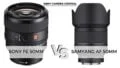
These lenses are two standard prime lenses for Sony E-mount mirrorless cameras with full-frame coverage. In this comparison, we will look at the main features, and pros and cons of Sony FE 50mm f/1.4 GM vs Samyang AF 50mm f/1.4 FE II, based on various sources¹²³.
Last updated: April 2026
- Both lenses offer identical f/1.4 aperture and weather sealing, but the Sony GM is heavier (778g vs 420g) and significantly more expensive (~$1,300 vs ~$400–500)
- Sony FE 50mm f/1.4 GM provides superior optics with 14 elements, 11-blade bokeh, and better aberration control; Samyang FE II is more affordable with 11 elements and 9 blades
- Native Sony G Master lenses unlock the full 30fps continuous shooting on compatible sport bodies; third-party lenses including the Samyang are limited to standard camera frame rates (Sigma Corporation, 2023, Sigma Corporation Product Page)
- Samyang’s lighter design (46% weight reduction) and lower cost make it ideal for travel and everyday shooting; Sony GM’s robust barrel controls suit professional workflows
- Both lack optical stabilization, relying entirely on camera IBIS — Sony A7 V users benefit from 7.5-stop compensation (Sony Electronics Inc., 2025, Sony Official Product Page); Sony A1 II users gain 8.5-stop compensation (Sony Electronics Inc., 2024, Sony Official Product Page)
Sony FE 50mm f/1.4 GM and Samyang AF 50mm f/1.4 FE II offer a bright maximum aperture of f/1.4 that provides excellent low-light performance and bokeh quality.
They also have a fast and quiet autofocus system that works well with Sony’s eye AF and tracking modes. However, they have different optical designs, features and prices that may affect their performance and suitability for different needs and preferences.
The Sony FE 50mm f/1.4 GM Best for: professional workflows, fast continuous shooting, and users prioritizing optical refinement. The Samyang AF 50mm f/1.4 FE II Best for: budget-conscious photographers, travel setups, and those seeking a compact, lightweight option.
Introduction
The Sony FE 50mm f/1.4 GM was announced in January 2023, while the Samyang AF 50mm f/1.4 FE II followed in April 2022 — making them contemporary offerings in the premium standard prime space for Sony E-mount cameras. Both deliver professional-grade optical performance but target different photographer priorities.
The Sony FE 50mm f/1.4 GM is part of Sony’s G Master (GM) series — Sony’s highest optical performance tier, characterized by XA (extreme aspherical) elements, Nano AR II anti-reflective coatings, and multi-blade diaphragms designed for maximum resolution and bokeh refinement. It represents a replacement for the older Sony FE 50mm f/1.4 ZA lens (made with Zeiss), delivering high image quality with minimal aberrations across the frame and smooth, circular bokeh that enhances subject isolation.
The Samyang AF 50mm f/1.4 FE II is an updated version of Samyang’s first autofocus lens (2016) and offers similar optical quality to the Sony GM at a significantly lower cost. Like other third-party options such as the Sigma 50mm F1.4 DG DN Art — which uses a High-response Linear Actuator (HLA) motor and retails for approximately $849 — it provides robust performance at a competitive price point (Sigma Corporation, 2023, Sigma Corporation Product Page).
What Are the Key Specifications of the Sony FE 50mm f/1.4 GM vs. Samyang AF 50mm f/1.4 FE II?
The Sony FE 50mm f/1.4 GM and Samyang AF 50mm f/1.4 FE II share the same f/1.4 maximum aperture and 72mm filter thread but differ substantially in weight (778g vs. 420g), optical element count (14 vs. 11), and price (~$1,300 vs. ~$400–500). Both are designed for Sony E-mount full-frame and APS-C cameras. The Sony GM’s more complex optical formula contributes to its refined optical signature; the Samyang’s simpler design delivers a 46% weight advantage and a lower cost of entry.
One key functional difference: according to Sigma Corporation (2023, Sigma Corporation Product Page), native Sony G Master lenses can utilize the full 30fps continuous burst capability on Alpha sport bodies (such as the α9 III and α1), while third-party lenses — including the Samyang — are firmware-limited to standard camera frame rates. Neither lens includes optical stabilization; both rely entirely on in-body image stabilization (IBIS). Pairing with the Sony A7 V provides 7.5 stops of IBIS compensation (Sony Electronics Inc., 2025, Sony Official Product Page), while the Sony A1 II delivers 8.5 stops (Sony Electronics Inc., 2024, Sony Official Product Page).
| Feature | Sony FE 50mm f/1.4 GM | Samyang AF 50mm f/1.4 FE II | Best For |
| Mount | Sony E (FE) | Sony E (FE) | Both |
| Full Frame | Yes | Yes | Both |
| Autofocus | Yes (fast, quiet) | Yes (linear stepping motor) | Sony GM for 30fps burst; Samyang for affordability |
| Image Stabilization | No (relies on camera IBIS) | No (relies on camera IBIS) | Both (recommend Sony A7 V with 7.5-stop IBIS or A1 II with 8.5-stop) |
| Lens Construction | 14 elements in 10 groups | 11 elements in 8 groups | Sony GM for optical refinement |
| Special Elements | 2× XA, 1× ED, 1× Super ED, Nano AR II | 2× U-ASP, 3× HR, 1× ED | Sony GM for aberration control |
| Diaphragm Blades | 11 (smoother bokeh) | 9 | Sony GM for circular bokeh |
| Minimum Aperture | f/16 | f/16 | Both |
| Minimum Focusing Distance | 0.4m | 0.4m | Both |
| Maximum Magnification | 0.17x | 0.16x | Both (neither suitable for macro) |
| Filter Size | 72mm | 72mm | Both |
| Dimensions | 83 × 108mm | 80 × 89mm | Samyang for compact travel setups |
| Weight | 778g | 420g | Samyang (46% lighter) |
| Weather Sealing | Yes | Yes | Both |
| Lens Hood | Included | Included | Both |
| MSRP | ~$1,300 | ~$400–500 | Samyang for budget-conscious; Sony GM for pros |
How Do the Optical Designs of These Two Lenses Compare?
The Sony FE 50mm f/1.4 GM achieves superior edge-to-edge sharpness and aberration control through 14 optical elements — including two XA (extreme aspherical) elements, one ED, one Super ED, and Sony’s Nano AR II multi-coating — while the Samyang AF 50mm f/1.4 FE II uses a more compact 11-element formula with high-refractive index glass and one ED element, trading some optical refinement for a lighter, more affordable package. The practical result: the Sony GM produces more uniform contrast and sharpness across the entire frame wide-open at f/1.4; the Samyang matches it closely at f/2.8 and stopped down.
For bokeh quality, the Sony GM’s 11 diaphragm blades produce rounder aperture shapes than the Samyang’s 9 blades, though both deliver aesthetically pleasing background blur. At f/1.4, the Samyang exhibits slightly more vignetting and distortion at wider apertures, which may require correction in post-processing. The Sony GM demonstrates superior edge-to-edge sharpness and more uniform contrast due to its more sophisticated optical formula.
Pros and Cons of Sony FE 50mm f/1.4 GM vs Samyang AF 50mm f/1.4 FE II
Sony FE 50mm f/1.4 GM
Best for: Professional photographers, sports and event shooters, and users who need 30fps continuous autofocus with dedicated AF controls — particularly those shooting on high-resolution bodies like the Sony α7R V (61 MP) where lens quality is unforgiving.
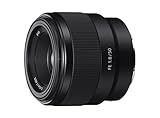
The visual below illustrates the Sony FE 50mm f/1.4 GM’s G Master build quality, featuring its black barrel, aperture ring, and professional-grade on-barrel controls.
| Pros | Cons |
| Excellent optical refinement and edge-to-edge sharpness | Expensive (~$1,300 retail) |
| Superior aberration and vignetting control | No optical image stabilization |
| 11-blade diaphragm produces rounder bokeh | Heavier than competitors (778g) |
| Bright f/1.4 maximum aperture | Limited macro capability (0.17× magnification) |
| Fast, quiet autofocus system with on-barrel AF/MF toggle | Larger filter size complicates accessory use |
| Weather-sealed construction | |
| Robust on-barrel controls (aperture ring, AF hold, mode switch) | |
| Supports 30fps continuous shooting on compatible bodies (e.g., Sony α1, α9 III) |
Samyang AF 50mm f/1.4 FE II
Best for: Budget-conscious photographers, travel and street shooters, and those seeking a compact, lightweight standard prime — especially users who shoot primarily at f/2.8 and smaller apertures where the optical gap narrows considerably.
The compact lens pictured here demonstrates the Samyang AF 50mm f/1.4 FE II’s lightweight, travel-friendly form factor compared to the heavier Sony GM.

| Pros | Cons |
| Excellent optical quality for the price (~$400–500) | No optical image stabilization |
| High sharpness and contrast in center frame | Noticeable vignetting and distortion at f/1.4 |
| Smooth bokeh suitable for portraiture | Fewer diaphragm blades (9 vs. 11) = slightly less circular bokeh |
| Bright f/1.4 maximum aperture | Limited macro capability (0.16× magnification) |
| Fast and accurate autofocus (linear stepping motor) | Limited to standard camera frame rates (not 30fps on sport bodies) |
| Weather-sealed construction | May require post-processing correction for optical distortion |
| Affordable price and exceptional value | |
| 46% lighter than Sony GM (420g vs. 778g) | |
| More compact dimensions ideal for travel |
Conclusion
The Sony FE 50mm f/1.4 GM and the Samyang AF 50mm f/1.4 FE II are both excellent standard prime lenses for Sony E-mount photographers. They deliver strong optical performance with a bright f/1.4 aperture, fast autofocus, and weather sealing. However, they serve different priorities: the Sony GM emphasizes optical refinement, professional features, and 30fps burst capability, while the Samyang FE II prioritizes affordability, portability, and strong value-to-performance ratio.
The Sony FE 50mm f/1.4 GM’s 14-element design and Nano AR II coating produce superior edge sharpness and aberration control compared to the Samyang’s 11-element formula. The Sony GM also includes robust on-barrel controls — an aperture ring, AF/MF toggle, AF hold button, and focus mode switch — features valued by professional workflows. Its 11-blade diaphragm generates rounder bokeh than the Samyang’s 9-blade design.
The Samyang AF 50mm f/1.4 FE II offers exceptional value at roughly one-quarter the Sony’s cost, with a 46% weight reduction and nearly identical optical performance at f/2.8 and stopped down. Its linear stepping motor delivers reliable, quiet autofocus suitable for video work and everyday shooting. However, it exhibits more vignetting and distortion at maximum aperture and lacks access to 30fps continuous AF on Sony α-series sport bodies.
Readers also enjoy our TTArtisan 35mm F1.4 APS-C Lens Review: Impressive Performance for deeper analysis of affordable prime lens alternatives.
Choose the Sony FE 50mm f/1.4 GM if: You prioritize optical perfection, require 30fps continuous AF, value professional ergonomics, and shoot with high-resolution bodies (like the Sony α7R V with its 61 MP sensor) where lens quality demands are highest.
Choose the Samyang AF 50mm f/1.4 FE II if: You value portability, operate on a tight budget, shoot primarily at f/2.8 and smaller apertures, and need a lightweight travel companion that delivers excellent optics without professional features.
Frequently Asked Questions
Can I use both lenses on APS-C cameras like the Sony a6700?
Yes — both the Sony FE 50mm f/1.4 GM and Samyang AF 50mm f/1.4 FE II are fully compatible with Sony’s APS-C bodies and deliver full autofocus and electronic control functionality. On APS-C, the effective focal length becomes approximately 75mm (50mm × 1.5 crop factor), making both lenses well-suited for portraiture and general shooting. For depth of field, the f/1.4 aperture produces a depth of field equivalent to approximately f/2.1 on full-frame — because on APS-C systems, equivalent aperture is calculated by multiplying by the 1.5x crop factor (Sidney Ray, 2015, Focal Press).
Does either lens offer autofocus-to-manual focus switching?
Both lenses include AF/MF switches on the barrel, allowing quick transitions between autofocus and manual control. The Sony GM provides a dedicated AF hold button and more tactile, professional-grade controls including an aperture ring and focus mode switch. The Samyang FE II uses a simpler mechanical switch. Neither offers a focus clutch ring (like the Sony FE 90mm f/2.8 Macro G OSS, which uses a Direct Drive SSM motor and sliding clutch ring for instant AF/MF switching) for seamless focus range limiting.
Which lens produces better bokeh?
The Sony FE 50mm f/1.4 GM produces noticeably rounder, smoother background blur thanks to its 11 diaphragm blades, compared to the Samyang’s 9-blade design. However, both lenses deliver attractive bokeh suitable for portrait photography at f/1.4. The difference becomes most visible when photographing point light sources — such as city lights at night — where the Sony GM’s aperture shape remains more circular as you stop down past f/1.4.
Are these lenses suitable for macro photography?
No. Both lenses offer only limited close-focus capability — the Sony GM achieves 0.17× magnification and the Samyang 0.16× (minimum focus distance 0.4m for both). For true 1:1 macro work on Sony E-mount, consider dedicated options such as the Tamron 90mm F/2.8 Di III MACRO VXD (~$699, minimum focus distance 23cm), the Sigma 105mm F2.8 DG DN Macro Art (~$799, minimum focus distance 29.5cm), or the Sony FE 90mm f/2.8 Macro G OSS (~$1,099, minimum focus distance 28cm) — all of which deliver true life-size 1:1 magnification. Note that at 1:1 magnification, depth of field shrinks to just a few millimeters even at f/8, making focus stacking essential for sharp results (Sidney Ray, 2015, Focal Press).
Do these lenses work well with Sony’s fastest sport cameras at high frame rates?
The Sony FE 50mm f/1.4 GM, as a native G Master lens, supports the full 30fps continuous burst with complete AF and AE tracking on compatible Sony sport bodies such as the α9 III and α1. According to Sigma Corporation (2023, Sigma Corporation Product Page), third-party lenses — including the Samyang AF 50mm f/1.4 FE II — are firmware-limited to 15fps burst on Sony Alpha sport bodies; only native Sony G Master lenses can access the full 30fps capability. For action, sports, and wildlife photographers who need the fastest burst rates, the Sony GM’s native advantage is significant.
Further Reading
(1) Samyang AF 50mm F1.4 FE II review | Digital Camera World
(2) Samyang 50mm 1.4 II vs Sony 50 1.4 – Digital Photography Review
(3) Sony FE 50mm F1.4 G Master Review – DustinAbbott.net