How I Think About Aperture (It’s Really About Working Distance)
The question I get most often is: what aperture for food? My real answer, pulled from 31 actual frames spanning 2018 to 2024: f4 is my most-used stop, median f3.2, never past f5.6. Not because I’m avoiding bokeh — because aperture on food is really a working-distance decision, not a depth-of-field one.
At 90mm on the a7 III, f3.2 puts me far enough back that I can position a fork, adjust a garnish, and keep my hand out of the frame without rearranging the whole scene. If I drop to f1.4 at that distance, the plane of acceptable sharpness becomes a liability — the raised rim of a ceramic plate falls soft before the food does. If I climb to f8, I’m spending two stops of light I don’t have indoors, for diffraction I don’t want, for depth I didn’t need.
When You Flatten the Angle, the Rules Change

The moment I go full overhead, depth of field stops being a selective-focus tool and becomes a texture decision. Everything on the plate is the same distance from the sensor, so f1.8 at 35mm softens the background rather than splitting the subject. Here it also kept my shutter fast enough to stop any wobble from a handheld position directly above the plate. The white ridged plate reads as geometry; the sauce is color and contrast. I’m not thinking about focus planes at this angle — I’m thinking about what fills the frame.

As soon as there’s depth in the subject — a pan that’s twelve inches deep, a spread of objects across a cutting board — I climb back to f4. At 32mm that gives me enough depth to hold the near lip of the pan and the far edge in the same plane of sharpness, while still rendering the background loose enough that it doesn’t compete.
Stop Fighting ISO Indoors


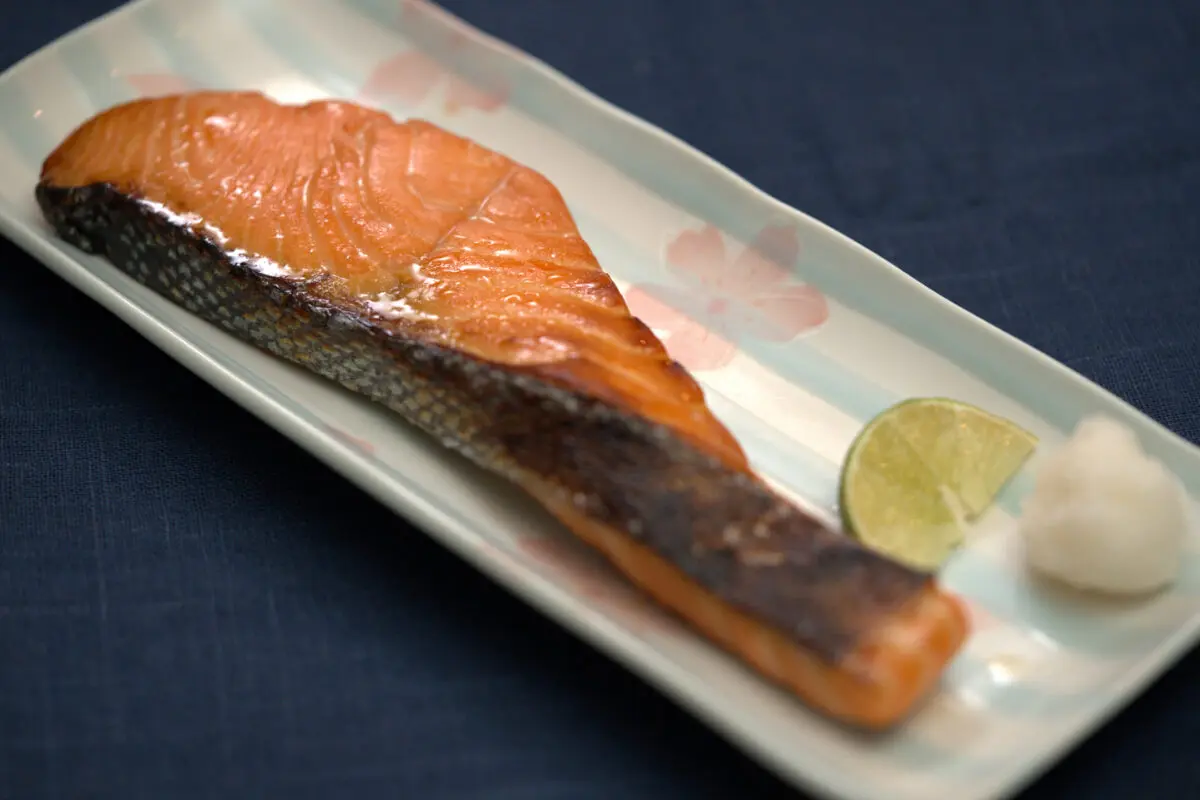
These two frames are what good light looks like: ISO 100, f1.4 because I wanted the look, not because I needed it. That’s the distinction I try to stay clear on. When the light is actually there, fast apertures become an expressive tool. When the light isn’t there — which is most indoor kitchens, most of the time — I let ISO ride. My median across all 31 frames is ISO 1000. The salmon above was ISO 2500, one south-facing window, July afternoon. I didn’t add a reflector or move the plate closer to the glass. The a7 III’s sensor handles it; fighting it with a slower shutter or a narrower aperture just creates motion blur or diffraction.
Focal Length Sets the Story Before You Press the Shutter

I shoot most food at 24mm because it tells a table story: the linen, the glass of water beside the bowl, the cutting board in the background. Those details establish place. At 35mm I’m telling a dish story — the sauce color, the herb scatter, the ridged ceramic edge. The switch between focal lengths is the same as a decision about how much context the viewer needs.


The two corn frames make this concrete. At 32mm, f4, the bowl is the subject; props behind it soften into color. At 16mm, f5.6, I’m documenting a workspace — the stripper tool, the salt cellar, the marble counter. Neither frame is wrong. But I had to decide which story to tell before I picked the focal length, or I’d have spent an hour bracketing everything.
Place Focus on the Nearest Interesting Edge


At f1.8 on an overhead, even with a flat plane, the near edge of the subject sharpens first and the eye follows. I put my focus point there deliberately — not on center, not on the label, but on whatever texture or color reads as the entry point. At f4 the depth is more forgiving, but “forgiving” doesn’t mean “let the camera decide.” I still select a point. Autofocus in food photography is a draft; focus point selection is the edit.
Color Separation Does More Work Than Composition

The persimmons on a gray surface at f1.4. The warm orange against the cool neutral does more compositional work than any rule-of-thirds placement. When I set up this frame I was looking for color separation before I thought about geometry. The bokeh on the background fruits is a bonus — what actually makes the foreground persimmon read as a subject is that nothing nearby competes with it in color temperature or brightness.
That’s the mental edit I run before raising the camera: does the subject own its color space? If something in the background is close in hue and brightness to the subject, I move the subject, flag the light, or change my angle until it isn’t. Aperture, ISO, and focal length are all downstream of that call.