Disclosure: As an Amazon Associate, Sony Camera Central earns from qualifying purchases. This post contains affiliate links — we may earn a commission at no extra cost to you.
Sony's top wide-angle lenses for landscape photography in 2026 include the ultra-compact E PZ 10-20mm F4 G, versatile FE 16-35mm F2.8 GM II, stabilized E 10-18mm F4 OSS, sharp FE 24mm F1.4 GM prime, value-packed FE 20mm F1.8 G, premium FE 16-35mm F2.8 GM, and the new FE 16-25mm F2.8 G. You'll find options for every budget and need, from lightweight travel companions to professional-grade optics. Discover which lens will elevate your landscape portfolio below.
Last updated: April 2026
- The FE 16-35mm F2.8 GM II is Sony's lightest full-frame F2.8 wide-angle zoom and the top pick for professionals balancing portability with G Master (Sony's highest-tier professional lens series) image quality.
- APS-C shooters have two dedicated wide-angle options: the E PZ 10-20mm F4 G (smooth power zoom, video-optimized) and the E 10-18mm F4 OSS (built-in optical stabilization for handheld work).
- Fast primes like the FE 24mm F1.4 GM and FE 20mm F1.8 G are essential for astrophotography and low-light landscapes where f/4 zooms require compromising ISO or shutter speed.
- According to DPReview Staff (2022, DPReview), Sony's high-resolution full-frame sensors demand sharp, high-quality glass — Sony G Master lenses are engineered to resolve the full potential of 61 MP and higher sensors without introducing softness.
- Sony's APS-C 1.5× crop factor narrows each lens's field of view — a 10mm ultra-wide frames like a 15mm on full-frame, so always factor this in when selecting focal lengths for APS-C bodies (Sidney Ray, 2015, Focal Press).
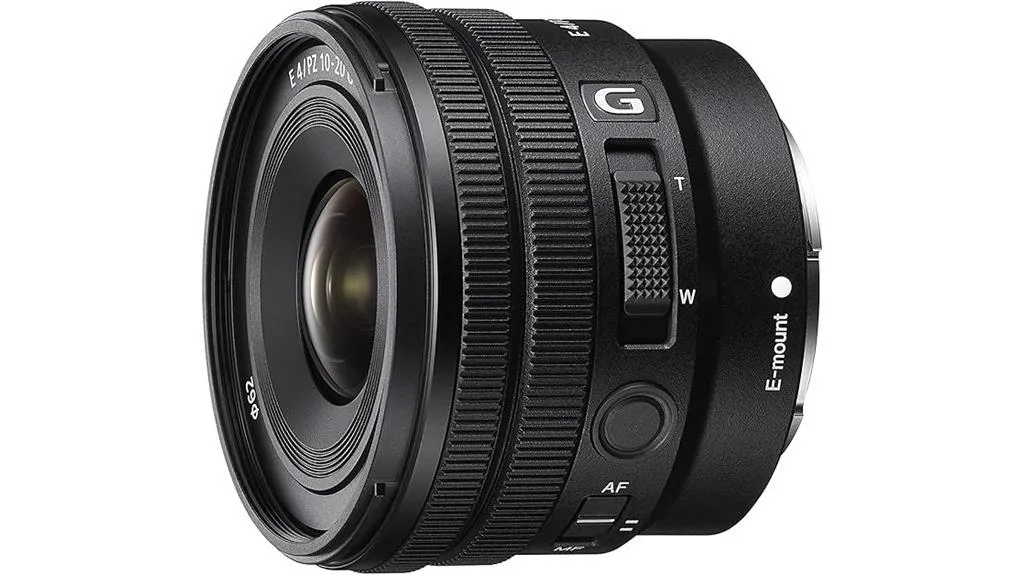
Sony E PZ 10-20mm F4 G APS-C Constant-Aperture Power Zoom G Lens

Landscape photographers seeking exceptional portability will find their match in Sony's ultra-compact E PZ 10-20mm F4 G lens. Weighing just 6.3 ounces, it's the lightest in its class while delivering impressive sharpness across its range.
The internal zoom mechanism maintains consistent length while shooting, making it ideal for handheld landscape work. Its two linear motors guarantee quick, quiet autofocus that tracks effectively in challenging conditions.
Though it lacks image stabilization, the lens compensates with superior optical performance, minimal focus breathing, and smooth power zoom capabilities perfect for both stills and 4K/8K video. You'll appreciate its versatility whether capturing vast mountain ranges or intimate forest scenes.
Best For: Landscape photographers and vloggers using Sony APS-C bodies (such as the a6700 or ZV-E10) who need a lightweight, ultra-wide angle power zoom that delivers exceptional sharpness and smooth, motorized zoom control for both stills and 4K video.
Pros:
- Incredibly lightweight (6.3 ounces) and compact design makes it ideal for travel and handheld shooting
- Internal zoom mechanism maintains consistent lens length while the power zoom provides smooth, shake-free adjustments
- Fast, quiet autofocus with two linear motors ensures reliable subject tracking for both stills and video
Cons:
- Lacks built-in image stabilization, requiring steady hands or a tripod in low light conditions
- Limited to APS-C camera bodies, not compatible with full-frame Sony cameras
- Power zoom mechanism relies on battery power, potentially increasing drain during extended shooting sessions
Sony FE 16-35mm F2.8 GM II

Professionals seeking the perfect blend of portability and performance will find their match in the Sony FE 16-35mm F2.8 GM II. As the world's smallest, lightest full-frame F2.8 wide-angle zoom, it weighs just 1.2 pounds while delivering exceptional G Master (Sony's flagship professional lens line, engineered for the highest resolving power and optical precision) image quality.
You'll appreciate the improved close-focusing capability (8.7 inches versus 11 inches in the original) and consistent F2.8 aperture throughout the zoom range. The lens excels in low-light conditions with outstanding corner sharpness and beautiful bokeh.
Landscape photographers particularly value its compact size for travel, while videographers benefit from minimized focus breathing and precise, quiet autofocus.
Best For: Professional photographers and videographers who demand the highest optical performance in a portable wide-angle zoom, particularly for landscape, architecture, event, and travel photography on full-frame Sony bodies.
Pros:
- Extremely lightweight and compact design (1.2 pounds) makes it ideal for travel and extended shooting sessions
- Superior optical performance with exceptional corner sharpness, beautiful bokeh, and improved close-focusing capability (8.7 inches)
- Excellent video performance with minimized focus breathing and quiet, precise autofocus system
Cons:
- Premium price point may be prohibitive for hobbyist photographers
- Some initial packaging concerns reported by users, though lens functionality was unaffected
- Released in August 2023, so long-term durability hasn't been thoroughly established compared to its predecessor
Sony – E 10-18mm F4 OSS Wide-Angle Zoom Lens (SEL1018),Black

Sony's E 10-18mm F4 OSS stands out as an exceptional choice for photographers seeking both versatility and quality in their wide-angle shots. With an impressive 109°–76° angle of view on APS-C cameras, you'll capture expansive landscapes with remarkable clarity.
The built-in OSS (Optical SteadyShot, Sony's in-lens optical image stabilization system) gives you an edge when shooting handheld at slower shutter speeds, while the constant f/4 aperture guarantees consistent exposure throughout the zoom range. Though pricier than the 16mm prime with converters, you'll appreciate the superior corner performance, especially at wider apertures.
Perfect for everything from landscape photography to real estate and vlogging, this lens delivers sharp images, accurate colors, and reliable autofocus in a surprisingly portable package.
Best For: Enthusiast photographers on Sony APS-C cameras who need a high-quality wide-angle zoom with built-in optical stabilization for handheld landscapes, architecture, real estate, and vlogging — especially on bodies without IBIS.
Pros:
- Built-in Optical SteadyShot (OSS) image stabilization allows for sharper handheld shots at slower shutter speeds
- Constant f/4 aperture throughout the zoom range ensures predictable exposure when changing focal lengths
- Superior corner performance and overall image quality compared to the 16mm prime with converters, especially at wider apertures
Cons:
- Higher price point compared to alternative options like the 16mm prime lens with converters
- Limited to f/4 maximum aperture, which isn't ideal for low-light situations without using higher ISO
- Relatively specialized focal range that may not be versatile enough to be an everyday lens for many photographers
Sony FE 24mm F1.4 GM Full Frame Wide-angle Prime Lens

The FE 24mm F1.4 GM stands as a masterpiece in Sony's wide-angle lineup, offering landscape photographers an exceptional combination of sharpness and versatility in a surprisingly compact package.
At just 15.7 ounces, this premium prime delivers extraordinary low-light performance with its bright F1.4 aperture—perfect for astrophotography and challenging lighting conditions. Its advanced optical design incorporates two XA (eXtreme Aspherical) elements and three ED (Extra-low Dispersion) glass elements, ensuring edge-to-edge clarity with minimal distortion.
You'll appreciate the beautiful bokeh from its 11-blade circular aperture while the DDSSM (Direct Drive Super Sonic Wave Motor, a high-torque precision AF motor) focus system provides swift, precise autofocus. Though expensive, users consistently rate it 4.7/5 stars, confirming its value for serious landscape work.
Best For: Professional photographers and serious enthusiasts seeking a premium full-frame wide-angle prime for astrophotography, Milky Way shooting, low-light landscapes, and environmental portraits — where the F1.4 aperture provides a decisive advantage over zoom alternatives.
Pros:
- Exceptional sharpness edge-to-edge with minimal distortion thanks to its advanced optical design featuring XA and ED elements
- Bright F1.4 aperture delivers stunning low-light performance and beautiful bokeh with the 11-blade circular aperture
- Remarkably compact and lightweight (15.7 oz) for a fast wide-angle prime, making it ideal for travel photography
Cons:
- High price point represents a significant investment compared to standard wide-angle options
- Fixed 24mm focal length lacks the versatility of zoom lenses for photographers who need variable framing options
- As a specialty lens, may not be the most practical first purchase for photographers just building their kit
Sony FE 20mm F1.8 G Ultra-Wide Prime Lens (SEL20F18G)

Landscape photographers seeking exceptional image quality in a portable package will find the Sony FE 20mm F1.8 G Ultra-Wide Prime Lens a remarkable tool for their creative arsenal. Weighing just 13.2 ounces, this lightweight lens delivers corner-to-corner sharpness with zero chromatic aberration.
You'll appreciate its versatility beyond landscapes—it excels in astrophotography, environmental portraits, and real estate photography. The F1.8 aperture gives you outstanding low-light performance and creative depth of field control. With two XD Extreme Dynamic Linear motors, you'll never miss a moment due to slow focusing.
Its performance rivals G Master lenses, making it an exceptional value for serious photographers.
Best For: Landscape and astrophotographers on full-frame Sony bodies who want near-G-Master optical performance in a compact, lightweight prime — especially strong value for Milky Way shooting and travel photography where every ounce counts.
Pros:
- Exceptional F1.8 aperture provides superior low-light performance and beautiful bokeh, making it versatile for astrophotography, landscapes, and environmental portraits
- Lightweight design at just 13.2 ounces makes it ideal for travel and outdoor photography without sacrificing image quality
- Features two XD Extreme Dynamic Linear motors delivering fast, precise autofocus for both stills and video applications
Cons:
- Some users report lens rattling issues which, while not affecting performance, may cause concern
- Premium price point compared to slower wide-angle alternatives in the same focal length
- Startup time can be slightly delayed when first mounting the lens to the camera
Sony – FE 16-35mm F2.8 GM Wide-Angle Zoom Lens (SEL1635GM), Black

Widely regarded as a professional photographer's dream, the FE 16-35mm F2.8 GM stands as Sony's original premium wide-angle zoom for landscape enthusiasts who refuse to compromise on image quality.
With two XA (eXtreme Aspherical) elements delivering exceptional 50 line pairs/mm resolution, you'll capture razor-sharp details from edge to edge. The constant F2.8 aperture and 11-blade diaphragm produce stunning bokeh while maintaining exposure throughout the zoom range. Weather-sealed construction guarantees reliability in challenging conditions.
Though weightier than some alternatives, the remarkable autofocus accuracy (boosting keeper rates from 30% to 95%) and minimal chromatic aberration make this lens worth every penny and ounce.
Best For: Professional landscape and architecture photographers on full-frame Sony bodies who prioritize the widest possible coverage (16mm), maximum weather sealing, and proven long-term durability over the lighter weight of the GM II.
Pros:
- Exceptional edge-to-edge sharpness with 50 line pairs/mm resolution and XA elements delivering outstanding image quality throughout the zoom range
- Constant F2.8 aperture with 11-blade diaphragm creates beautiful bokeh while maintaining consistent exposure
- Impressive autofocus accuracy that dramatically improves keeper rates (from 30% to 95%) with minimal chromatic aberration
Cons:
- Significant size and weight that somewhat negates the portability advantage of mirrorless camera systems
- Higher price point puts it out of reach for many hobbyist photographers
- Focus-by-wire mechanism may feel less responsive than mechanical focusing for some users
Sony FE 16-25mm F2.8 G

Introducing Sony's newest addition to their lineup, the FE 16-25mm F2.8 G stands out as a remarkably compact yet powerful wide-angle zoom lens for landscape photographers who don't want to compromise on image quality or portability.
At just 1.5 pounds with a compact form factor, this lens easily fits into your travel kit while delivering outstanding G Lens resolution. Its dual Linear Motors guarantee fast, quiet autofocus—perfect for capturing fleeting landscape moments. You'll appreciate the excellent close-up performance at 18cm and the convenient 67mm filter thread compatibility with popular prime lenses.
Users consistently praise its sharpness, minimal focus breathing, and versatility for landscapes and architecture.
Best For: Landscape and travel photographers on full-frame Sony bodies who want a compact f/2.8 zoom for carry-everywhere use — particularly strong for those who already own 67mm filters and want thread compatibility across their kit.
Pros:
- Exceptionally compact and lightweight (1.5 pounds) design makes it ideal for travel while maintaining professional G Lens image quality
- Fast, quiet dual Linear Motor autofocus system with minimal focus breathing, perfect for both still and video shooting
- Versatile 16-25mm range with impressive 18cm close-up capabilities and convenient 67mm filter thread compatibility
Cons:
- Limited zoom range (16-25mm) compared to standard wide-angle zooms like 16-35mm models
- Premium pricing may be prohibitive for budget-conscious photographers
- Released recently (April 2024), so long-term durability and performance are yet to be fully established
Factors to Consider When Choosing Sony Wide Angle Lenses

Selecting the right Sony wide angle lens for landscape photography requires weighing several key factors that affect both performance and practicality. You'll need to evaluate your budget constraints, aperture requirements for low-light shooting, and whether you prefer the versatility of a zoom or the optical quality of a prime lens. Your camera's sensor size, along with the lens's physical dimensions and weight, will also greatly impact your shooting experience, especially during long hikes or travel photography sessions.
What Budget Should You Plan for a Sony Wide-Angle Lens?
For most landscape photographers, the G-series primes (FE 20mm F1.8 G) represent the strongest value entry point, while professionals who demand the highest optical performance, weather sealing, and long-term resale value should invest in G Master glass. Four key financial considerations should guide your Sony wide-angle lens purchase. First, evaluate the price-to-performance ratio, as constant aperture options deliver superior quality but at premium prices. Consider whether your photography level justifies the investment—hobbyists might find budget-friendly alternatives sufficient while professionals often benefit from higher-end optics.
Second, compare features across different price brackets. A slightly more expensive lens might offer considerably better autofocus performance or weather sealing. Third, prioritize durability and low distortion, as these qualities reduce long-term replacement costs and post-processing time.
Finally, research resale potential. Well-regarded Sony lenses like the G Master series typically retain value better than third-party alternatives, potentially offsetting their higher initial cost if you upgrade later.
What Aperture Do You Need for Landscape Photography?
For most daytime landscapes, an f/4 aperture is sufficient — but if you shoot at dawn, dusk, or for astrophotography, an f/2.8 or wider aperture is a meaningful advantage that enables faster shutter speeds and lower ISO settings in the field. While landscape photographers traditionally work with smaller apertures (f/8–f/11) to maximize depth of field, you'll still benefit from lenses with wider maximum apertures like f/2.8 or f/1.4.
These faster lenses excel in challenging lighting conditions, such as sunrise, sunset, or night photography—particularly for astrophotography where capturing the Milky Way demands both wide angle and light-gathering capability. Constant aperture lenses maintain consistent exposure throughout their zoom range, offering greater creative flexibility in varying conditions.
Though budget options with f/4 maximum apertures can deliver excellent results in daylight, investing in a faster lens provides versatility for low-light landscapes and superior autofocus performance—critical when incorporating foreground elements or capturing fleeting moments of perfect light.
How Much Focal Range Flexibility Do You Need?
For most landscape photographers, a zoom lens in the 16–35mm range offers the most practical versatility — covering both dramatic ultra-wide compositions and more natural mid-wide perspectives in a single optic without a lens change. Ultra-wide options (10–20mm) excel at dramatic vistas and tight spaces, making them perfect for expansive landscapes where you want to emphasize depth. Meanwhile, standard wide-angle lenses (24–35mm) offer more natural perspectives with less distortion.
Zoom lenses like Sony's 16-35mm variants give you the best of both worlds, allowing you to adapt to changing conditions without switching equipment. Remember that constant aperture models (typically f/2.8) maintain consistent exposure throughout the zoom range—ideal when you're shooting in varying light conditions. Also, check minimum focusing distance to guarantee you can capture detailed foregrounds while maintaining that sweeping wide-angle view.
Should You Choose an APS-C or Full-Frame Wide-Angle Lens?
Full-frame Sony cameras with native FE lenses deliver the truest wide-angle coverage and superior low-light performance; APS-C systems are more compact and affordable but narrow the field of view — choose based on your priority between portability and maximum image quality. APS-C sensors apply a 1.5× crop factor, turning a 10-20mm lens into an equivalent 15-30mm field of view—perfect for vlogging and wide landscapes while maintaining portability. According to Sidney Ray (2015, Focal Press), for equivalent depth of field on APS-C, the effective aperture is also multiplied by the crop factor, so an f/2.8 lens on APS-C produces depth of field closer to f/4.2 on a full-frame system.
Full-frame lenses deliver true wide-angle performance with a 16-35mm lens maintaining its actual range, ideal for capturing expansive vistas and architectural scenes without cropping. You'll also benefit from superior low-light performance and the ability to achieve a shallower depth of field.
Consider your priorities carefully: APS-C systems offer more compact, affordable lenses that won't weigh you down during travel, while full-frame options provide premium optics, better build quality, and specialized features designed for professional landscape photography.
How Much Do Size and Weight Matter for a Landscape Lens?
For landscape photographers who hike to remote locations, a lens under one pound significantly reduces fatigue during long shoots — the E PZ 10-20mm F4 G (6.3 oz) and FE 20mm F1.8 G (13.2 oz) are standouts for trail-friendly portability. Selecting the ideal Sony wide-angle lens requires careful consideration of size and weight, especially for landscape photographers who frequently trek to remote locations. A lens weighing under a pound will greatly reduce fatigue during those extended sunset shoots or multi-mile hikes to capture the perfect vista.
The most compact ultra-wide options offer enhanced usability in confined spaces without compromising image quality—crucial when you're shooting in tight canyons or dense forests. You'll also find that lighter lenses provide better balance with your camera body, improving stability for handheld shooting.
When comparing models, don't just examine optical performance—check the physical dimensions too. A smaller lens won't just fit better in your camera bag; it'll make your entire landscape photography experience more enjoyable and productive.
Do You Need Image Stabilization in a Wide-Angle Landscape Lens?
Built-in OSS (Optical SteadyShot) is most valuable on APS-C bodies without IBIS and for handheld video work; if your Sony camera includes in-body image stabilization, in-lens OSS becomes less critical for static landscape tripod work but still adds meaningful benefit for handheld shooting. While you might assume tripods eliminate the need for image stabilization, you'll appreciate built-in stabilization when shooting handheld during golden hour or in challenging conditions.
Not all Sony wide-angle options include OSS, forcing you to compensate with higher ISO settings or extremely steady hands. When shooting in dynamic environments or creating video content, stabilized lenses deliver noticeably smoother results with minimal shake.
The combination of wide apertures and effective stabilization gives you greater flexibility with shutter speeds without sacrificing image quality. As you weigh your options, consider your shooting style—if you frequently work in low light or shoot handheld, prioritizing lenses with robust stabilization will greatly enhance your landscape portfolio.
What Build Quality Should Your Landscape Lens Have?
Landscape photographers shooting in harsh outdoor environments should prioritize weather-sealed Sony G Master or G-series lenses, which feature environmental sealing rated to handle moisture, dust, and the unpredictable conditions encountered in the field. The longevity of your landscape lens investment hinges critically on build quality, which distinguishes professional-grade optics from entry-level alternatives. When selecting a Sony wide-angle lens, examine its weather sealing capabilities—vital protection against moisture, dust, and environmental challenges you'll encounter during outdoor shoots.
Premium Sony G Master lenses feature robust metal barrels and environmental sealing that can withstand harsh conditions from misty waterfalls to sandy beaches. You'll appreciate responsive, smooth-turning focus and zoom rings during critical moments when the perfect light is fleeting.
Don't overlook weight considerations, especially for hiking or travel photography. While heavier lenses often indicate superior glass elements, Sony's newer designs balance quality with portability. The ideal landscape lens combines durability with comfortable handling for those long sunrise treks and extended field sessions.
How Important Is Autofocus Performance for Landscape Photography?
For pure static landscape tripod work, autofocus speed is secondary to optical quality — but fast linear motors in Sony G and G Master lenses become a decisive advantage when you need precise focus on foreground elements, moving water, or subjects in low-contrast golden-hour light. Sony's wide-angle lenses equipped with linear motors deliver the precision and speed you'll need when shooting dynamic scenes like moving clouds or breaking waves.
Look for lenses that minimize focus breathing—a vital feature that maintains consistent framing during focus adjustments in both stills and video work. You'll appreciate responsive autofocus in challenging low-light conditions, especially during golden hour or blue hour landscape shoots.
Consider the lens's weight and size too, as lighter options typically allow for quicker focus adjustments—particularly valuable when shooting handheld or vlogging. Many Sony wide-angles also excel at close-up focusing, letting you highlight interesting foreground elements while maintaining background sharpness throughout your landscape compositions.
Sony Wide-Angle Lens Comparison Table
The table below compares all seven lenses across the key specifications that matter most for landscape photography. Use it to quickly identify which lens fits your format, weight tolerance, and shooting priorities.
| Lens | Format | Focal Length | Max Aperture | Weight | Stabilization | Best For |
|---|---|---|---|---|---|---|
| E PZ 10-20mm F4 G | APS-C | 10–20mm | f/4 | 6.3 oz | None (relies on IBIS) | Travel vlogging, lightweight landscape |
| FE 16-35mm F2.8 GM II | Full-frame | 16–35mm | f/2.8 | 1.2 lbs | None (relies on IBIS) | Professional landscape, events, travel |
| E 10-18mm F4 OSS | APS-C | 10–18mm | f/4 | N/A | Built-in OSS | APS-C handheld landscape, real estate, vlogging |
| FE 24mm F1.4 GM | Full-frame | 24mm (prime) | f/1.4 | 15.7 oz | None (relies on IBIS) | Astrophotography, low-light landscapes, portraits |
| FE 20mm F1.8 G | Full-frame | 20mm (prime) | f/1.8 | 13.2 oz | None (relies on IBIS) | Astrophotography, landscape, value G-series prime |
| FE 16-35mm F2.8 GM | Full-frame | 16–35mm | f/2.8 | Heavier than GM II | None (relies on IBIS) | Premium landscape, architecture, proven durability |
| FE 16-25mm F2.8 G | Full-frame | 16–25mm | f/2.8 | 1.5 lbs | None (relies on IBIS) | Compact travel zoom, 67mm filter compatibility |
Frequently Asked Questions
What is the best Sony wide-angle lens for landscape photography overall?
The Sony FE 16-35mm F2.8 GM II is the top all-around choice for full-frame landscape photographers — it combines the widest zoom range, a fast constant f/2.8 aperture, and G Master optical quality in the lightest package of any full-frame f/2.8 wide-angle zoom. For budget-conscious shooters, the FE 20mm F1.8 G delivers near-GM image quality at a lower price point.
What does “G Master” mean on Sony lenses?
G Master (abbreviated “GM”) is Sony's highest-tier professional lens designation. G Master lenses are engineered to deliver the maximum resolving power required by Sony's highest-resolution full-frame sensors (including 61 MP and 50 MP bodies), and are built with weather-sealed metal barrels, XA (eXtreme Aspherical) elements, and premium AF motors. According to DPReview Staff (2022, DPReview), Sony's 61 MP sensor demands sharp lenses — G Master glass is specifically designed to meet that standard without introducing softness at the pixel level.
Do I need image stabilization in a wide-angle lens for landscapes?
Not necessarily. If your Sony camera body includes IBIS (in-body image stabilization) — as found in the A7 IV, A7R V, A7 V, and A9 III — in-lens OSS is less critical for tripod-based landscape work. Built-in OSS becomes more important on older APS-C bodies without IBIS (such as the ZV-E10 or a6100), and for handheld video work where smooth footage requires both lens and body stabilization working together.
Should I choose an APS-C or full-frame wide-angle lens for landscapes?
Choose full-frame if you prioritize the widest possible field of view, superior low-light performance, and maximum dynamic range. Choose APS-C if portability and affordability are your priorities. As noted by Sidney Ray (2015, Focal Press), Sony APS-C sensors apply a 1.5× crop factor — a 10mm lens on APS-C frames like a 15mm lens on full-frame, which still delivers a very wide perspective for landscape work while keeping the overall kit significantly lighter.
Is an f/2.8 or f/4 aperture better for landscape photography?
For most daylight landscapes, f/4 is fully adequate and allows for lighter, more affordable lenses. An f/2.8 or wider aperture is most valuable for golden hour, blue hour, astrophotography, and Milky Way shooting where gathering more light enables lower ISO settings and faster shutter speeds. If you never shoot after dark, an f/4 zoom like the E 10-18mm F4 OSS or E PZ 10-20mm F4 G can save significant weight and cost with no practical optical compromise during daytime shooting.
Conclusion
You've got an incredible range of Sony wide-angle options to capture stunning landscapes in 2026. Whether you're drawn to the versatility of the FE 16-35mm F2.8 GM II or the ultra-wide views of the 10-20mm power zoom, there's a perfect lens for your vision. Consider your focal length needs, aperture requirements, and budget when making your choice. With Sony's optical excellence, you'll be creating breathtaking landscape images in no time.
See also: best zoom lenses for sony a7c in 2026: standard, wide-angle & telephoto ….