Disclosure: As an Amazon Associate, Sony Camera Central earns from qualifying purchases. This post contains affiliate links — we may earn a commission at no extra cost to you.
If you shoot macro on a Sony camera, you already know that lighting is half the battle. Getting close enough to reveal the intricate eye facets of a jumping spider or the veining of a flower petal means your camera’s built-in flash is completely useless — it fires straight over the lens and misses your subject entirely. What you need is a dedicated macro flash designed to throw light right where you’re focusing: inches from the front of your lens.
This guide covers the best macro flash options for Sony shooters in 2026 — ring flashes, twin flash systems, and continuous LED alternatives — with a focus on what actually works with Sony’s Multi Interface (MI) hot shoe and TTL metering system. We’ve separated the actual flash units from the diffuser accessories so you know exactly what you’re buying.
Quick-Reference Comparison Table
| Flash | Type | TTL for Sony | HSS | Power | Approx. Price |
|---|---|---|---|---|---|
| Godox MF-R76S | Ring Flash | Yes (Sony TTL) | Yes | 76Ws / GN14 | ~$249 |
| Nissin MF18 (Sony) | Ring Flash | Yes (ADI/P-TTL) | Yes (to 1/8000) | 82Ws / GN16 | ~$299 |
| Godox MF12-K2 w/ X3-S | Twin Flash | Yes (Sony TTL) | No | 12W × 2 | ~$189 |
| Meike MK-MT24S | Twin Flash | Yes (MI hot shoe) | Yes | GN14 × 2 | ~$159 |
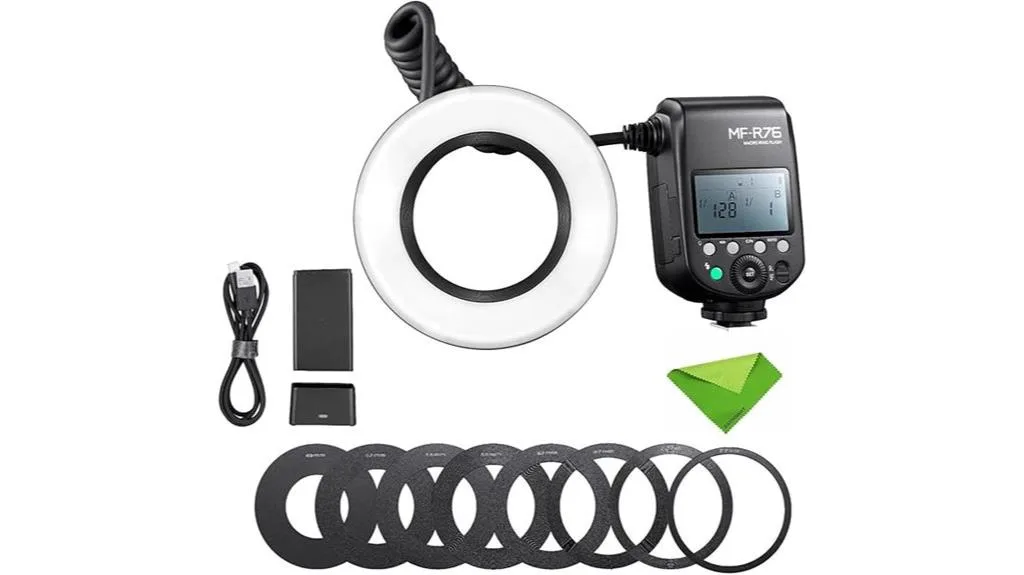
| GODOX MF-R76 | Ring Flash | No (manual only) | No | 76Ws / GN14 | ~$199 |
| Godox ML-150II | Ring Flash | No (manual only) | No | GN12 | ~$89 |
| LED Macro Arm Light | Continuous LED | N/A | N/A | Continuous | ~$45 |
Best Macro Flashes for Sony Cameras in 2026
1. Godox MF-R76S — Best Overall for Sony Shooters

The Godox MF-R76S is the macro ring flash Sony shooters have been waiting for: a Sony-native TTL version of the already excellent MF-R76, with full 2.4G wireless integration into Godox’s X system. If you own a Sony Alpha mirrorless body — an a7 IV, a7R V, a6700, ZV-E1, or any MI hot shoe camera — this is the ring flash to own.
At 76Ws with a guide number of 14 (ISO 100/m), the MF-R76S packs serious power into a ring form factor. Its dual-flash tube design lets you dial in A/B ratios independently — run them 1:1 for flat, shadow-free light on jewelry, or shift one side up to 8:1 for a directional look that adds dimension to insects and plant textures. Power steps down in 1/10 EV increments from full power to 1/256.
What makes this genuinely different from the manual MF-R76 is TTL metering and HSS. The camera takes over exposure calculation via Sony’s TTL system, so you can shoot a fast-moving insect in changing light without constantly tweaking power manually. HSS lets you shoot at shutter speeds up to 1/8000s — useful when shooting outdoors in bright sun where you want to open up to f/4 or f/5.6 for a blurred background rather than being stuck at sync speed.
The included lithium battery delivers up to 550 full-power flashes per charge with a recycle time of 0.1–1s. Eight adapter rings (49–77mm) are included. Color temperature is a warm daylight 5900K. The large LCD panel on the back is clear and readable even in direct sunlight.
The one limitation worth noting: like all ring flashes, the MF-R76S produces an unmistakable circular catchlight in reflective subjects like insect eyes and water droplets. Some photographers love this look; others prefer the less symmetrical catchlights from a twin flash setup. That’s a creative preference, not a flaw.
Best For: Sony Alpha mirrorless shooters who want full TTL automation and HSS in a ring flash with Godox X system wireless integration. The clear top pick for most Sony macro photographers.
Pros:
- Full Sony TTL metering — no manual exposure guessing
- HSS to 1/8000s for outdoor macro with wide apertures
- Godox X system wireless — pairs with X3-S, XPro-S, or any Godox master trigger
- Dual-tube A/B ratio control (8:1 range) for directional lighting
- 550 full-power flashes from built-in lithium battery
Cons:
- Heavier than the manual MF-R76 due to onboard electronics
- Ring catchlights may not suit all subjects
- Requires Sony MI hot shoe — not compatible with standard hot shoe adapters for wireless TTL
2. Nissin MF18 for Sony — Best Native ADI/P-TTL Precision
The Nissin MF18 is purpose-built for Sony’s ADI and P-TTL metering systems and has been the go-to premium macro ring flash for Sony shooters for several years. Unlike third-party TTL implementations that reverse-engineer Sony’s protocol, Nissin’s MF18 speaks Sony’s metering language natively — including ADI (Advanced Distance Integration) metering that factors in lens-to-subject distance data when calculating exposure.
The standout specification is Fine Macro mode: power can be adjusted from 1/128 to 1/1024 in 1/6 EV steps. That’s the finest power control of any macro ring flash on the market, and it matters when you’re shooting at 1:1 magnification and a fraction of a stop separates a correct exposure from a blown highlight. Full range is 1/1 (82Ws, GN16) down to 1/1024.
Like the Godox MF-R76S, the MF18 supports HSS to 1/8000s in both TTL and manual modes. It includes four built-in LED modeling lights that help you prefocus on difficult subjects in low light — a genuinely useful feature when you’re trying to lock onto the eye of a fly in a dark forest. Six anodized aluminum adapter rings are included: 49, 55, 62, 67, 72, and 77mm.
The A and B tubes can be controlled independently, and each can be switched off completely. Build quality is solid: mostly plastic construction but with a metal hot shoe and no flex or creaking under use. The interface is straightforward with dedicated controls for TTL compensation, mode switching, and ratio adjustment.
Where the MF18 falls slightly behind the Godox MF-R76S is in the wireless ecosystem — the MF18 doesn’t integrate into Godox X or any other major 2.4G wireless system natively. It can be triggered externally, but if you already use Godox gear across your kit, the MF-R76S offers tighter integration. If you’re shooting Sony-only and want the most precise Sony-native TTL implementation available, the Nissin MF18 is hard to argue against.
Best For: Dedicated Sony shooters who want maximum TTL precision with Sony’s ADI metering system and the finest power control available in a ring flash. Excellent for scientific/technical macro where exposure accuracy is critical.
Pros:
- Native Sony ADI/P-TTL metering — deepest Sony integration of any third-party macro flash
- Fine Macro mode: 1/6 EV power steps from 1/128 to 1/1024 — finest control available
- HSS to 1/8000s in both TTL and manual modes
- Four built-in LED modeling lights for low-light focusing
- 82Ws / GN16 — slightly more power than the Godox MF-R76S
Cons:
- No native integration with Godox X or other major wireless TTL ecosystems
- Slightly larger and heavier form factor than some ring flash alternatives
- Only six adapter rings included (missing 52mm, 58mm that Godox includes)
3. Godox MF12-K2 with X3-S Trigger — Best Twin Flash for Sony

The Godox MF12-K2 is a twin macro flash system: two compact 12W flash heads that mount independently around the lens barrel via flexible gooseneck arms, controlled wirelessly via 2.4G. The Sony-compatible bundle pairs the two MF12 flash heads with the Godox X3-S trigger that sits on your Sony MI hot shoe — giving you full wireless TTL control without a master flash head.
Twin flash lighting is fundamentally different from ring flash lighting. Each MF12 head can be positioned independently, allowing you to control the direction, intensity, and angle of light on each side of your subject. For insects and textured surfaces, this produces a more three-dimensional result than ring flash — texture is revealed by directional light rather than flattened by even illumination. You can also fire just one head for strong single-directional light, or set A/B ratios across five groups and 32 channels for complex multi-light macro setups.
The specs are genuinely impressive for a system this compact. Each MF12 head has a guide number of 16.1 (ISO 100/m) with power adjustable from 1/1 to 1/128 in 1/10 EV increments. Flash duration is as fast as 1/34,000s — short enough to freeze the wing beat of a flying insect if you’re in high-speed sync territory. Recycle time is 0.01–1.7s from the internal USB-C rechargeable lithium battery (approximately 500 full-power flashes per charge).
One practical note: the MF12-K2 kit does not include an X-system trigger in all versions — make sure you’re buying the bundle that includes the Godox X3-S for Sony (ASIN B0CY5GW4LY on Amazon), not just the two flash heads. Without the trigger, you’ll need a separate Godox master unit on your hot shoe.
The one limitation of the MF12 system is the non-replaceable internal battery. It charges via USB-C and delivers excellent capacity, but if the battery degrades after several years, you’re replacing the head rather than a battery. For most photographers this isn’t a concern within the first few years of ownership.
Best For: Sony macro photographers who want directional control over their lighting — insects, textures, 3D products where ring flash illumination is too flat. The twin flash format gives you studio-level lighting control in a macro package.
Pros:
- Independent positioning of two flash heads — unmatched directional control
- 2.4G wireless TTL with Sony compatibility via X3-S trigger
- Extremely fast 1/34,000s flash duration for freezing motion
- Five groups, 32 channels — scalable to complex multi-light setups
- USB-C rechargeable; ~500 flashes per charge; 0.01s minimum recycle time
Cons:
- Non-replaceable internal battery limits long-term repairability
- No HSS — limited to sync speed (typically 1/250s) for flash-ambient balance
- Requires X3-S trigger on hot shoe; ensure Sony-compatible bundle when purchasing
4. Meike MK-MT24S — Best Budget Twin Flash for Sony
The Meike MK-MT24S is a 2.4G wireless macro twin flash kit built specifically for Sony MI hot shoe cameras. It’s the affordable path to twin flash lighting — around half the price of equivalent Canon and Nikon first-party options — and it supports TTL metering via Sony’s MI hot shoe, including HSS, front curtain, and rear curtain sync.
The system consists of two R200 wireless flash heads, a GT620S TTL transceiver for Sony (mounts on the MI hot shoe), and six adapter rings (52–77mm). Each R200 head can rotate 60° horizontally and 45° vertically and is completely detachable, allowing you to position them off-axis or even handheld for creative off-camera macro lighting. Guide number is GN10 per head (GN14 ISO 200), and each head supports three groups (A/B/C) across four channels with seven power levels (1/64–1/1).
For nature macro photographers working in the field — insects, spiders, small reptiles — the MT24S’s combination of off-camera flex and Sony TTL metering makes it an exceptionally capable system at its price point. The 2.4G wireless range is stable within 15m from any angle, and the transceiver communicates reliably with Sony Alpha bodies tested on the a7 III, a7R IV, a6400, and a6600.
Build quality is mid-tier — the plastic construction is functional rather than premium, and the swivel joints on the flash heads can loosen over time with heavy use. But for photographers who want twin flash control without investing in a premium Godox or Nissin system, the MT24S delivers genuine Sony TTL functionality at an entry-level price.
Best For: Budget-conscious Sony shooters who want twin flash TTL control for field macro photography. Great entry point into directional macro lighting without the premium price tag.
Pros:
- Sony MI hot shoe TTL metering included — not just manual triggering
- HSS, front/rear curtain sync support
- Flash heads are fully detachable for off-camera, handheld positioning
- Heads rotate 60° horizontal / 45° vertical for flexible directional control
- Significantly lower cost than equivalent Canon/Nikon first-party twin flash systems
Cons:
- Mid-tier plastic construction; swivel joints can loosen with heavy use
- GN10 per head — less power than Godox MF12 heads
- Missing 49mm adapter ring (starts at 52mm)
5. GODOX MF-R76 — Best Manual Ring Flash
The original GODOX MF-R76 (without the “S” for Sony TTL) is a fully manual macro ring flash with 76Ws of power. It’s compatible with Sony, Canon, Nikon, Fuji, Olympus, and Panasonic — but it does not communicate TTL metering data to any camera. You set power manually.
That said, manual mode is not a limitation for experienced macro photographers. Many prefer it: you set power once, you know exactly what the flash will do, and you’re not fighting TTL’s occasionally erratic exposure calculations at extreme close focus distances. The dual-flash tube design with independent A/B ratio control (10 power levels, 1/128 to 1/1) gives you precise, repeatable results once you’ve dialed in your base exposure.
The MF-R76 uses a built-in rechargeable lithium battery delivering up to 660 full-power flashes — 110 more than the TTL version — with a recycle time of 0.1–2.7s. Eight adapter rings (49–77mm) are included. At around $50–70 less than the Sony TTL version, it’s the right choice if you already shoot manually, use a different TTL system, or want maximum power output over automation.
Note: If you’re considering this, the Sony TTL version (MF-R76S) is only $50–70 more and adds TTL, HSS, and 2.4G wireless. Unless you have a strong reason to stay manual, the MF-R76S is the better investment for most Sony shooters.
Best For: Experienced macro photographers who prefer manual flash control, or shooters on a tighter budget who don’t need TTL automation. Also the right choice for controlled studio macro work where consistent manual settings are preferred.
Pros:
- 76Ws / GN14 — same power as the Sony TTL version
- 660 full-power flashes per charge — more than the TTL variant
- Dual-tube A/B ratio control with 10 power levels
- Multi-brand compatibility (Sony, Canon, Nikon, Fuji, Olympus, Panasonic)
- Lower cost than the TTL version
Cons:
- No TTL — all exposure is manual
- No HSS — limited to sync speed
- No wireless integration with Godox X system (MF-R76S adds this)
6. Godox ML-150II — Best Budget Manual Ring Flash

The Godox ML-150II is the entry-level ring flash for macro photographers who want to get started without a large investment. At around $89, it’s the most affordable ring flash option in this guide — and it delivers genuine results for still subjects in controlled conditions.
It’s an all-manual flash with eleven brightness levels and a GN of approximately 12 at ISO 100. Recycle time is 0.1–2s. It works with lens diameters from 49mm to 77mm via the included adapter rings, and it’s compatible with Sony, Canon, Nikon, Fuji, Olympus, and Panasonic via standard hot shoe mounting. There’s no TTL, no HSS, and no wireless control — it fires when you press the shutter, at whatever power level you’ve set.
The ML-150II produces shadowless, flat ring-flash illumination that works well for product photography, flowers, and still insects. The improved diffuser in the Mark II version softens the output noticeably compared to the original. For photographers shooting controlled tabletop macro — jewelry, coins, small product shots — this delivers good results at a fair price.
Where it falls short is at extreme close focus distances (1:1 and beyond) where overexposure is easy to manage but requires careful power stepping. It also lacks a modeling light, which makes prefocusing in low light more difficult. For dynamic subjects or outdoor use, you’ll quickly outgrow it — but as an introduction to ring flash lighting, it punches above its price.
Best For: Photographers new to macro ring flash who shoot still subjects in controlled conditions — product shots, flowers, indoor macro. A solid starting point before committing to a more capable system.
Pros:
- Lowest cost entry into dedicated ring flash lighting
- Works with Sony and all major camera brands via standard hot shoe
- Eleven brightness levels; 49–77mm adapter ring compatibility
- Improved Mark II diffuser produces softer, more even output than the original
Cons:
- No TTL, no HSS, no wireless — fully manual only
- No modeling light makes low-light focusing more difficult
- Prone to overexposure at very close focus distances at higher power settings
7. LED Macro Arm Light — Best Continuous Light Alternative

Not every macro photographer wants flash. Continuous LED lighting has real advantages: what you see is what you get — there’s no guessing about exposure, the light is visible through the viewfinder in real time, and it works with video just as well as stills.
The LED Macro Arm Light attaches via cold shoe and positions two flexible aluminum arms (11.4 inches each) around the lens. Ten brightness levels, three lighting modes (both, left only, right only), and 5600K daylight-balanced output at CRI 95+ deliver clean, accurate color rendering. At 13 ounces with Type-C charging and pass-through power while shooting, it’s genuinely practical for extended sessions.
The key difference from flash: you’re not freezing motion with a 1/34,000s burst of light — you’re relying on your shutter speed to freeze the subject. For still or slow-moving subjects this is fine. For insects or anything that moves unpredictably, a flash system that fires at 1/1000s or faster will outperform continuous LED every time. But for product, food, flower, and studio macro, the live preview advantage of continuous light makes it a genuinely useful tool.
Best For: Macro photographers who shoot video alongside stills, or who prefer the live preview of continuous light for still subjects like products, food, and flowers. Not recommended as primary lighting for active insects or wildlife.
Pros:
- Live preview — see exactly how the light falls before you shoot
- Works equally well for macro video
- Independent left/right arm control for directional continuous lighting
- USB-C power pass-through — works while plugged in
- CRI 95+ for accurate color rendering
Cons:
- Cannot freeze fast-moving subjects the way flash can
- Arm length (11.4 inches) can limit positioning with some lens configurations
- Some reliability reports on long-term charging durability
Macro Flash Diffuser Accessories
The following products are flash diffuser accessories, not flash units. They attach to existing speedlites or macro lenses to modify and soften the light. They’re genuinely useful accessories for macro work, but they’re not standalone lighting systems — you need a flash to use them.
Camera Flash Diffuser, Foldable with Storage Bag

A foldable soft cloth diffuser that attaches over the front of your lens to scatter speedlite flash output for close-up subjects. Creates gentler, more natural lighting for macro and portrait work. Works with lenses under 3 inches in diameter. Expect 2–3 stops of light loss and compensate with ISO. Portable and collapsible with a storage bag included.
Macro Photography Diffuser Kit for Speedlite Flash (90–105mm Lenses)

A horseshoe-shaped diffuser kit designed for longer macro lenses in the 90–105mm range. Dimensions of 370 × 260mm provide good coverage for most macro subjects. Compatible with Lwa, EOS, Nik, and other mount options. Note: assembly instructions are sparse; allow time to figure out the setup. At its price point, a functional option for the occasional macro photographer who already owns a speedlite.
Macro Photography Flash Softbox Diffuser Kit (Jewelry / Insect)

A third-generation horseshoe-design softbox diffuser optimized for jewelry and insect photography. Touch fastener connections make setup reasonably quick. High-toughness materials improve on earlier versions. Compatible with Canon, Nikon, Sony, and other macro lenses. Folds flat for storage. Note that this product was previously listed as unavailable — it is now in stock as of early 2026.
Choosing a Macro Flash for Sony Cameras: What You Need to Know
Sony’s Multi Interface (MI) Hot Shoe
Sony’s Multi Interface hot shoe is not a standard ISO hot shoe. It carries additional data pins that enable Sony’s TTL metering, HSS, and wireless communication protocols. Most modern Sony Alpha mirrorless bodies (a7 series, a9 series, a6xxx series, ZV-E1) use the MI hot shoe.
The practical implication: a flash that says “compatible with Sony” may mean only that it fires on a Sony camera via the standard center pin — that’s basic trigger compatibility, not TTL. To get TTL automation on Sony, you need a flash that specifically supports Sony’s MI hot shoe protocol. All four flash units recommended above that include TTL (MF-R76S, Nissin MF18, Godox MF12-K2 via X3-S, Meike MT24S) are verified MI hot shoe TTL compatible with current Sony Alpha bodies.
Sony ADI and P-TTL Metering
Sony uses two TTL metering modes for flash: P-TTL (Pre-flash TTL, similar to Canon E-TTL and Nikon i-TTL) and ADI (Advanced Distance Integration). ADI is Sony’s advanced mode that factors in the actual focus distance from the lens — reducing the chance of exposure errors when the flash-to-subject distance changes rapidly. It requires a lens that transmits distance data to the camera.
The Nissin MF18 explicitly supports ADI metering, making it the most technically complete Sony TTL implementation. The Godox MF-R76S and Meike MT24S use P-TTL metering, which is reliable but doesn’t use the distance data ADI integrates. For most shooting situations — flowers, insects in controlled light, product shots — P-TTL is more than adequate. ADI’s advantage is most noticeable in mixed ambient/flash situations where subject distance is changing.
Ring Flash vs. Twin Flash: Which Should You Choose?
This is the most common question in macro flash selection, and the answer depends on what you’re photographing:
Ring flash (MF-R76S, Nissin MF18, MF-R76, ML-150II) surrounds the lens with a circular light source that fires from roughly the same axis as the lens. The result is even, shadow-free illumination across the entire subject. This is ideal for jewelry, coins, stamps, scientific specimens — anything where even illumination across the whole subject is the goal. The limitation: flat ring-flash light eliminates shadow, which also eliminates the sense of three-dimensional depth and texture.
Twin flash (Godox MF12-K2, Meike MT24S) places two separate heads that you can angle independently. Directional light from two sides reveals texture, creates dimensionality, and produces more natural-looking results on subjects with complex surface relief — insects, bark, stone, fabric. You can also adjust ratios so one side is dominant, simulating a main-light/fill-light ratio rather than even fill. For nature macro, twin flash generally produces more dynamic and compelling results than ring flash, at the cost of more complex setup.
Many experienced macro photographers own both and choose based on the day’s subject matter. If you’re buying your first dedicated macro flash, a ring flash is the more accessible starting point — the Godox MF-R76S is the best Sony-specific choice. If you’re already past that stage and want to develop your macro lighting further, the Godox MF12-K2 twin flash system opens up more creative possibilities.
HSS (High-Speed Sync) for Outdoor Macro
Standard flash sync speed on most Sony Alpha bodies is 1/250s (some go to 1/400s with electronic shutter or anti-distortion shutter). In bright sunlight, this means you may need to stop down to f/8 or f/11 to get a correct exposure — limiting your depth of field control. HSS breaks this barrier by allowing flash to sync at any shutter speed, including 1/2000s or faster.
For outdoor macro photography where you want to use wide apertures (f/4, f/5.6) to throw the background out of focus while using flash to illuminate the foreground subject, HSS is valuable. Both the Godox MF-R76S and Nissin MF18 support HSS. The Meike MT24S also supports HSS. The Godox MF12-K2 does not — it’s limited to standard sync speed.
TTL vs. Manual Flash: Which Is Better for Macro?
Both modes are used by working macro photographers, and each has genuine advantages:
TTL is faster to adapt when conditions change — moving from shade to sunlight, or following an insect that moves toward and away from the camera. The camera calculates exposure automatically. The downside: TTL can be inconsistent at extreme close focus distances (1:1 and beyond) where small changes in subject reflectivity or background influence the metering significantly.
Manual is completely predictable — once you’ve found the right power level for a given distance and aperture, every shot is consistent. Many insect photographers work manually because they’ve found a power level that works at their preferred shooting distance and don’t need the camera second-guessing the exposure. The Nissin MF18’s Fine Macro mode (1/6 EV steps to 1/1024) is specifically designed to make manual mode practical at extreme magnifications.
The recommendation: start with TTL to understand the exposures, then dial in manual when you’re shooting consistently at a fixed distance. Having a flash that does both (MF-R76S, MF18, MF12-K2, MT24S) gives you the flexibility to choose.
Power Output and Guide Number
Macro flash power is measured in watt-seconds (Ws) or guide number (GN at ISO 100/m). Ring flashes typically range from GN12 (ML-150II) to GN16 (Nissin MF18). At macro distances — usually 15–40cm from subject to flash head — even a GN12 flash has plenty of power; the limiting factor is usually being able to step down to the minimum power setting without overexposing.
More useful than raw power is the low-end power range. A flash that can step down to 1/256 or 1/1024 power is more useful at close focus distances than one that only goes to 1/64. The Nissin MF18’s 1/1024 minimum is the most useful specification for extreme macro (beyond 1:1) where flash power at normal settings would blow out everything.
Frequently Asked Questions
Do I need a dedicated macro flash, or can I use a regular speedlite?
You can use a regular speedlite for macro photography, but it’s not ideal. A standard speedlite mounted on the hot shoe fires from behind and above the lens — at macro distances (15–40cm from subject), the lens barrel itself blocks much of the light and the angle is too steep to illuminate what you’re focused on. A dedicated macro ring flash or twin flash mounts on the lens barrel and fires from directly around or beside the subject, which is what macro lighting requires. If you use a speedlite, you’ll need it off-camera (triggered wirelessly) and positioned low and to the side — which works, but adds setup complexity and removes the “macro lighting” geometry advantages of a ring or twin system.
Will a Godox macro flash work with my Sony a7 IV / a7R V / a6700?
Yes. The Godox MF-R76S and Godox MF12-K2 (with X3-S trigger) both support Sony TTL via the MI hot shoe and are compatible with all current Sony Alpha mirrorless bodies including the a7 IV, a7R V, a7C II, a9 III, a6700, and ZV-E1. The X3-S trigger, which sits on the hot shoe for the MF12-K2 system, is Godox’s Sony-specific trigger and communicates full TTL + wireless control to any Godox 2.4G-compatible flash unit.
What’s the difference between the Godox MF-R76 and MF-R76S?
The Godox MF-R76 is a manual-only macro ring flash compatible with all camera brands. It does not communicate TTL metering data to any camera — you set power manually. The MF-R76S is the Sony-native TTL version. It adds Sony TTL metering (the flash calculates exposure automatically based on a pre-flash metering sequence), HSS (high-speed sync up to 1/8000s), and 2.4G wireless integration with the Godox X system. The MF-R76S also reduces maximum battery life from 660 flashes to 550 due to the added electronics. The price difference is approximately $50–70. For Sony shooters who want TTL, the MF-R76S is the clear choice.
Is ring flash or twin flash better for insect photography?
Twin flash generally produces more compelling results for insects and small animals. The directional light from independently positioned heads reveals surface texture, creates realistic catchlights in insect eyes (rather than the distinctive donut-shaped ring flash catchlight), and allows you to simulate natural side lighting. Ring flash is faster and simpler to use — you don’t need to position the heads — and it’s better for flat, shadow-free illumination of specimens. Many insect photographers use twin flash as their primary system and ring flash as a backup. If you’re choosing one system for insect work, the Godox MF12-K2 twin flash with X3-S for Sony is the top recommendation.