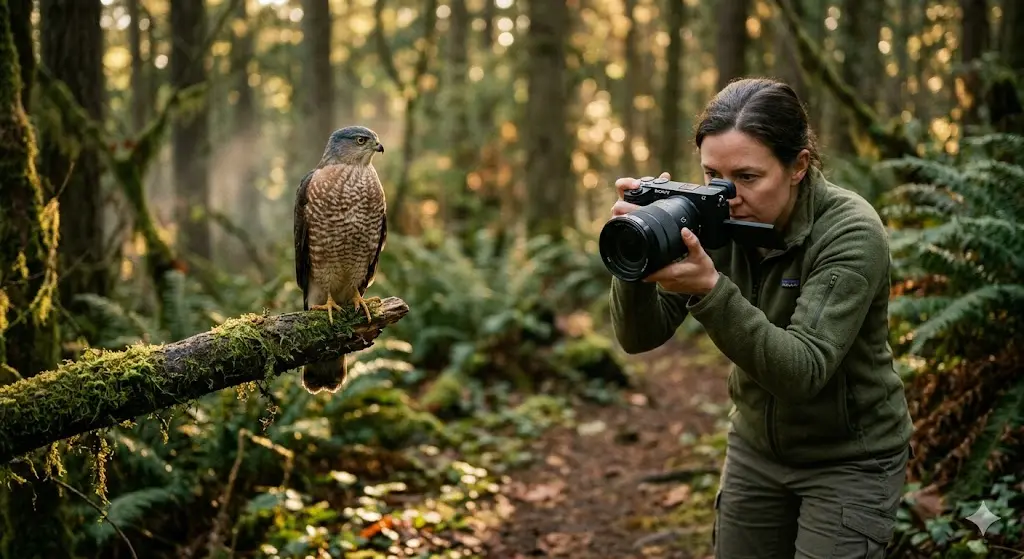
The Sony A6700 punches above its weight class for wildlife photography. Its AI Subject Recognition system—identical to what Sony uses in the much more expensive A7 V—combined with a 1.5× APS-C crop factor that extends telephoto reach, makes it a surprisingly capable wildlife tool at under $1,400. The key is knowing how to configure it.
Why the A6700 Is Excellent for Wildlife
- AI Subject Recognition: Bird, Animal, and Insect detection modes with full eye-tracking capability
- 1.5× crop advantage: A 200-600mm lens on the A6700 delivers 300-900mm equivalent reach—the same field of view as a 400-600mm+ lens on full-frame
- 11fps burst: Sufficient for most wildlife moments; 30fps with electronic shutter in lower-resolution crop
- 26MP resolution: Room to crop further beyond the 1.5× body crop
- Compatible with all Sony FE telephoto glass: Including the excellent FE 200-600mm G OSS
Best A6700 Wildlife AF Settings
Focus Mode
AF-C (Continuous) — always. AF-S won’t track moving subjects and is not suitable for wildlife photography.
Subject Recognition Mode
- Bird: For any avian subject — songbirds, raptors, shorebirds, waterfowl. Activates eye detection and body tracking
- Animal: For mammals — deer, fox, bears, dogs. Optimized for four-legged body anatomy with eye tracking for cats/dogs
- Insect: For dragonflies, butterflies, beetles. Detects wing and body shape patterns
Switch between recognition types via the Quick Menu (Fn button) — assign Subject Recognition to the Fn menu for one-press access in the field.
AF Area Mode
- Wide: Default for open scenes. The camera scans the entire frame for recognized subjects. Best when you don’t know exactly where in the frame the subject will appear.
- Zone: Restrict detection to a 3×3 sub-section. Useful for hides, blinds, or situations where the subject consistently appears in a predictable area (a perch, a feeding station, a forest gap).
- Tracking: Touch the subject on screen or use the joystick to initiate lock. The camera then tracks that specific individual through the frame.
AF Drive Speed
Set to Fast. This controls how quickly the lens focus motor moves to a new distance when a subject changes its distance from the camera rapidly. Fast is essential for birds in flight diving or accelerating toward the camera.
AF Tracking Sensitivity
- 4–5: For single subjects in open habitat (solitary bird in flight, single deer)
- 3: For subjects near other animals (mixed bird flocks, grouped mammals) where switching between individuals is less desirable
- 1–2: For subjects that frequently pass behind vegetation where you want the camera to hold position prediction through brief occlusions
Burst Mode Configuration
Drive Mode
- Hi (11fps, mechanical): Best burst mode for most wildlife with full resolution and no rolling shutter concerns
- Electronic Shutter burst (up to 30fps): Higher frame rate at reduced resolution; use for very fast subjects (diving gannets, flushed birds) where rolling shutter isn’t a concern
Memory card requirement for sustained burst: V90-rated UHS-II SD card (ProGrade V90, Sony Tough M) or CFexpress Type A for the primary slot. V60 cards will cause the buffer to fill mid-sequence at 11fps RAW.
Pre-Capture Setting
The A6700 supports Pre-Capture: Menu → Camera 1 → Drive Mode → Pre-Capture. Set to 0.5–1 second. The camera buffers frames from before you fully press the shutter. For take-off moments—the most valuable and unpredictable in bird photography—pre-capture recovers the frames that happened before your reaction.
Exposure Settings for Wildlife
Shutter Priority (S) or Manual + Auto ISO
Two common approaches:
- Shutter Priority: Set 1/2000s for birds in flight, 1/1000s for slower mammals. Let the camera manage aperture and Auto ISO. Simple and effective for variable lighting conditions across a morning shoot.
- Manual + Auto ISO: Fix aperture at maximum (f/5.6 at 600mm end of 200-600mm zoom) and shutter at 1/2000s. Auto ISO adjusts for changing clouds. More control over depth of field at the aperture side.
Auto ISO Maximum
Set Auto ISO maximum to ISO 6,400 on the A6700. At ISO 6,400, noise is visible but acceptable for web and moderate-size prints. Above 6,400, AI denoise in Lightroom/Topaz can recover the image, but limit Auto ISO to avoid habitually noisy captures in good light.
Minimum Shutter Speed for Wildlife
- Perched birds, stationary mammals: 1/500s (prevents camera shake at 600mm)
- Walking/feeding birds: 1/1000s
- Birds in flight: 1/2000s minimum; 1/3000–4000s for fast/small species
- Running mammals: 1/1600–2000s
Best Telephoto Lenses for A6700 Wildlife
| Lens | Reach on A6700 | Weight | Price |
|---|---|---|---|
| Sony FE 200-600mm f/5.6-6.3 G OSS | 300-900mm equiv | 2,115g | ~$1,999 |
| Sony FE 100-400mm f/4.5-5.6 GM OSS | 150-600mm equiv | 1,395g | ~$2,499 |
| Sigma 100-400mm f/5-6.3 DG DN OS | 150-600mm equiv | 1,140g | ~$849 |
| Sony FE 70-350mm f/4.5-6.3 G OSS (APS-C) | 105-525mm equiv | 625g | ~$799 |
| Tamron 150-500mm f/5-6.7 Di III VC VXD | 225-750mm equiv | 1,725g | ~$1,299 |
The Sony FE 200-600mm G OSS is the definitive wildlife lens for the A6700. On APS-C, it delivers 300-900mm equivalent reach with Sony’s excellent OSS stabilization. The 1.4× teleconverter extends maximum reach to 1,260mm equivalent—useful for distant shorebirds or mountain wildlife, though autofocus performance decreases with the converter in place.
Budget-conscious wildlife photographers should seriously consider the Sigma 100-400mm DG DN OS at ~$849. It delivers 150-600mm equivalent reach on A6700, good AF tracking with Sony’s recognition system, and weighs 1,140g versus the Sony 200-600mm’s 2,115g. For hiking-focused wildlife photography where weight matters, the Sigma’s reach-to-weight ratio is excellent.
Field Setup Tips
Custom Memory Modes
The A6700 has three custom memory positions (C1, C2, C3 dial positions on the mode dial). Save:
- C1: Birds in flight — AF-C, Wide, Bird recognition, Fast drive speed, 11fps burst, 1/2000s, Auto ISO 6400
- C2: Perched birds/stationary wildlife — AF-C, Flexible Spot M, Bird/Animal recognition, Single Shot, 1/500s, Auto ISO 3200
- C3: Mammals — AF-C, Wide, Animal recognition, Hi burst, 1/1600s, Auto ISO 6400
Switching between presets takes one dial movement—critical when a scene changes from a stationary perched bird to sudden flight.
Monopod vs Tripod for the 200-600mm
At 2.1kg, the 200-600mm requires support for extended sessions. A monopod provides good stability for lateral panning shots while allowing quick repositioning. A tripod with a gimbal head (Wimberley, Jobu Design) provides the most stable platform for long waits at a fixed location. For mobile wildlife photography (hiking to subjects), a monopod plus good technique at 1/1000s+ shutter speed is the practical choice.
Frequently Asked Questions
Is 11fps enough for bird-in-flight photography on the A6700?
Yes for most birds. At 11fps over a 2-second burst, you capture 22 frames—enough to find the peak wing position, correct eye alignment, and ideal background relationship. For extreme-speed subjects (peregrine falcon dives, gannets hitting water), 20fps (available via electronic shutter with slight crop) helps, but 11fps is the professional standard for most wildlife burst photography.
Does the Sony A6700 shoot 4K with the 200-600mm lens in wildlife mode?
Yes. The A6700 shoots 4K/30p (oversampled) with the 200-600mm, delivering a 450-900mm equivalent video field of view. For wildlife video, AF-C with Bird or Animal recognition in video mode works effectively. 4K/60p uses a further crop, extending the effective telephoto reach but at the cost of some oversampled quality.
How does A6700 wildlife AF compare to the A7 V?
They use the same AI recognition system and processor. Performance differences are minimal—a few percent in hit rate for small fast birds in the most demanding conditions. For practical wildlife photography, the A6700’s AF is not the limiting factor. The sensor’s high-ISO performance (better on the full-frame A7 V at identical settings) is the more meaningful difference in low-light dawn/dusk wildlife sessions.
The Sony A6700 with the 200-600mm G OSS or Sigma 100-400mm is one of the best value wildlife photography setups available in 2025. The APS-C reach advantage, combined with AI subject recognition that rivals bodies costing three times as much, makes it a genuinely competitive tool for serious wildlife photographers working within a budget.