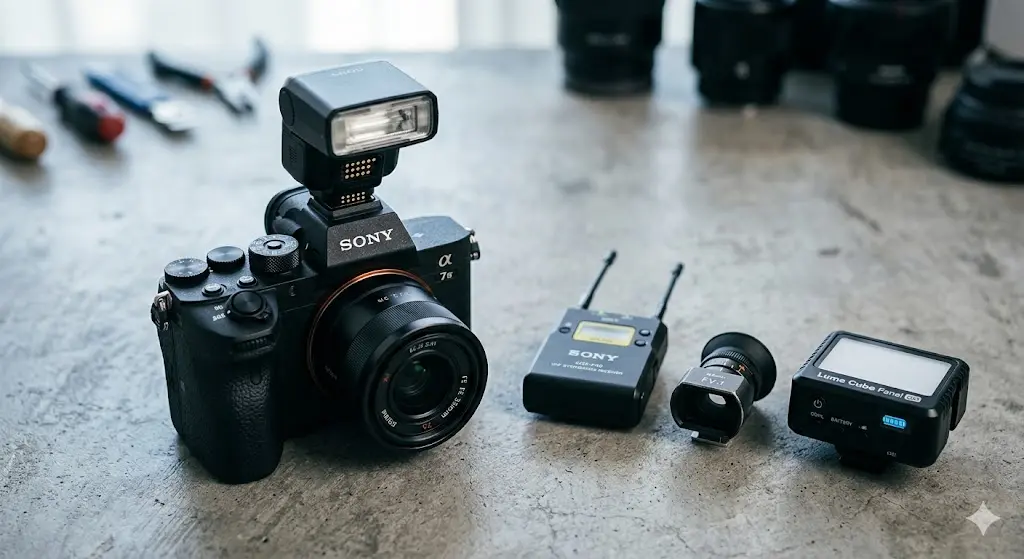
Sony’s Multi Interface (MI) Shoe is one of the most under-appreciated features of the Sony Alpha ecosystem. Unlike a standard cold shoe that provides only a mechanical mount, the MI Shoe carries digital data communication, power, and audio signals—enabling accessories that work more intelligently than comparable hotshoe accessories on other systems. Knowing what’s available and how it works helps build a more capable Sony kit.
What Is the Sony Multi Interface Shoe?
The MI Shoe appears on top of most Sony Alpha mirrorless cameras and is backward-compatible with standard ISO hotshoe accessories (flashes, triggers) through an adapter or direct mount where the ISO contacts align. The additional contacts in Sony’s proprietary extension carry:
- Digital audio data (for digital microphones like the ECM-B10 and ECM-M1)
- Power for connected accessories (eliminates separate batteries on some devices)
- TTL flash communication for Sony HVL-series flashes
- Control signals to compatible accessories for synchronized operation
The key benefit: Sony digital audio accessories connected to the MI Shoe deliver audio directly to the camera without going through an analog conversion—eliminating the noise, interference, and gain staging issues that affect 3.5mm analog audio connections.
Sony MI Shoe Audio Accessories
| Accessory | Type | Connection | Price | Best For |
|---|---|---|---|---|
| Sony ECM-M1 | Multi-directional digital mic | MI Shoe (digital) | ~$349 | Run-and-gun, vlog, interviews |
| Sony ECM-B10 | Shotgun digital mic | MI Shoe (digital) | ~$149 | Forward-facing capture, event |
| Sony ECM-W3S | Wireless digital lavalier | MI Shoe receiver (digital) | ~$299 | Documentary, interview, vlog |
| Sony UWP-D22 | Wireless UHF lavalier | MI Shoe adapter or 3.5mm | ~$599 | Professional ENG, broadcast |
| Rode Wireless GO II | Wireless dual lav | 3.5mm TRS (to MI Shoe adapter) | ~$299 | Popular dual-channel wireless |
| DJI Mic 2 | Wireless dual transmitter | 3.5mm or direct to some Sony | ~$349 | Content creator wireless |
Sony ECM-M1: The Best MI Shoe Microphone
The ECM-M1 is Sony’s flagship shotgun microphone for the MI Shoe and represents exactly what the digital audio connection enables. The mic has eight configurable pickup patterns (selectable from the camera menu on compatible bodies) including forward directional, side stereo, front stereo, and omnidirectional. Pattern switching happens digitally without changing physical settings on the microphone.
Digital audio delivery to the camera means zero analog noise floor, no RF interference from wireless video systems or on-set electronics, and automatic synchronization to the camera’s recording timeline without separate timecode. On the A7 V, A7C II, and FX30, the ECM-M1 appears as a digital audio source in the camera menu with controllable gain, pattern selection, and monitoring.
Sony ECM-B10: Compact Digital Shotgun
The ECM-B10 is a smaller, more affordable digital MI Shoe microphone. Single cardioid directional pattern; designed for run-and-gun and vlogging where the extra pattern flexibility of the ECM-M1 isn’t needed. At half the price, it’s the more practical choice for a single-operator setup where forward-facing audio is the primary requirement.
The ECM-B10 is powered entirely from the camera—no battery required. This simplifies operation: plug in and shoot. Battery life isn’t a separate consideration.
Sony ECM-W3S: Wireless Digital System
The ECM-W3S consists of a wireless transmitter/lavalier and a receiver that mounts to the MI Shoe and delivers audio digitally to the camera. The digital wireless connection delivers audio without the analog noise floor, and the system automatically links to the camera for monitoring and gain control through the camera menu.
Range is rated at 50 meters line-of-sight, adequate for most documentary, interview, and event work. The system records a backup audio track internally to the transmitter in case wireless signal drops—useful for important once-only moments.
Sony MI Shoe Flash Accessories
| Flash | Guide Number | TTL via MI Shoe | Price |
|---|---|---|---|
| Sony HVL-F60RM2 | 60 (ISO 100) | Yes | ~$599 |
| Sony HVL-F46RM | 46 (ISO 100) | Yes | ~$349 |
| Sony HVL-F32M | 32 (ISO 100) | Yes | ~$249 |
| Godox V860III-S | 60 (ISO 100) | Yes (Sony version) | ~$199 |
| Godox TT685II-S | 60 (ISO 100) | Yes (Sony version) | ~$99 |
Sony’s native flash series (HVL) provides full TTL metering via the MI Shoe, high-speed sync, and radio commander capability for off-camera flash systems. For most photographers, the Godox Sony-compatible flashes at half the price of Sony’s own options deliver equivalent TTL and HSS performance at a significantly better value.
MI Shoe Video and Monitoring Accessories
Sony XLR-K3M Audio Adapter
The XLR-K3M attaches to the MI Shoe and provides two XLR audio inputs with phantom power—effectively adding professional XLR audio capability to any Sony body. At ~$399, it’s significantly cheaper than a full Cinema Line body upgrade. For A7 V or A7C II shooters who occasionally need XLR audio, this is a practical bridge solution.
Sony FA-WRC1M Wireless Radio Commander
The wireless flash commander mounts to the MI Shoe and controls multiple off-camera Sony or compatible Godox flash units wirelessly with full TTL and HSS support. Enables complex off-camera lighting setups without tethering cables.
MI Shoe Compatibility: Which Cameras
Sony’s Multi Interface Shoe appears on:
- All Sony Alpha full-frame mirrorless bodies (A7/A9/A1 series)
- Sony A6700 and APS-C Alpha bodies (A6000-series)
- Sony FX30, FX3, FX6 Cinema Line bodies
- Sony ZV-E10 II (standard hotshoe compatible, not full MI Shoe)
- Some Sony ZV-series bodies have a simplified hotshoe; verify compatibility before purchasing MI Shoe accessories
Third-party accessories designed for Sony MI Shoe include a specific “Sony version” (different from Canon, Nikon, or Fuji versions of the same product). The Godox V860III-S, for example, is specifically the Sony TTL version. Standard ISO hotshoe flashes physically fit the MI Shoe but operate in manual-only mode without TTL communication.
Adapter for Standard Hotshoe Accessories
The Sony ADP-MAA Multi Interface Shoe Adapter (~$29) converts the MI Shoe to a standard ISO hotshoe for older or third-party accessories that use only the center contact. Required for older Sony-brand flashes that predate the MI Shoe standard, or for non-Sony TTL flashes that use a different proprietary protocol.
Frequently Asked Questions
Can I use a Rode VideoMic on the Sony MI Shoe?
Yes—via physical mounting on the shoe. Rode VideoMic and VideoMic Go II are standard analog microphones that plug into the 3.5mm input on the camera body for audio. They don’t use the MI Shoe’s digital data connection, only the physical mount for positioning. The Sony ECM-B10 or ECM-M1 use the full digital MI Shoe connection for superior audio quality.
Does the Sony ECM-M1 work with all Sony cameras?
The ECM-M1 works on all cameras with the MI Shoe for physical mounting and digital audio. However, the pattern-switching feature controlled from the camera menu requires firmware support on newer bodies (A7 V, A7C II, A9 III, FX30). Older bodies (A7 IV and earlier) may not support in-camera pattern control even with the ECM-M1 connected.
What’s the advantage of digital audio via MI Shoe vs 3.5mm?
Digital audio via MI Shoe: no noise floor, no RF interference, no analog cable susceptibility, automatic gain staging from camera, pattern control from camera menu. 3.5mm: universal compatibility with any microphone, works on any camera, more third-party options. For Sony native accessories, digital MI Shoe audio is clearly superior; for non-Sony microphones, 3.5mm remains the connection point.
Is the Sony MI Shoe the same on the A6700 and A7 V?
Yes—the MI Shoe interface is standardized across all current Sony Alpha bodies. Accessories designed for the MI Shoe (ECM-B10, ECM-M1, HVL flashes) work on both APS-C and full-frame Sony cameras that carry the MI Shoe.
Sony’s Multi Interface Shoe ecosystem is one of the system’s underappreciated strengths. The digital audio accessories in particular—especially the ECM-M1 and ECM-W3S—deliver professional audio quality that elevates Sony camera audio significantly above what analog hotshoe microphones on competing systems can achieve.