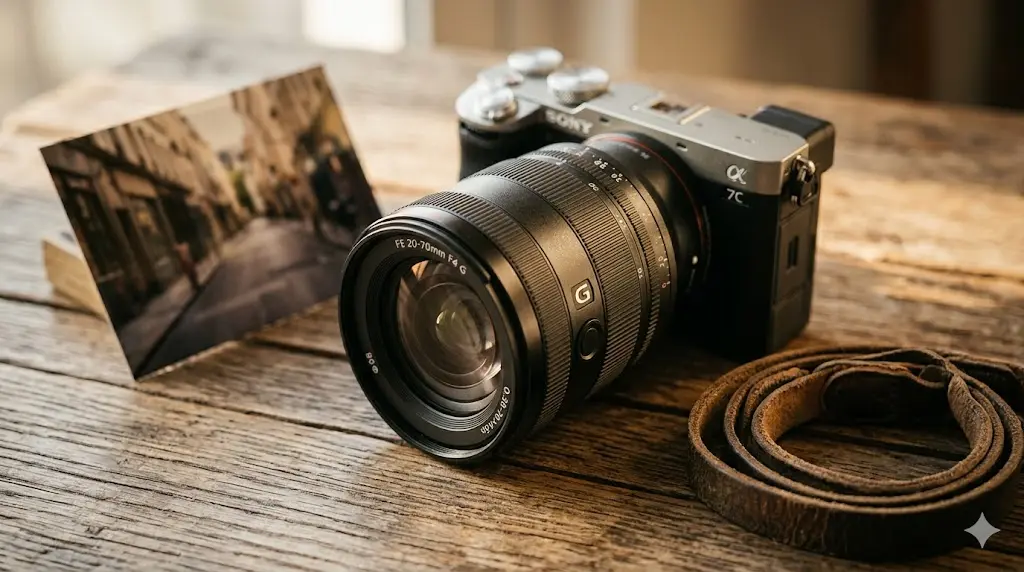
The Sony FE 20-70mm f/4 G launched in 2023 as one of the more thoughtfully conceived lenses in the Sony lineup. By shifting the wide end from 24mm (conventional) to 20mm, Sony created a zoom that replaces both a standard kit zoom and a separate wide-angle lens for many photographers. The 20-70mm focal range—with constant f/4—covers architecture, landscape, environmental portrait, travel, and casual street work in a single lens.
Sony 20-70mm f/4 G vs Competing Ranges
| Lens | Range | Aperture | Weight | Price |
|---|---|---|---|---|
| Sony FE 20-70mm f/4 G | 20-70mm | f/4 constant | 488g | ~$1,099 |
| Sony FE 24-70mm f/4 Zeiss | 24-70mm | f/4 constant | 426g | ~$1,199 |
| Sony FE 24-70mm f/2.8 G Master II | 24-70mm | f/2.8 constant | 695g | ~$2,299 |
| Tamron 17-28mm f/2.8 Di III RXD | 17-28mm | f/2.8 constant | 420g | ~$799 |
| Sony FE 28-60mm f/4-5.6 | 28-60mm | f/4-5.6 variable | 167g | ~$299 |
The 20mm Starting Point: Why It Matters
The 4mm difference between 20mm and 24mm is more significant than it sounds. The field of view at 20mm is 94 degrees diagonal; at 24mm it’s 84 degrees. In practice, this difference becomes obvious in indoor architecture (fitting a full room into a shot from a corner), landscape photography (including a larger sky without tilting the camera up), and any situation where you need maximum coverage without switching to a dedicated wide lens.
For photographers who previously carried a 16-35mm for wide work and a 24-70mm or 24-105mm for versatility, the 20-70mm is a genuine consolidation option. It doesn’t replace ultra-wide (12-16mm) for dramatic perspective work, but it covers the range where most travel and documentary photographers actually spend their time.
Optical Quality
Sharpness
The 20-70mm G is sharp across its range at f/4—center sharpness is excellent from 20mm through 70mm, and corner performance is good for a wide-range zoom. At 20mm, the corners show some expected softness that clears up to usable by f/5.6 and excellent by f/8. For landscape work where you’re typically at f/8–f/11 for depth of field, the corner performance is non-issue.
At 50-70mm, the lens performs very well—portrait-quality center sharpness and good edge performance. For environmental portrait work, this end of the zoom range is particularly strong.
Distortion and CA
Distortion at 20mm is barrel distortion (outward bulging) corrected automatically in-camera for JPEG and via lens profile in Lightroom for RAW. At 35-70mm, distortion is minimal and corrects easily. Chromatic aberration is low for a wide-range zoom—high-contrast edges at 20mm show slight lateral CA that disappears with auto lens corrections.
Bokeh
f/4 is not a bokeh lens at wide to normal focal lengths—at 20mm and 35mm, everything from 1 meter to infinity is essentially in focus at f/4. At 70mm with a subject at 1.5 meters, f/4 produces some background separation with smooth, if not dramatic, out-of-focus rendering. For portrait work requiring significant background blur, a faster prime is needed; the 20-70mm is a versatility-first lens.
Autofocus Performance
The 20-70mm uses Sony’s G-series linear motor autofocus—not quite the XD Linear Motor speed of G Master lenses, but fast and accurate for a versatile zoom. Face and eye detection work reliably across the zoom range. For travel photography, event documentation, and environmental portraiture, the AF keeps up without hesitation.
Focus breathing at 35-70mm is minimal—the lens is usable for video work where focus pulls are needed. At 20mm, slight breathing is present but acceptable for most video contexts.
Build and Handling
The 20-70mm G is weather-sealed (dust and moisture resistant) and uses Sony’s G-series construction standard. The 72mm filter thread is shared with several other Sony lenses, making filter system compatibility practical. The zoom ring moves smoothly with appropriate resistance—not too stiff for one-handed zoom, not so loose it creeps when the camera is angled down.
At 488g, it’s heavier than the compact 24-70mm f/4 Zeiss (426g) but significantly lighter than the 24-70mm f/2.8 G Master II (695g). For all-day carry on a trip, the weight feels appropriate rather than excessive.
20-70mm vs 24-70mm f/4 Zeiss: Which to Choose?
The Sony FE 24-70mm f/4 Zeiss is the lens the 20-70mm G essentially replaces in Sony’s lineup:
- 20-70mm G wins: Extra 4mm at the wide end, G-series linear motor AF (faster/quieter), better weather sealing, sharper at 20mm
- 24-70mm f/4 Zeiss wins: Slightly lighter (426g vs 488g), lower price (~$1,199 vs $1,099—roughly even, actually), T* coating on some versions
- Verdict: The 20-70mm G is the better lens for most uses; the Zeiss survives primarily for weight-sensitive setups or photographers who specifically prefer 24mm minimum focal length
20-70mm vs 24-70mm f/2.8 G Master II
The f/2.8 G Master II is two stops faster and has G Master optical quality. The comparison is really a question of priorities:
- If you shoot indoors regularly, need subject separation in portraits, or work in low light without flash: f/2.8 matters significantly
- If you primarily shoot outdoors in good light, use flash for events, or value keeping kit weight down: f/4 at $1,200 less is a reasonable trade-off
- The G Master II also starts at 24mm (versus 20mm on the f/4 G)—a point in the f/4 G’s favor for wide-angle work
Ideal Use Cases for the 20-70mm f/4 G
- Travel photography: One lens for the trip covering wide architecture, street scenes, and portrait-length subjects. The wide end handles cramped interiors; the 70mm end handles casual portraits.
- Documentary and journalism: Flexible range for unpredictable situations with excellent autofocus and weather sealing for outdoor assignments
- Video B-roll: Wide range in a single lens for documentary-style coverage without lens changes
- Hiking and outdoor photography: Wide enough for landscape, long enough for environmental portrait, light enough to carry all day
Frequently Asked Questions
Is the Sony 20-70mm f/4 G good for indoor photography?
Depends on lighting. In well-lit interiors with window light or artificial lighting, yes—the 20mm wide end is particularly useful for capturing full rooms. In dim bars, restaurants, or candle-lit venues where you need more than ISO 6,400, the f/4 maximum aperture becomes a limitation where a faster prime (35mm f/1.8, 50mm f/1.4) would perform better.
Does the Sony 20-70mm f/4 G work for astrophotography?
Marginally. f/4 is 2.5 stops slower than f/1.8—requiring significantly higher ISO or longer exposures (which cause star trailing) compared to a fast wide prime. The 20mm field of view is wide enough for Milky Way work, but a Sony FE 20mm f/1.8 G at f/1.8 is far better suited to astrophotography. The 20-70mm is a daytime versatility lens, not a low-light specialist.
Can the Sony 20-70mm replace a 16-35mm f/2.8?
Partially. The 20mm wide end replaces the 20-35mm range of a 16-35mm at f/4. For the extreme 16-20mm range and f/2.8 low-light performance, a 16-35mm f/2.8 remains necessary. For photographers who rarely use below 20mm, the 20-70mm is a better all-purpose solution than a 16-35mm + separate longer lens.
Is the Sony 20-70mm f/4 G good for video?
Yes—it’s one of the better video walk-around zooms Sony makes at f/4. The linear motor AF is quiet and smooth, focus breathing at most zoom positions is well-controlled, and the 20-70mm range covers most documentary and event video needs in a single lens. Not a cinema-grade lens (no dedicated focus ring or manual iris), but excellent for run-and-gun documentary and corporate video.
The Sony FE 20-70mm f/4 G is one of the most practical recommendations in the Sony FE lineup for photographers who want to simplify their kit. It delivers thoughtfully executed optical performance at a price point that’s competitive with the competition, and its 20mm starting point gives it a genuine advantage over conventional 24-70mm zoom designs.