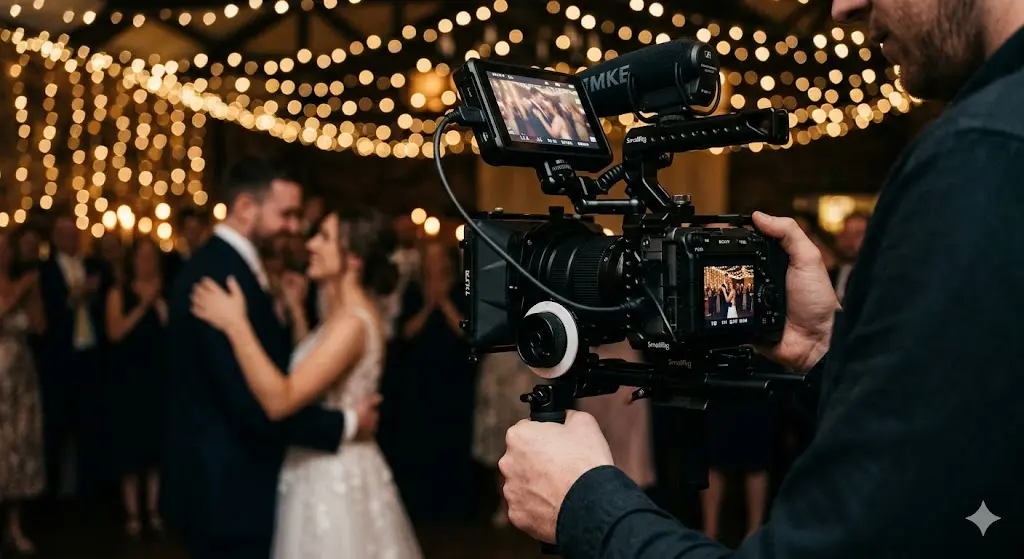
The Sony FX30 sits at the intersection of professional capability and accessible pricing—a Cinema Line APS-C body at roughly $2,000 that punches well above its price class in video quality. For wedding videographers, the question isn’t whether it’s good; it’s whether it’s enough for a professional paid service. After using the FX30 across multiple full-day wedding productions, here’s a realistic assessment.
FX30 vs FX3 vs A7S III for Weddings
| Spec | Sony FX30 | Sony FX3 | Sony A7S III |
|---|---|---|---|
| Sensor | 20MP APS-C | 12MP Full-Frame | 12MP Full-Frame |
| Native ISO (high) | 2,500 | 12,800 | 12,800 |
| Max ISO | 102,400 | 409,600 | 409,600 |
| 4K Recording | 4K/120p (crop) | 4K/120p (crop) | 4K/120p (FF) |
| Active Cooling | Yes (fan) | Yes (fan) | No (passive) |
| XLR Audio | Via handle | Via handle | Via handle |
| Crop Factor | 1.5× | 1.0× | 1.0× |
| Price | ~$1,999 | ~$3,799 | ~$3,499 |
Image Quality: Where the FX30 Excels
The FX30’s 20MP APS-C sensor with dual native ISO delivers excellent 4K footage in good to moderate lighting. S-Log3 files show 14+ stops of dynamic range, which handles the bright windows-dark interior contrast typical of church ceremonies and reception halls competently. In S-Cinetone, the colors are warm and flattering—important for skin tones in wedding footage where post-production turnaround is often tight.
At the base ISO of 800, the FX30 is clean and detailed. At ISO 2,500 (second native ISO), there’s an acceptable noise increase that reads as film grain rather than digital noise—commercially usable for reception venues with dim ambient lighting.
The Low-Light Reality Check
This is where the FX30 needs honest evaluation. Wedding receptions frequently feature ambient lighting in the range of ISO 6,400–25,600 territory for a full-frame camera. At those ISOs on the FX30, noise becomes a creative limitation rather than an asset:
- ISO 6,400 on FX30: Visible noise, usable with Neat Video or DaVinci Resolve’s noise reduction
- ISO 12,800 on FX30: Heavy noise, limits delivery to 1080p or heavily processed outputs
- ISO 12,800 on FX3/A7S III: Clean broadcast-quality footage
For outdoor weddings, golden-hour ceremonies, and well-lit venues, the FX30 is a complete professional solution. For candlelit receptions, dark ballrooms, or any venue where you’ll regularly exceed ISO 3,200, the FX3 or A7S III’s full-frame sensor is a serious workflow advantage.
Autofocus for Wedding Work
The FX30 uses the same AI Subject Recognition system as the A7 V and A6700—excellent face and eye tracking in video mode that makes unattended or single-operator B-roll shooting practical. During ceremony coverage, the camera reliably held focus on faces during processionals, vow exchanges, and ring ceremonies without operator intervention.
AF Transition Speed at 3 (medium) produces natural-looking focus pulls when subjects move or new subjects enter frame. For interview setups—seated guests sharing memories—the FX30 focused confidently through dim ambient light at f/1.8 with Sony’s 24mm G Master lens.
Audio for Weddings
The XLR Top Handle (sold separately for FX30, ~$349) is essentially mandatory for professional wedding work. Two XLR inputs with phantom power accommodate a wireless lavalier system (DJI Mic 2, Rode Wireless PRO) and a shotgun (Sony ECM-B10). The handle also includes a 3.5mm backup input.
Without the XLR handle, the multi-interface shoe accepts the Sony ECM-B10 digital microphone directly. This is a viable single-operator setup for civil ceremonies and informal receptions where lavalier access to the officiant and couple isn’t possible.
The Crop Factor Issue for Wide-Angle Coverage
The APS-C 1.5× crop factor means a 24mm lens becomes ~36mm equivalent—a normal field of view rather than wide. For wedding videography that requires wide coverage of venues, ceremony halls, and reception spaces, this creates a lens cost consideration:
- To achieve 24mm equivalent on FX30: Need a 16mm lens (~Sony 16mm f/1.4 or Sigma 16mm f/1.4, ~$449–$499)
- To achieve 16mm equivalent: Need a ~11mm lens (options are limited and expensive)
- FX3: 24mm G Master gives native 24mm coverage—no mental math required
For videographers already shooting Sony APS-C and owning wide APS-C glass, this is a non-issue. For those coming from full-frame, the focal length recalculation affects every lens in the kit.
Two-Camera Wedding Setup
The most compelling wedding use case for the FX30 is as a B-camera or C-camera alongside an FX3 or A7S III A-camera system. The FX30’s identical color science (S-Cinetone, S-Log3, same Creative Looks) means matching footage in edit requires no separate correction. The price point makes it practical to run three cameras simultaneously for ceremony coverage without tripling the gear budget.
A viable wedding kit:
- A-camera: FX3 + 24mm f/1.4 GM (on a gimbal for ceremony walk-ins)
- B-camera: FX30 + 50mm f/2.5 G (locked-off ceremony wide shot on tripod)
- C-camera: FX30 + 16mm f/1.4 Sigma (second shooter handheld)
Total kit cost: ~$7,000–$8,000 versus $12,000+ for three FX3 bodies. The low-light trade-off is accepted for the B and C camera positions, which typically hold wider shots with more ambient light than the close A-camera coverage.
Is the FX30 Enough for Solo Wedding Videography?
For outdoor and well-lit wedding work: Yes, absolutely. The FX30 produces 4K footage that delivers on any platform including large-screen presentation at the wedding venue or cinema-quality highlight reels.
For dark indoor venues as a sole camera: It’s a risk. The high-ISO limitation becomes visible in challenging conditions, and wedding clients who pay professional rates expect clean, beautiful footage in every environment. Either supplement with fast primes (f/1.4), plan to use extensive noise reduction in post, or set the price point appropriately for the capability.
Frequently Asked Questions
Does the Sony FX30 overheat during weddings?
No—the active cooling fan prevents thermal shutdown during extended recording. Full-day wedding coverage (8+ hours of intermittent recording) has been reported without thermal issues. This is a significant advantage over the A7S III, which occasionally requires cooling breaks in extended hot-weather shoots.
What lenses work best for the FX30 at weddings?
The Sigma 18-35mm f/1.8 DC DN Art (APS-C native, ~$649, ~27-52mm equivalent) is a standout wedding prime zoom for FX30. For primes: Sigma 16mm f/1.4 DC DN (24mm equiv), Sony E 35mm f/1.8 OSS (52mm equiv), and Sigma 56mm f/1.4 DC DN (84mm equiv portrait) cover every wedding scenario.
Should I use S-Log3 or S-Cinetone for wedding videography on the FX30?
S-Cinetone for fast turnaround and direct delivery. S-Log3 for maximum grading latitude in high-contrast scenes (bright church windows, harsh midday outdoor ceremonies). Many wedding videographers use S-Cinetone for the full day and switch to S-Log3 only for specific challenging lighting situations.
Is 4K/120p on the FX30 usable for slow motion at weddings?
Yes, with the understanding that it uses a Super 35 crop (1.5× from APS-C, so ~2.25× from full-frame). Wide angles require ultrawide lenses. At 120p for first dance or champagne pour slow motion, the footage is excellent quality and adds production value.
The Sony FX30 is a legitimate professional wedding camera—not a compromise or a budget substitute—when deployed in situations that match its capabilities. For well-lit ceremonies and venues, it produces broadcast-quality footage at a camera body price that improves the economics of building a multi-camera wedding production kit.