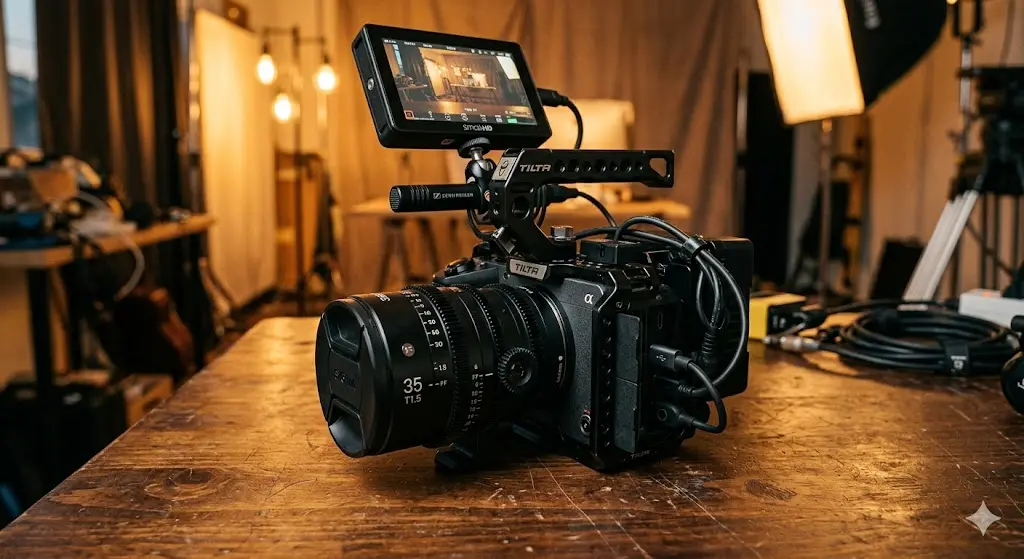
The Sony FX3 is one of the most unusual cameras in Sony’s lineup: it looks like a compact cinema camera, costs as much as a professional body, but delivers imaging capability that serious videographers have been asking for since the A7S III launched. Two years into the FX3’s life and with firmware updates continuing, here’s where it stands in 2025.
FX3 vs FX30 vs A7S III: Spec Comparison
| Spec | Sony FX3 | Sony FX30 | Sony A7S III |
|---|---|---|---|
| Sensor | 12.1MP Full-Frame BSI | 20.1MP APS-C | 12.1MP Full-Frame BSI |
| Base ISO | Dual (800/12,800) | Dual (800/2,500) | Dual (80/12,800) |
| Max Video | 4K/120p (crop) | 4K/120p (crop) | 4K/120p (FF/crop) |
| Recording Limit | Unlimited (with fan) | Unlimited (with fan) | Unlimited |
| Cooling | Active fan (internal) | Active fan (internal) | Passive (no fan) |
| Top Handle | Included (XLR) | Available separately | Not included |
| XLR Audio | Via handle | Via handle | Via handle |
| Price | ~$3,799 | ~$1,999 | ~$3,499 |
Build and Design for Video Production
The FX3 is built like a tool, not a camera. The form factor—roughly boxier than the A7 series—takes some adjustment if you’re coming from a DSLR-style body, but it’s purpose-built for rigging. The bottom 1/4-20 thread and NATO rail compatibility means it slots into cage/monitor/wireless audio setups without adapters. The top handle provides two XLR inputs with phantom power and analog audio monitoring.
The active cooling fan is the feature that differentiates cinema-line bodies from the A7 series. With the fan running on Auto, the FX3 will record for hours in warm environments without thermal throttling. In practice, shooting in summer at 35°C ambient with S-Log3 4K/25p, the camera ran 6 hours straight on a gimbal before the battery called it quits. Thermal management is genuinely best-in-class for this sensor size.
Image Quality and Low-Light Performance
The 12.1MP full-frame sensor is the same class as the A7S III, and low-light performance reflects that. At its 12,800 second native ISO, footage is clean enough for broadcast delivery. At ISO 51,200, noise is present but structured—organic-looking, not digital blotches. At ISO 204,800, it’s usable for creative effect in extreme low-light narrative work.
For anything requiring stills beyond 12MP, this is the wrong camera. Sony designed the FX3 exclusively around motion work. There is no dedicated photo shooting mode; it captures 12MP stills as a secondary function.
The dual native ISO means there’s no noise penalty for jumping between, say, an indoor scene at ISO 12,800 and a daylight exterior at ISO 800. Well-exposed footage at both ISOs matches in noise character, which simplifies color grading timelines with mixed lighting conditions.
Video Recording: Formats and Quality
The FX3 records internally to XAVC S 4:2:0 10-bit and XAVC HS 4:2:2 10-bit. For most delivery formats (YouTube, Vimeo, broadcast HD), XAVC S is sufficient. For color grading headroom in complex lighting, XAVC HS 4:2:2 gives a noticeably more pliable image in the highlights and shadows.
S-Log3 is the workhorse profile. The FX3’s S-Log3 combined with 15+ stops of latitude means a properly exposed log file is extremely resistant to over-exposure. S-Cinetone is available as a lower-contrast option that requires less grading—useful for event work where turnaround time matters more than maximum dynamic range.
4K/120p is available with a slight APS-C crop. For slow-motion work at A-camera resolution, this is excellent. The full-frame 4K/60p is the mode most videographers use for primary delivery—clean, oversampled from 5.8K, with rolling shutter that’s among the lowest in its class.
Autofocus for Video
The FX3’s AF system uses Sony’s AI Subject Recognition, and it’s one of the reasons this camera is popular for documentary and event work. Tracking a speaking subject across a frame as they move toward or away from camera at f/1.8 produces smooth, confident focus pulls that would require a dedicated focus puller on a dedicated cinema camera. AF transition speed and sensitivity are both adjustable from the menu during live recording without touching the camera physically.
Face detection in 4K S-Log3 at 1600% monitor gain (for exposure checking) still works reliably—the camera tracks subjects even when the monitor preview looks completely blown. This matters for operators used to monitoring a log image on-set.
Audio
With the XLR handle attached, the FX3 accepts two XLR inputs at +48V phantom, line level, or mic level. Audio monitoring via the 3.5mm headphone jack is clean. The multi-interface shoe also accepts Sony’s digital audio accessories (ECM-B10, ECM-M1) directly.
The internal microphone is functional but not intended for production audio—it’s a reference track. Proper dual-system or on-camera XLR audio is the expected workflow.
Who Should Buy the Sony FX3?
- Documentary and event videographers: The combination of unlimited recording, XLR audio, great AF, and full-frame low-light is the ideal doc camera kit.
- Commercial shooters transitioning from dedicated cinema cameras: The cinema-style body and mounting system bridge the gap without committing to a RED or ARRI budget.
- Run-and-gun solo operators: All controls on the camera body, no menu-diving needed mid-shoot, and the gimbal balance is excellent with the compact form factor.
- Not ideal for: Still photographers, sports/wildlife shooters needing 20+ fps, or anyone who needs more than 12MP resolution.
FX3 vs A7S III: Which Should You Choose?
Both use the same core sensor and processor. The FX3 wins for rigging flexibility, unlimited recording in heat, XLR audio, and cinema-style body ergonomics. The A7S III wins for hybrid photo/video use, EVF shooting, and slightly lower price. If you’re building a dedicated video rig, FX3. If you need one camera to do both stills and video professionally, A7S III.
Frequently Asked Questions
Does the Sony FX3 shoot RAW video?
Yes, via HDMI to compatible external recorders (Atomos Shogun, Blackmagic Video Assist). The FX3 outputs 16-bit RAW over HDMI for maximum post-production latitude. Internal recording is XAVC S 4:2:0 or XAVC HS 4:2:2 10-bit.
Is the Sony FX3 good for YouTube?
Excellent for YouTube, but overkill in terms of specs for most creators. The FX30 delivers similar 4K quality at half the price. The FX3 makes sense for YouTube if you’re shooting in challenging low-light, need the XLR audio setup, or are building a multi-purpose production rig.
What lenses work best on the FX3?
Any Sony FE mount lens. For video: the Sony 35mm f/1.4 G Master, 24mm f/1.4 G Master, and 85mm f/1.4 G Master are the primary creative primes. For zoom work, the 28-135mm f/4 G Power Zoom provides smooth, cine-style zoom control with a dedicated zoom ring.
How long can the FX3 record continuously?
With the internal fan active, indefinitely (limited by card capacity and battery only). Without the fan (silent shooting mode), thermal limits apply around 40 minutes at 4K in warm conditions.
Does the FX3 have image stabilization?
Yes, 5.5-stop IBIS comparable to the A7S III. Combined with Active Mode electronic stabilization for walking shots, gimbal-free handheld work is viable for B-roll, though a gimbal is still recommended for long handheld sequences.
The Sony FX3 is a specialist tool for a specific professional use case, and in that use case it’s nearly unbeatable at its price point. For videographers building a serious production kit around Sony’s ecosystem, it remains one of the best camera investments in the $3,000–$4,000 range.
Sony FX3 — frequently asked.
Pulled from the actual searches that brought you here.
Does the Sony FX3 shoot RAW video?
Yes, via HDMI to compatible external recorders (Atomos Shogun, Blackmagic Video Assist). The FX3 outputs 16-bit RAW over HDMI for maximum post-production latitude. Internal recording is XAVC S 4:2:0 or XAVC HS 4:2:2 10-bit.
Is the Sony FX3 good for YouTube?
Excellent for YouTube, but overkill in terms of specs for most creators. The FX30 delivers similar 4K quality at half the price. The FX3 makes sense for YouTube if you’re shooting in challenging low-light, need the XLR audio setup, or are building a multi-purpose production rig.
What lenses work best on the FX3?
Any Sony FE mount lens. For video, the Sony 35mm f/1.4 G Master, 24mm f/1.4 G Master, and 85mm f/1.4 G Master are the primary creative primes. For zoom work, the 28-135mm f/4 G Power Zoom provides smooth, cine-style zoom control with a dedicated zoom ring.
How long can the FX3 record continuously?
With the internal fan active, indefinitely (limited by card capacity and battery only). Without the fan (silent shooting mode), thermal limits apply around 40 minutes at 4K in warm conditions.
Does the FX3 have image stabilization?
Yes, 5.5-stop IBIS comparable to the A7S III. Combined with Active Mode electronic stabilization for walking shots, gimbal-free handheld work is viable for B-roll, though a gimbal is still recommended for long handheld sequences.