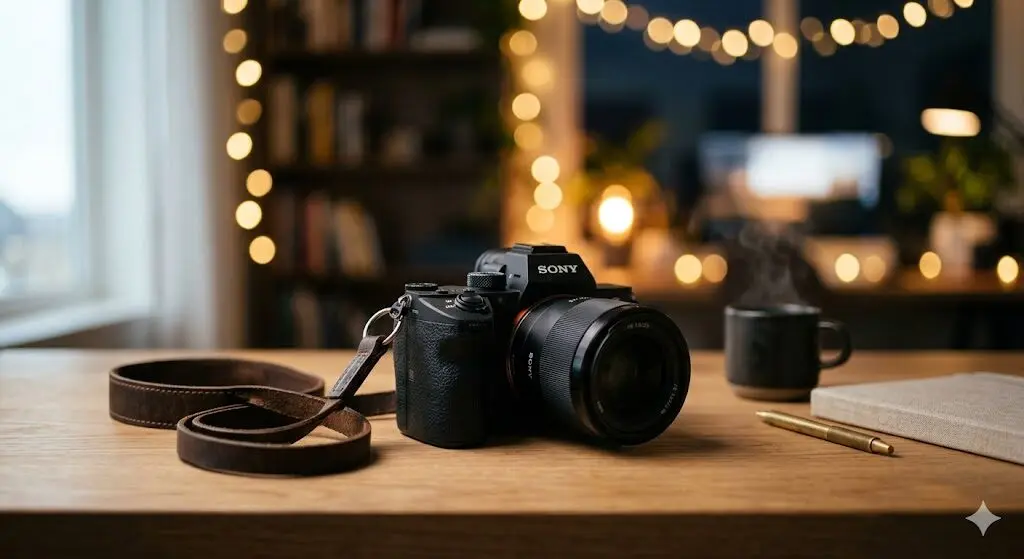
The Sony FX30 launched in October 2022 at $1,799 body-only, making it the most affordable entry point into Sony’s Cinema Line. It slots below the FX3 (full-frame, $3,799) and FX6 ($5,999) while sharing the Cinema Line DNA: XLR audio, full-size HDMI, fan-cooled body for sustained recording, and Log/RAW compatibility. The sensor is a 26MP APS-C BSI CMOS — the same chip that powers the A6700 — but tuned for Sony’s cinema color science and operating modes. After extended testing across documentary, run-and-gun, and narrative short film production, here’s the honest assessment.
Key Specifications
Sensor: 26MP APS-C BSI CMOS. Processor: BIONZ XR. Video: 4K/120p (APS-C), 4K/60p Super 35 (full-sensor readout), 4K/120p at 1.24x crop. Internal recording: 4K XAVC-I (600 Mbps), 4K XAVC HS H.265 10-bit 4:2:2 at All-I up to 500 Mbps. S-Log2, S-Log3, S-Cinetone, 14 Creative Looks.
Audio: 2x XLR/TRS combination inputs (via included XLR handle), 48V phantom power, 4-channel audio recording. The XLR handle is included in the box — a genuine win at this price point. Autofocus: AI-based Real-time Recognition (same system as A7R V), covering humans, animals, birds, insects, vehicles. IBIS: 5-axis, up to 5 EV stops (8.5 stops with Active Mode + compatible OSS lens).
Build Quality and the Cinema Line DNA
The FX30 body is compact — 131 x 84 x 84mm, 715g with battery — but built differently from Sony’s consumer cameras. The magnesium alloy body is dust and moisture resistant, with a design optimized for cage mounting, follow focus systems, and monitor attachment. The 1/4-20 and 3/8-16 threaded sockets are positioned for standard cinema rigging.
The integrated fan is the headline hardware difference from consumer Sony cameras. It runs quietly during standby and ramps up during sustained 4K recording, preventing thermal throttling. In practice: the FX30 sustained 4K/60p recording for 90 minutes continuously in an ambient 22°C environment without a thermal limit warning. The A6700, lacking this fan, hits thermal limits after approximately 30 minutes of 4K/60p. For documentary or event work, this is a decisive advantage.
No built-in EVF is a trade-off — the FX30 assumes you’ll use an external monitor or loupe. A hot shoe is included, but serious productions will attach via the multi-interface shoe or HDMI output to a 5-inch field monitor.
Video Quality: 4K and Slow Motion
The FX30’s headline video specification is 4K/120p — the highest frame rate 4K Sony offers in this price range as of 2026. This enables 5x slow motion in 24p timelines without speed ramping artifacts. The 4K/120p mode uses a 1.24x crop (effectively 1.24 x 1.5 = 1.86x compared to full-frame), so you’ll need wider focal lengths to maintain field of view.
4K/60p in Super 35 mode reads the full APS-C sensor, downsampling for excellent detail and minimal rolling shutter. The XAVC-I 600 Mbps All-Intra codec produces files that cut cleanly in DaVinci Resolve with minimal buffering even on M-series MacBooks. S-Log3 footage at ISO 800 shows excellent shadow latitude and grades well to standard cinema looks using the official Sony LUTs or custom CDL grading.
Noise performance in video mode is tuned differently from photo mode. The FX30 defaults to Cine ISO (equivalent to standard ISO x 2.5 approximately), so its “ISO 800” cine is roughly ISO 2000 in standard terms. For indoor documentary work at Cine ISO 2000–4000, the FX30 produces very clean footage. ISO 12800 cine is usable with careful NR in post.
Autofocus in Video Mode
AI-based continuous autofocus in video mode is the FX30’s most important operational advantage for run-and-gun shooters. The Real-time Recognition AF tracks subjects through interview setups, documentary action, and talking-head configurations with minimal hunting. Focus transitions are smooth and selectable (Fast / Normal / Slow) to match editorial requirements.
For narrative work where focus pulls need to be intentional and controlled, many operators will prefer manual focus with the FX30’s focus map overlay (peaking + magnification). But for one-person documentary crews, the AF reduces cognitive load enough to matter.
| Spec | FX30 (2022) | FX3 (2021) | A6700 (2023) |
|---|---|---|---|
| Sensor | 26MP APS-C BSI | 12.1MP FF BSI | 26MP APS-C BSI |
| Max 4K Frame Rate | 4K/120p (1.24x crop) | 4K/120p (with crop) | 4K/120p (S35) |
| Internal Recording | 10-bit 4:2:2 All-I | 10-bit 4:2:2 All-I | 10-bit 4:2:2 |
| XLR Audio | Yes (handle included) | Yes (handle included) | No |
| Cooling Fan | Yes | Yes | No |
| Sustained 4K/60p | 90+ min | 90+ min | ~30 min |
| RAW Output (HDMI) | 16-bit RAW via HDMI | 16-bit RAW via HDMI | No |
| Body Price | $1,799 | $3,799 | $1,399 |
Audio: The XLR Advantage
The included XLR handle adds 2x XLR/TRS inputs with 48V phantom power. Four-channel audio recording (2x XLR + internal microphone or digital audio input) is available in XAVC-I at high bit rates. For documentary and interview work, this eliminates the need for a separate audio recorder in many situations. The preamps are clean to approximately -50 dBu self-noise — adequate for professional XLR microphones in controlled environments, though not quite at dedicated field recorder levels.
Photo Capability
The FX30 does shoot stills — 26MP RAW + JPEG — with the AI autofocus working in photo mode too. For a hybrid operator who occasionally needs a stills frame from a video assignment, it’s capable. It’s not optimized for stills: no top display, minimal customization for photo workflows, and the body ergonomics prioritize horizontal video operation. For dedicated hybrid work, the A6700 body (same sensor, photo-oriented controls, cheaper) may be more practical.
Who Should Buy the Sony FX30?
The FX30 is the right camera for: solo documentary filmmakers who need sustained 4K recording and professional audio inputs, wedding and event videographers who want cinema color science and professional XLR audio in a compact body, and short film or branded content producers who need a Cinema Line camera at sub-$2K price points. The fan, XLR handle, and RAW HDMI output push it firmly into professional video territory that the A6700 and consumer cameras don’t reach.
Frequently Asked Questions
Does the FX30 shoot 4K/120fps full-frame?
No. The FX30 has an APS-C sensor. 4K/120p uses a 1.24x crop within the APS-C sensor. Full Super 35 readout goes up to 4K/60p.
What’s the difference between the FX30 and A6700?
Same sensor, but the FX30 adds a cooling fan (crucial for sustained recording), XLR audio handle, Cinema Line color science, RAW HDMI output, and cinema-optimized body design. The A6700 adds a built-in EVF, better photo ergonomics, and lower price — better for hybrid shooters who prioritize stills.
Does the FX30 have in-body image stabilization?
Yes, 5-axis IBIS. With Active Mode and an OSS lens, Sony rates the combined stabilization at up to 8.5 EV stops — very effective for handheld video work.
Can I use full-frame FE lenses on the FX30?
Yes. FE lenses mount natively on the FX30’s E-mount. They work with a 1.5x crop factor due to the APS-C sensor. A 24mm FE lens behaves as a 36mm equivalent. Sony’s APS-C E-mount lenses (SEL) also work with no crop penalty.
What cards does the Sony FX30 use?
Single CFexpress Type A slot + single UHS-II SD slot. For 4K/120p All-Intra recording (600 Mbps), use a Sony or Lexar CFexpress Type A card rated for sustained writes. UHS-II SD is suitable for H.265 XAVC HS at lower bit rates.