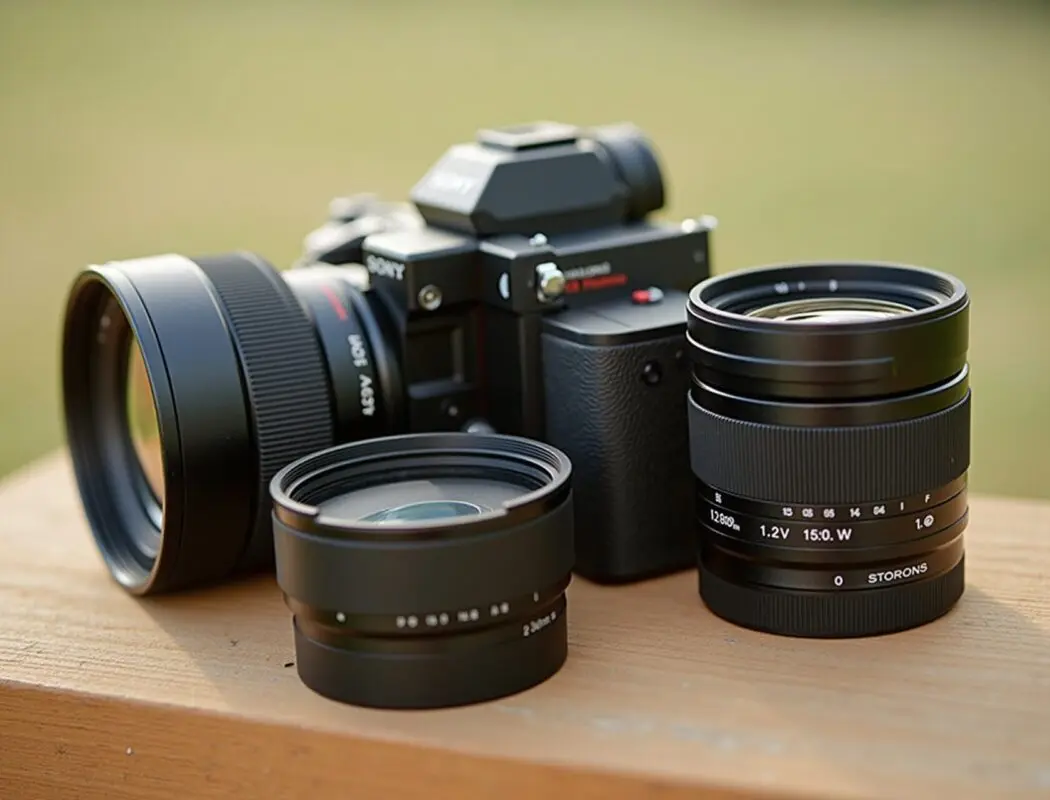
The Sony a7V is Sony’s most advanced full-frame mirrorless camera for 2026, packing a 33-megapixel partially stacked Exmor R sensor, next-generation AI-powered autofocus, and a price tag of $2,898. Whether you’re upgrading from the a7IV or jumping into the Alpha ecosystem for the first time, the lens you pair with this body will define the images you create.
The partially stacked sensor design gives the a7V faster readout speeds than a traditional BSI sensor (reducing rolling shutter and improving electronic shutter performance) while keeping the price well below the fully stacked a9 III. Sony’s new AI AF engine recognizes subjects with unprecedented accuracy — humans, animals, birds, insects, vehicles, and even specific poses — making lens autofocus speed and compatibility more important than ever.
After extensive testing across portrait sessions, landscape outings, event shoots, and video production, here are the best lenses for the Sony a7V in 2026, organized by shooting discipline.
We also compiled a list of the best lenses sony-fx30 lenses worth considering for this type of shooting.
Quick Comparison Table
| Lens | Category | Price | Weight | Best For |
|---|---|---|---|---|
| Sony FE 85mm f/1.4 GM II | Portrait | $1,798 | 642g | Best portrait lens overall |
| Sony FE 50mm f/1.4 GM | Portrait / General | $1,219 | 516g | Daily driver prime |
| Sigma 85mm f/1.4 DG DN Art | Portrait | $1,099 | 630g | Budget portrait alternative |
| Sony FE 16-35mm f/2.8 GM II | Landscape / Wide | $2,298 | 547g | Best wide zoom overall |
| Sigma 14-24mm f/2.8 DG DN Art | Landscape / Ultra-Wide | $1,399 | 795g | Ultra-wide on a budget |
| Sony FE 20mm f/1.8 G | Landscape / Astro | $900 | 373g | Astro & compact wide prime |
| Sony FE 24-70mm f/2.8 GM II | Standard Zoom | $2,298 | 695g | Professional workhorse |
| Sigma 24-70mm f/2.8 DG DN II Art | Standard Zoom | $1,169 | 740g | Best value f/2.8 standard zoom |
| Sony FE 24-50mm f/2.8 G | Standard Zoom | $498 | 299g | Ultra-compact f/2.8 |
| Sony FE 20-70mm f/4 G | Standard Zoom / Video | $1,098 | 488g | Most versatile everyday zoom |
| Sony FE 70-200mm f/2.8 GM II | Telephoto | $2,798 | 1,045g | Best telephoto zoom |
| Sigma 70-200mm f/2.8 DG DN OS Sport | Telephoto | $1,499 | 1,135g | Telephoto value pick |
| Tamron 35-150mm f/2-2.8 | Telephoto / Event | $1,899 | 1,165g | Wedding & event beast |
| Sony FE PZ 16-35mm f/4 G | Video | $1,198 | 353g | Power zoom for filmmakers |
| Sony FE 28-135mm f/4 G PZ OSS | Video / Cine | $2,498 | 1,215g | Cinema-standard zoom |
| Sony FE 100mm f/2.8 Macro GM OSS | Macro | $1,498 | 700g | Best macro lens overall |
| Sony FE 90mm f/2.8 Macro G OSS | Macro | $1,048 | 602g | Classic macro benchmark |
Best Portrait Lenses for the Sony a7V
Portrait photography is where the a7V’s AI autofocus truly shines. The camera’s ability to lock onto eyes — even when partially obscured or in profile — means your lens just needs to resolve fine detail and deliver gorgeous bokeh. Here are the three best portrait lenses for the system.
Sony FE 85mm f/1.4 GM II — Best Portrait Lens Overall
Price: ~$1,798 | Weight: 642g | Filter Size: 77mm
The Sony FE 85mm f/1.4 GM II is the benchmark portrait lens for E-mount in 2026. Sony redesigned this lens with dual XD linear motors that are perfectly matched to the a7V’s AI AF system, delivering silent, instantaneous focus acquisition even during rapid subject movement.
Optically, the GM II produces some of the smoothest bokeh of any 85mm lens ever made. The 11-blade circular aperture creates perfectly round out-of-focus highlights, and chromatic aberration is virtually nonexistent. Wide open at f/1.4, you get razor-sharp eyes with a dreamy background separation that gives portraits a three-dimensional quality.
At 642g, it’s noticeably lighter than the original 85mm GM, making it feasible for extended portrait sessions without fatigue. The focus-hold button and aperture ring (with de-click switch) add professional control.
Why pair it with the a7V: The XD linear motors keep up with the a7V’s 120fps AF calculation speed. When shooting wide open at f/1.4, the AI eye-AF compensates for the paper-thin depth of field, ensuring sharp eyes frame after frame. This is the lens that fully exploits what the a7V’s AF system can do.
Sony FE 50mm f/1.4 GM — Best Daily Driver Prime
Price: ~$1,219 | Weight: 516g | Filter Size: 67mm
If you want one prime lens that handles everything from environmental portraits to street photography to casual product shots, the 50mm f/1.4 GM is your lens. At 516g and with a 67mm filter thread, it strikes an ideal balance between performance and portability.
The optical design delivers outstanding sharpness from f/1.4 onward — there’s almost no need to stop down for improved center sharpness. Bokeh is smooth and neutral, free of the “busy” rendering some 50mm designs produce. The lens focuses extremely close (minimum 0.38m), giving you creative flexibility for tighter compositions.
On the a7V, the 50mm GM focuses with lightning speed thanks to XD linear motors. It’s also an excellent video lens: the 50mm perspective is natural for talking-head content, and the focus breathing is well-controlled for smooth rack focuses.
Why pair it with the a7V: The 50mm focal length on the a7V’s 33MP sensor gives you enough resolution to crop into a 75mm-equivalent framing while retaining over 14 megapixels — effectively giving you two focal lengths in one lens.
Sigma 85mm f/1.4 DG DN Art — Best Budget Portrait Lens
Price: ~$1,099 | Weight: 630g | Filter Size: 77mm
The Sigma 85mm f/1.4 DG DN Art delivers roughly 90% of the Sony GM II’s optical performance at 60% of the price. Sharpness is excellent across the frame, and the bokeh — while slightly less refined than the GM II in direct comparison — is still beautiful for portrait work.
Sigma designed this lens natively for mirrorless mounts, so it focuses quickly and quietly on the a7V. The build quality is excellent with a dust- and splash-resistant metal barrel. At 630g, it’s nearly identical in weight to the Sony.
Where does the Sigma fall short? The GM II’s XD linear motors are marginally faster for continuous AF tracking, and the Sony’s bokeh has a slightly creamier rendering at very wide apertures. For most portrait shooters, these differences won’t matter in real-world use.
Why pair it with the a7V: If you’re investing $2,898 in the a7V body and need to keep overall system cost down, saving $700 on the portrait lens while still getting outstanding results is a smart move. The a7V’s AI AF compensates for any slight speed difference in the Sigma’s focusing motors.
Best Landscape and Wide-Angle Lenses for the Sony a7V
The a7V’s 33MP sensor resolves incredible detail when paired with a sharp wide-angle lens. For landscape, architecture, and astrophotography, here are the top picks.
Sony FE 16-35mm f/2.8 GM II — Best Wide Zoom Overall
Price: ~$2,298 | Weight: 547g | Filter Size: 82mm
The Sony FE 16-35mm f/2.8 GM II is one of the sharpest zoom lenses ever made for any mirrorless system. Edge-to-edge sharpness is exceptional even at 16mm and f/2.8, which is exactly what landscape and architecture shooters need — no more stopping down to f/8 just to get the corners sharp.
At 547g, it’s remarkably light for an f/2.8 wide zoom. The original 16-35mm GM weighed 680g, so Sony cut over 130g while improving optical performance across the board. The lens accepts 82mm front filters, making it straightforward to use polarizers and ND filters for landscape work.
For astrophotography, the f/2.8 maximum aperture paired with the a7V’s excellent high-ISO performance (clean up to ISO 12,800) lets you capture stunning Milky Way shots. Coma performance in the corners is well-controlled, keeping stars as points rather than smearing them into wings.
Why pair it with the a7V: The GM II’s extreme corner sharpness is a perfect match for the a7V’s 33MP sensor. Lesser wide-angle zooms may show soft corners that become painfully obvious at this resolution. The fast f/2.8 aperture also opens up indoor architecture and real estate photography where you need to capture a scene without cranking ISO too high.
Sigma 14-24mm f/2.8 DG DN Art — Best Ultra-Wide Zoom
Price: ~$1,399 | Weight: 795g | Filter Size: Rear (sheet filter holder)
When 16mm isn’t wide enough, the Sigma 14-24mm f/2.8 DG DN Art pushes into ultra-wide territory. At 14mm on a full-frame sensor, you’re capturing a massive 114-degree field of view — perfect for dramatic landscape compositions, tight interior architecture, and astrophotography where you want to capture as much sky as possible.
The optical performance is outstanding for the price. Distortion is well-controlled through software correction, and sharpness across the frame rivals lenses costing significantly more. The lens uses a rear filter holder for sheet-type gelatin or polyester filters, since the bulbous front element can’t accept traditional screw-on filters.
At 795g, it’s heavier than the Sony 16-35mm GM II, but that’s typical for ultra-wide zoom designs. The build quality is Sigma’s excellent Art-line standard with weather sealing.
Why pair it with the a7V: The 14mm focal length combined with the a7V’s 33MP resolution creates landscape images with staggering detail from foreground to infinity. For astrophotographers, 14mm at f/2.8 captures significantly more sky than a 16-35mm zoom at the same aperture.
Sony FE 20mm f/1.8 G — Best Compact Wide Prime
Price: ~$900 | Weight: 373g | Filter Size: 67mm
The Sony FE 20mm f/1.8 G is a hidden gem in the E-mount lineup. At only 373g with a compact profile, it’s the kind of lens you can leave on the a7V all day without noticing the weight. Yet it delivers stunning sharpness and an f/1.8 aperture that makes it arguably the best astrophotography lens in the entire Sony system.
For Milky Way shooting, f/1.8 gathers 2x more light than f/2.8, letting you shoot at lower ISO or shorter exposures. Star coma in the corners is minimal. The 67mm filter thread accepts affordable filter sets, and the lens focuses close enough (0.19m) for creative wide-angle close-up perspectives.
Beyond astro, this is an excellent lens for travel, vlogging (paired with the a7V’s stabilization), and environmental portraits where you want to show the subject in their surroundings.
Why pair it with the a7V: The a7V’s excellent in-body image stabilization (IBIS) makes handheld shooting at 20mm remarkably stable, even in low light. Combine that with f/1.8 and you can shoot handheld in conditions where most photographers would reach for a tripod.
Best Standard Zoom Lenses for the Sony a7V
A standard zoom is the most versatile lens you can own. It covers the range most photographers use 80% of the time. The a7V has four outstanding options at different price points and design philosophies.
Sony FE 24-70mm f/2.8 GM II — Best Professional Standard Zoom
Price: ~$2,298 | Weight: 695g | Filter Size: 82mm
The Sony FE 24-70mm f/2.8 GM II is the professional workhorse zoom for the Alpha system. If you shoot events, weddings, journalism, or any discipline where you need one lens that does it all at a professional level, this is it.
At 695g, it’s one of the lightest full-frame 24-70mm f/2.8 lenses on the market. Sharpness is outstanding at every focal length and aperture combination. The lens focuses internally, maintains its length throughout the zoom range, and features Sony’s XD linear motors for fast, precise autofocus.
The f/2.8 constant aperture gives you enough background separation for flattering portraits at 70mm while also working beautifully for low-light event coverage. Color rendering is neutral and consistent, which is critical for professional workflows where you need images from different focal lengths to match.
Why pair it with the a7V: The GM II’s autofocus speed fully exploits the a7V’s AI AF tracking. During events, the camera can switch between human eye-AF, animal detection, and general subject tracking seamlessly, and the lens keeps pace with every focus demand. This is the combination working pros will default to.
Sigma 24-70mm f/2.8 DG DN II Art — Best Value Standard Zoom
Price: ~$1,169 | Weight: 740g | Filter Size: 82mm
The Sigma 24-70mm f/2.8 DG DN II Art — widely called the “GM Slayer” — has earned that reputation. In optical bench tests, it matches or occasionally exceeds the Sony GM II in sharpness, particularly in the 35-50mm range. At $1,169, it costs almost exactly half the Sony.
The trade-offs are minor: it’s 45g heavier than the Sony GM II, the autofocus is slightly slower in continuous tracking (though still excellent), and build quality, while very good, doesn’t quite have the Sony’s polished feel. The lens is weather-sealed and built to professional standards.
For photographers who want f/2.8 standard zoom performance without the GM price tag, the Sigma II Art is the clear choice. The $1,129 you save could go toward a second lens — add a Sigma 85mm f/1.4 DG DN Art and you’d have a two-lens kit that costs less than the Sony GM II alone.
Why pair it with the a7V: Sigma’s latest firmware ensures full compatibility with the a7V’s AI AF features. The lens supports all AF modes including real-time tracking and the new AI subject recognition. Focus accuracy is on par with native Sony lenses for stills; only in demanding continuous-AF video scenarios might you notice a slight edge to the GM II.
Sony FE 24-50mm f/2.8 G — Best Ultra-Compact Standard Zoom
Price: ~$498 | Weight: 299g | Filter Size: 67mm
At $498 and just 299g, the Sony FE 24-50mm f/2.8 G is a revelation. This is the lens you throw in your bag when you want f/2.8 quality without committing to the size and weight of a traditional standard zoom. It’s smaller than many kit lenses, yet it delivers an f/2.8 constant aperture with excellent sharpness.
The zoom range is more limited — 24-50mm versus the traditional 24-70mm — but for many photographers, 50mm is plenty of reach for everyday shooting. The compact size makes the a7V feel almost like an APS-C setup in terms of handling.
Image quality is surprisingly close to the GM II for the price. Sharpness is excellent in the center at all focal lengths and very good in the corners. Bokeh is pleasant at f/2.8, particularly at 50mm where you can achieve meaningful background separation.
Why pair it with the a7V: The 24-50mm f/2.8 G turns the a7V into the ultimate travel and street photography kit. With the camera’s advanced stabilization and AI AF, you get a professional-grade system that weighs well under a kilogram total. For content creators who need to move fast and light, this combination is hard to beat.
Sony FE 20-70mm f/4 G — Most Versatile Everyday Zoom
Price: ~$1,098 | Weight: 488g | Filter Size: 72mm
The Sony FE 20-70mm f/4 G takes the standard zoom concept and stretches it in the wide direction. Starting at 20mm instead of the traditional 24mm gives you significantly more environmental context in your shots, making this lens ideal for travel, vlogging, and any shooting situation where you want maximum versatility in a single optic.
At f/4, you sacrifice one stop compared to f/2.8 zooms, but you gain a much wider starting focal length and save significant weight (488g versus 695g for the GM II). The 20-70mm range covers everything from wide-angle landscapes to medium telephoto portraits, reducing the need to carry multiple lenses.
Sharpness is excellent throughout the range, and the lens handles video work beautifully — minimal focus breathing, smooth zoom action, and the compact size works well on gimbals. This is also one of our top video lens picks (more on that below).
Why pair it with the a7V: The 20-70mm range on the a7V’s 33MP sensor lets you crop the 70mm end to simulate roughly 105mm at 14MP — still plenty of resolution for web and social media. Combined with the 20mm wide end, you effectively have a 20-105mm range in a single compact lens.
Best Telephoto Lenses for the Sony a7V
Whether you’re shooting sports, wildlife, events, or compressed landscape compositions, a telephoto zoom is essential. The a7V’s AI AF system makes these lenses perform at their absolute best for tracking moving subjects.
Sony FE 70-200mm f/2.8 GM II — Best Telephoto Zoom Overall
Price: ~$2,798 | Weight: 1,045g | Filter Size: 77mm
The Sony FE 70-200mm f/2.8 GM II is the gold standard for telephoto zooms in the E-mount system. At 1,045g, it’s the lightest 70-200mm f/2.8 in its class, and the optical performance is staggering — tack-sharp at every focal length, even wide open at f/2.8.
The lens features four XD linear motors that make it one of the fastest-focusing telephoto zooms available. For sports and action photography on the a7V, the combination is nearly unstoppable. The a7V’s AI AF locks onto subjects and the GM II’s motors respond instantaneously to keep focus locked as subjects move through the frame.
Bokeh at 200mm f/2.8 produces beautiful background compression for portraits, and the close-focus distance (0.4m at 70mm) allows for quasi-macro shots of details. The lens is fully weather-sealed and built to withstand professional use.
Why pair it with the a7V: This is the combination for sports and wildlife shooters who need the best tracking AF performance. The a7V’s AI subject recognition (animals, birds, vehicles) combined with the GM II’s autofocus speed means you’ll nail shots that would be impossible with lesser hardware. Add the 1.4x teleconverter for a 98-280mm f/4 reach when you need extra focal length.
Sigma 70-200mm f/2.8 DG DN OS Sport — Best Value Telephoto
Price: ~$1,499 | Weight: 1,135g | Filter Size: 77mm
The Sigma 70-200mm f/2.8 DG DN OS Sport delivers 70-200mm f/2.8 performance at roughly half the price of the Sony GM II. Optical quality is excellent — in controlled testing, sharpness rivals the GM II at most focal lengths, with only slight differences visible at the extreme corners when pixel-peeping.
At 1,135g, it’s about 90g heavier than the Sony, which is barely noticeable in real-world shooting. The lens includes optical stabilization (OS) that works in concert with the a7V’s IBIS for outstanding stabilization performance. Build quality is excellent with comprehensive weather sealing.
The autofocus is fast and accurate for stills, though the GM II maintains a slight edge in continuous AF speed during demanding action sequences. For wedding, event, and portrait work — where subjects aren’t moving as erratically as athletes — the Sigma performs identically to the Sony in practical terms.
Why pair it with the a7V: At $1,499, you’re saving $1,299 compared to the GM II. That’s enough to buy an entire additional lens. If you’re building a multi-lens kit on a budget, the Sigma 70-200mm plus the Sigma 24-70mm f/2.8 DG DN II Art ($1,169) costs less than the Sony 70-200mm GM II alone — and you get two outstanding lenses instead of one.
Tamron 35-150mm f/2-2.8 — Best Event and Wedding Lens
Price: ~$1,899 | Weight: 1,165g | Filter Size: 82mm
The Tamron 35-150mm f/2-2.8 is one of the most unique lenses in any camera system. It covers the 35-150mm range — essentially combining a standard zoom and a telephoto into one lens — while maintaining an f/2-2.8 aperture throughout. For wedding and event photographers, this means one lens that handles everything from venue-wide shots to tight portraits without a lens change.
At 35mm f/2, you get exceptional low-light performance for reception and ceremony shots. Zoom to 150mm f/2.8 and you have beautiful portrait compression with professional-grade background separation. The transition is seamless, and the image quality is impressive throughout the range.
The lens is heavy at 1,165g, which is the main trade-off. For an all-day wedding shoot, you’ll feel the weight. But the convenience of never changing lenses — never missing a moment because you had the wrong focal length mounted — is invaluable for event professionals.
Why pair it with the a7V: Wedding photographers will love the a7V’s AI AF tracking faces through the chaos of a dance floor while the Tamron provides the flexibility to shoot wide and tight without stopping to swap lenses. The f/2 maximum aperture at 35mm is wider than any zoom in this guide, making it exceptional for dark venue work.
Best Video Lenses for the Sony a7V
The a7V is a serious video tool, recording 4K 120p internally with no crop and supporting S-Log3 for professional color grading. Lens choice for video prioritizes different qualities than stills: smooth focus transitions, minimal breathing, consistent aperture, and practical zoom control.
Sony FE 20-70mm f/4 G — Best Vlogging and Hybrid Lens
Price: ~$1,098 | Weight: 488g
Already featured in our standard zoom section, the 20-70mm f/4 G earns a second mention as the best hybrid stills/video lens. The 20mm wide end is perfect for vlogging at arm’s length — you don’t need a selfie screen extender. The zoom range covers B-roll, interviews, and establishing shots in a single lens.
Focus breathing is well-controlled, meaning the field of view doesn’t shift noticeably when the camera racks focus between subjects. The constant f/4 aperture means exposure doesn’t change as you zoom, which is essential for video. The lightweight 488g design works beautifully on gimbals and handheld stabilizers.
Why pair it with the a7V for video: The a7V’s excellent IBIS combined with this lens’s compact design creates a run-and-gun setup that captures smooth, professional-looking footage without external stabilization. For YouTube creators, travel videographers, and documentary shooters, this is the one-lens solution.
Sony FE PZ 16-35mm f/4 G — Best Power Zoom for Filmmakers
Price: ~$1,198 | Weight: 353g | Filter Size: 72mm
The Sony FE PZ 16-35mm f/4 G brings a critical feature for video shooters: a power zoom mechanism. The electronically driven zoom produces perfectly smooth, consistent zoom movements that manual zoom rings simply cannot replicate. For filmmakers who need cinematic zoom shots, this is the only wide zoom in the E-mount system with this capability at this focal range.
At 353g, it’s incredibly lightweight and compact, making it ideal for gimbal work, drone mounting (on larger cinema drones), and any situation where weight matters. The f/4 constant aperture is adequate for most video scenarios, especially given the a7V’s clean high-ISO performance.
The lens also has a programmable zoom speed, so you can set exactly how fast or slow the zoom moves. This is particularly useful for controlled documentary-style zooms and establishing shot transitions.
Why pair it with the a7V for video: The a7V can control the power zoom via the camera body’s zoom lever (or a remote control), letting you operate zoom without touching the lens. Combined with AF tracking, you get a one-operator setup that mimics a two-person camera crew.
Sony FE 28-135mm f/4 G PZ OSS — Cinema Standard Zoom
Price: ~$2,498 | Weight: 1,215g | Filter Size: 95mm
The Sony FE 28-135mm f/4 G PZ OSS is the lens that put the Alpha system on the map for professional video production. Originally designed for the FS series cinema cameras, it works beautifully on the a7V for anyone doing serious narrative or commercial video work.
The 28-135mm power zoom range covers the three most common cinema focal lengths (35mm, 50mm, 85mm) in a single servo-driven zoom. Focus breathing is essentially zero — this is a lens designed for pulling focus on set. The optical stabilization adds an extra layer of smoothness to handheld work.
At 1,215g and with a 95mm filter thread, this is a large lens that transforms the a7V into a proper cinema rig. It’s at its best mounted on a cage with a matte box and follow focus system. For solo corporate video or documentary shooters who need cinema-quality zoom in one lens, it’s the professional standard.
Why pair it with the a7V for video: The a7V’s 4K 120p recording combined with this lens’s cinema-grade optics creates a compact production setup that rivals dedicated cinema cameras costing 3-5x more. The servo zoom integrates with the a7V’s camera controls for smooth, repeatable zoom movements.
Best Macro Lenses for the Sony a7V
The a7V’s 33MP sensor reveals extraordinary detail in macro photography. Whether you shoot product photography, insects, or botanical subjects, a dedicated macro lens unlocks a world of detail invisible to the naked eye.
Sony FE 100mm f/2.8 Macro GM OSS — Best Macro Lens Overall
Price: ~$1,498 | Weight: 700g | Filter Size: 67mm
The Sony FE 100mm f/2.8 Macro GM OSS goes beyond standard macro by offering 1.4x magnification — that’s 40% more magnification than a typical 1:1 macro lens. This means you can fill the frame with smaller subjects without additional extension tubes or close-up diopters.
What sets the GM macro apart is the STF (Smooth Trans Focus) apodization element built into the optical design. This produces incredibly smooth, buttery bokeh that is visually distinct from any other macro lens. The out-of-focus areas melt away with zero hard edges or distracting artifacts, making this lens exceptional for product photography where you want the subject to pop against a clean background.
The lens includes optical stabilization (OSS) which is critical at macro distances where even tiny camera movements produce visible blur. Combined with the a7V’s IBIS, you get effective stabilization of approximately 6.5 stops — making handheld macro work genuinely practical.
Why pair it with the a7V: The 33MP sensor paired with 1.4x magnification reveals detail that no previous Alpha body could capture at this scale. The AI AF system tracks small subjects like insects surprisingly well, though focus stacking (using the a7V’s built-in focus stacking feature) is still recommended for maximum depth of field in macro work.
Sony FE 90mm f/2.8 Macro G OSS — Best Value Macro Lens
Price: ~$1,048 | Weight: 602g | Filter Size: 62mm
The Sony FE 90mm f/2.8 Macro G OSS has been a Sony macro benchmark since its introduction, and it remains an excellent choice for the a7V. The lens offers true 1:1 magnification, outstanding sharpness, and built-in optical stabilization at a price $450 less than the GM macro.
Image quality is superb. At macro distances, the lens resolves exceptional detail across the frame. Bokeh is very pleasant — it lacks the STF magic of the GM, but it’s still smooth and well-behaved. The 90mm focal length provides slightly more working distance than shorter macro lenses, which is helpful when photographing skittish insects or lighting product setups.
The lens is lighter at 602g and slightly more compact than the GM macro, making it a better fit for field macro work where you’re hiking to locations. Weather sealing protects against dust and moisture.
Why pair it with the a7V: The 90mm G macro is a proven performer that gets the most out of the a7V’s resolution without breaking the bank. If macro is a secondary discipline for you — something you do occasionally rather than as your primary focus — the 90mm G gives you all the capability you need while saving money for other lenses.
Sony a7V-Specific Buying Considerations
Choosing lenses for the a7V isn’t just about optical quality — the camera’s unique technology creates specific compatibility and performance considerations you should factor into your decisions.
The Partially Stacked Sensor Advantage
The a7V uses a partially stacked CMOS sensor, which sits between the traditional BSI (back-side illuminated) design of the a7IV and the fully stacked sensor in the a9 III. In practical terms, this means:
- Faster readout reduces rolling shutter in electronic shutter mode. This matters for video shooters using silent shooting.
- Faster AF calculation (up to 120 cycles per second) means your lens’s autofocus motor needs to keep up. Lenses with XD linear motors or equivalent fast-motor designs will fully exploit this speed.
- Higher resolution demands more from your glass. At 33MP, lens resolving power matters. Budget lenses from five or more years ago may appear softer than expected — the sensor can outresolve them.
Every lens recommended in this guide has the optical quality to resolve the a7V’s 33MP sensor fully. If you’re considering lenses not on this list, check whether they were designed for modern high-resolution sensors.
AI AF Compatibility: Why Lens Choice Matters More Than Ever
The a7V’s AI AF system runs a deep learning model that processes 120 AF calculations per second, tracking subjects with unprecedented reliability. However, this system is only as good as the lens’s ability to execute the focus commands it receives. Here’s what to prioritize:
- XD linear motors (Sony) or HLA/stepping motors (Sigma/Tamron) respond fastest. Older lenses with SSM or SAM motors will still work but may show slight lag during rapid tracking.
- Firmware updates matter. Check that third-party lenses are running the latest firmware for a7V compatibility. Both Sigma and Tamron released day-one firmware updates for the a7V launch.
- Focus breathing compensation is available on the a7V for supported lenses. Sony native lenses generally support this feature; third-party support varies by model.
Third-Party Lens Compatibility
Early during the a7V’s pre-release phase, some prototype units exhibited autofocus issues with certain Viltrox and other Chinese-manufactured lenses. This generated concern in online forums. However, this issue was confirmed fixed in all retail production units. All major third-party lenses from Sigma, Tamron, Samyang/Rokinon, and Viltrox work correctly with the retail a7V.
If you’re buying third-party lenses, simply ensure they’re running the latest firmware (available from each manufacturer’s website or lens dock utility). Sony’s open protocol for E-mount communication means third-party manufacturers can achieve near-native AF performance.
Lens Pairing Tips for a7V Shooters
Building a well-rounded kit doesn’t mean buying every lens on this list. Here are three suggested kits at different budget levels:
Budget Two-Lens Kit (~$2,270):
- Sigma 24-70mm f/2.8 DG DN II Art ($1,169) — your everyday lens
- Sigma 85mm f/1.4 DG DN Art ($1,099) — your portrait and low-light lens
Versatile Three-Lens Kit (~$4,500):
- Sony FE 20-70mm f/4 G ($1,098) — ultra-versatile everyday
- Sony FE 85mm f/1.4 GM II ($1,798) — portrait and low-light
- Sigma 70-200mm f/2.8 DG DN OS Sport ($1,499) — telephoto reach
Professional “Holy Trinity” Kit (~$7,394):
- Sony FE 16-35mm f/2.8 GM II ($2,298) — wide
- Sony FE 24-70mm f/2.8 GM II ($2,298) — standard
- Sony FE 70-200mm f/2.8 GM II ($2,798) — telephoto
Frequently Asked Questions
What is the best first lens for the Sony a7V?
If you’re buying one lens to start, the Sony FE 20-70mm f/4 G ($1,098) is our top recommendation. It covers an exceptionally useful focal range (wider than a traditional 24-70mm), weighs only 488g, and delivers excellent optical quality for both stills and video. It won’t give you the f/2.8 aperture for extreme low light or shallow depth of field, but it covers more shooting situations than any other single lens on this list.
If you need f/2.8 on a budget, the Sony FE 24-50mm f/2.8 G ($498) is an incredible starting point that costs less than most kit lenses while delivering significantly better results.
Will my Sony a7IV lenses work on the a7V?
Yes. Every E-mount lens ever made is fully compatible with the a7V. You don’t need to buy new lenses when upgrading from the a7IV, a7III, a7C II, or any other E-mount Sony body. Your existing lenses will work and likely perform better on the a7V thanks to the improved AF system and sensor.
The only caveat is that older lenses with slower autofocus motors may not fully exploit the a7V’s 120fps AF calculation speed. They’ll still work — they just won’t track moving subjects as aggressively as newer lenses with XD or linear motor designs.
Are Sigma and Tamron lenses fully compatible with the a7V?
Yes. Sigma, Tamron, Samyang/Rokinon, and Viltrox all have full compatibility with the Sony a7V in retail production units. Any early-prototype compatibility concerns were resolved before the camera’s retail launch. We recommend updating your third-party lenses to the latest firmware for optimal performance.
Do I need GM (G Master) lenses for the a7V?
No. While GM lenses represent the pinnacle of Sony’s optical engineering, the G-series and third-party Art/Sport lenses deliver outstanding results on the a7V. The 33MP sensor will show differences between a GM lens and a cheaper alternative in extreme pixel-level comparisons, but for the vast majority of real-world shooting scenarios — prints, web publishing, social media, and even large-format output — the G-series and top third-party lenses produce indistinguishable results.
Invest in GM glass where your primary discipline demands it (e.g., the 85mm GM II for dedicated portrait work), and save money with excellent alternatives for secondary uses.
What about APS-C lenses on the a7V?
APS-C (E-mount) lenses will physically mount on the a7V, and the camera will automatically crop to APS-C mode (14MP from the 33MP sensor). While this works, we recommend full-frame lenses to use the a7V’s full resolution. The one exception: Sony’s APS-C 10-20mm f/4 PZ G makes a handy ultra-wide option if you already own it — 10mm on APS-C crop is equivalent to 15mm, which is useful for vlogging and interiors.
Conclusion: Our Top Picks by Category
The Sony a7V is an extraordinary camera that deserves equally capable glass. Here are our top lens picks across every major shooting category:
- Best Portrait Lens: Sony FE 85mm f/1.4 GM II ($1,798) — unmatched bokeh, speed, and AF precision
- Best Wide-Angle Zoom: Sony FE 16-35mm f/2.8 GM II ($2,298) — edge-to-edge sharpness in a compact package
- Best Standard Zoom: Sony FE 24-70mm f/2.8 GM II ($2,298) for pros; Sigma 24-70mm f/2.8 DG DN II Art ($1,169) for value
- Best Telephoto: Sony FE 70-200mm f/2.8 GM II ($2,798) for performance; Sigma 70-200mm f/2.8 DG DN OS Sport ($1,499) for value
- Best Video Lens: Sony FE 20-70mm f/4 G ($1,098) for hybrids; Sony FE PZ 16-35mm f/4 G ($1,198) for filmmakers
- Best Macro: Sony FE 100mm f/2.8 Macro GM OSS ($1,498) for maximum capability; Sony FE 90mm f/2.8 Macro G OSS ($1,048) for value
- Best First Lens: Sony FE 20-70mm f/4 G ($1,098) — the most versatile single lens in the system
- Best Budget Entry: Sony FE 24-50mm f/2.8 G ($498) — f/2.8 quality at kit-lens pricing
No matter your shooting style or budget, there’s an outstanding lens for the a7V in Sony’s extensive E-mount ecosystem. The key is matching your primary discipline to the right glass — and with the a7V’s AI AF and 33MP sensor, every lens on this list will deliver results that weren’t possible even two years ago.