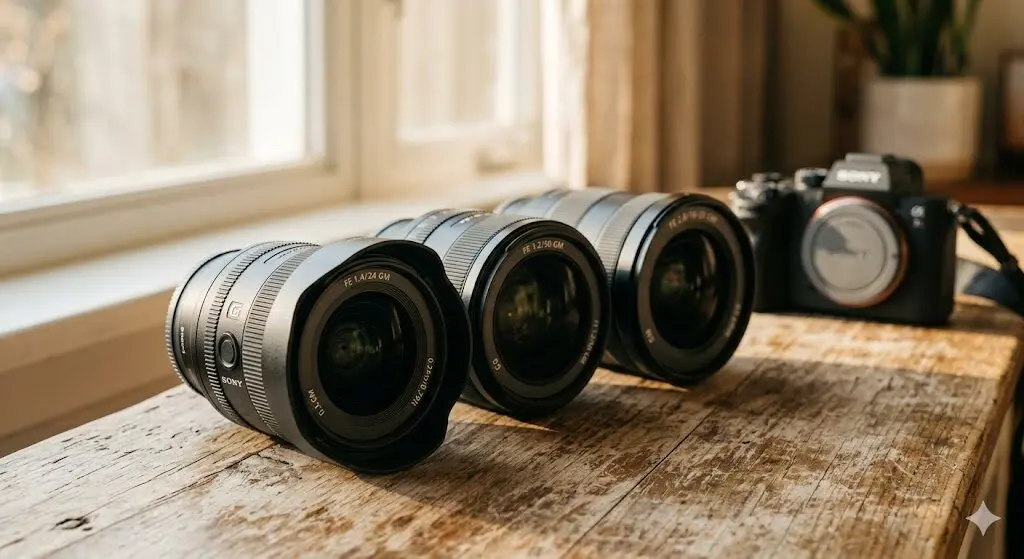
Best Sony Lenses for Beginners Under $500
Sony’s lens ecosystem can seem overwhelming—and expensive—when you’re getting started. The good news: you don’t need a G Master lens to take excellent photos on a Sony camera. Several lenses under $500 deliver genuinely impressive image quality with fast, reliable autofocus that works well with Sony’s AI subject recognition system. Here’s the best starting kit at every focal length.
Best Beginner Sony Lenses at a Glance
| Lens | Type | Equivalent FOV | Price | Best For |
|---|---|---|---|---|
| Sony FE 50mm f/1.8 (full-frame) | Prime | 50mm | ~$249 | Portraits, low-light, general |
| Sony FE 28mm f/2 (full-frame) | Prime | 28mm | ~$299 (used) | Street, travel, environmental |
| Sony FE 28-60mm f/4-5.6 (full-frame) | Zoom | 28-60mm | ~$299 | Versatile kit for A7 series |
| Sony E 35mm f/1.8 OSS (APS-C) | Prime | ~52mm | ~$449 | Portrait standard for APS-C |
| Sigma 30mm f/1.4 DC DN (APS-C) | Prime | ~45mm | ~$339 | Best value APS-C prime |
| Sigma 16mm f/1.4 DC DN (APS-C) | Prime | ~24mm | ~$399 | Wide APS-C, vlog, landscapes |
| Sigma 56mm f/1.4 DC DN (APS-C) | Prime | ~84mm | ~$479 | Portrait prime for APS-C |
| Sony FE 85mm f/1.8 (full-frame) | Prime | 85mm | ~$549 (just over) | Portrait, events |
Full-Frame Lenses Under $500
Sony FE 50mm f/1.8: The Best Value Prime for Sony Full-Frame
The FE 50mm f/1.8 at ~$249 is the first lens most Sony full-frame owners should buy after the kit zoom. At 50mm, the field of view closely matches natural human eye perspective—images look “real” rather than wide or compressed, making it ideal for portraits, street photography, food, and everyday documentation.
The f/1.8 aperture allows significant background separation when focused close (1–2 meters), and enables shooting in low light at lower ISO settings than any kit zoom. In a dim restaurant at f/1.8 + ISO 1600 versus kit zoom at f/5.6 + ISO 6400, the difference in noise and image quality is substantial.
AF performance is good—not G Master speed, but reliable for still subjects and moderately moving ones. Eye AF works. The compact size (186g) makes the kit weightless for travel.
Sony FE 28mm f/2: Budget Street and Travel Prime
The FE 28mm f/2 is an older lens (2015) but still one of the most compact primes available for Sony full-frame. At f/2, it’s a stop and a half faster than a typical 24-70mm kit zoom at equivalent focal lengths. The 28mm field of view is wide enough for travel scenes and architecture without being as extreme as 20-24mm ultra-wides.
New pricing has dropped to ~$299 used; new examples sometimes appear around $399. For street photography, travel, and casual portrait work on a full-frame Sony, the 28mm f/2 represents exceptional value. Note: it doesn’t have IBIS (relying on in-body IBIS) and the minimum focus distance (24cm) is one of the shortest in the lineup—great for tabletop shots.
Sony FE 28-60mm f/4-5.6: Collapsible Kit Zoom
The 28-60mm f/4-5.6 kit zoom is the lightest zoom lens Sony makes for full-frame—only 167g, collapsible to a pancake-style form factor when not in use. It’s included with the A7C II and ZV-E1 in kit configurations and is available separately at ~$299. For photographers who want a full-frame camera that fits in a jacket pocket (body + collapsed zoom = approximately jacket-pocket sized), this is the enabler.
Image quality is competent rather than exceptional. f/4-5.6 variable aperture limits low-light performance compared to fast primes. But for daytime travel, casual photography, and video content where light is adequate, it delivers clean, usable images. The tiny size is the feature.
APS-C Lenses Under $500
Sigma 30mm f/1.4 DC DN Contemporary: Best Value APS-C Prime
The Sigma 30mm DC DN at ~$339 is the single best value prime for the Sony A6700 and APS-C lineup. At 30mm on APS-C, the field of view is approximately 45mm equivalent—a slightly wide “normal” perspective. f/1.4 enables significant background blur and excellent low-light performance.
Sharpness from f/1.4 is excellent—better than many more expensive options. AF compatibility with Sony’s Eye AF is full and reliable. The compact, lightweight design (265g) balances perfectly on the A6700. For street photography, portrait work, travel, and everyday shooting, the Sigma 30mm f/1.4 is an outstanding starting prime at an unbeatable price.
Sigma 16mm f/1.4 DC DN Contemporary: Wide APS-C Prime
The Sigma 16mm f/1.4 DC DN (~$399) gives APS-C cameras a native-field-of-view wide prime at approximately 24mm equivalent. At f/1.4, it’s bright enough for interior shooting and astrophotography. The 16mm field of view works for environmental portraits with context, landscape shooting, architecture, and vlogging (wide enough to include the face and background simultaneously at arm’s length).
Corner sharpness at f/1.4 is softer than center, but corners clear up by f/2.8. For landscape work where you’d use f/8 anyway, the corners are excellent. One of the best wide primes for APS-C Sony at any price.
Sigma 56mm f/1.4 DC DN: Budget Portrait Prime for APS-C
The Sigma 56mm f/1.4 (~$479) gives the A6700 an 84mm-equivalent portrait focal length with f/1.4 aperture. Portrait bokeh at this combination (84mm equivalent, f/1.4, at typical 1.5-2.5m portrait distance) is genuinely impressive—smooth, well-separated from the background, with a flattering compression that most photographers associate with traditional portrait primes.
The Sigma 16/30/56mm trio (~$1,220 total) forms a complete APS-C prime kit covering wide, normal, and portrait focal lengths—an excellent entry into Sony’s APS-C ecosystem without requiring full-frame investment.
Sony E 35mm f/1.8 OSS: Native APS-C Portrait Standard
The Sony E 35mm f/1.8 OSS (~$449) gives APS-C cameras a ~52mm equivalent field of view with built-in optical stabilization (OSS)—useful on bodies like the ZV-E10 II that lack IBIS. At 154g, it’s the lightest fast prime option. The native Sony design ensures full compatibility with all AF features without third-party firmware considerations.
Compared to the Sigma 30mm f/1.4 at the slightly different focal length: the Sony 35mm OSS has IBIS, is lighter, and is native; the Sigma 30mm is f/1.4 (one-third stop faster) and sharper at equivalent apertures. For cameras with built-in IBIS (A6700), the Sigma wins on optical performance; for cameras without IBIS (ZV-E10 II, older A6100), the Sony’s stabilization is meaningful.
Starting Kit Recommendations
First Lens After a Sony Full-Frame Body
Sony FE 50mm f/1.8 ($249). It’s compact, fast, and teaches good compositional discipline working with a fixed focal length.
First Lens After a Sony APS-C Body
Sigma 30mm f/1.4 DC DN ($339) if the body has IBIS (A6700); Sony E 35mm f/1.8 OSS ($449) if the body lacks IBIS (ZV-E10 II, older APS-C).
Two-Lens Budget APS-C Starter Kit
- Sigma 16mm f/1.4 DC DN (~$399) — wide coverage for landscape, vlog, street
- Sigma 56mm f/1.4 DC DN (~$479) — portrait and telephoto work
- Total: ~$878 — covers wide to portrait with no gap in the range that matters most
Frequently Asked Questions
Do I need to buy Sony brand lenses for Sony cameras?
No. Third-party lenses from Sigma, Tamron, Samyang, and others work fully with Sony E-mount bodies. Sigma’s Contemporary and Art series lenses, in particular, offer excellent compatibility with Sony Eye AF and Subject Recognition—performance equivalent to many Sony native lenses at significantly lower prices.
Will cheap Sony lenses damage my camera?
Cheap lenses with poor build quality can get dust inside the body when mounted and unmounted repeatedly. Well-made lenses from Sony, Sigma, and Tamron are safe. Avoid extremely cheap no-brand lenses on Amazon/AliExpress with no reputable manufacturer backing.
Is the Sony FE 50mm f/1.8 good for portraits?
Yes—excellent for portrait work on a full-frame body. The 50mm field of view has a natural, uncompressed look at typical portrait distances. For classic “head and shoulders” portrait compression, 85mm is better, but for environmental portraits where you want subject and setting both visible, 50mm is ideal. The f/1.8 aperture provides meaningful background separation.
What’s the best budget zoom for a Sony A6700?
The Sony E PZ 16-50mm f/3.5-5.6 OSS kit lens is the lightest option, though image quality is only adequate. For a meaningful step up, the Sony E 18-135mm f/3.5-5.6 OSS (~$649 new, often found used at ~$350-400) covers 27-202mm equivalent with good sharpness and built-in stabilization—a strong all-in-one travel and versatility lens for the A6700 at a reasonable price.
You don’t need to spend thousands to get great results on Sony cameras. The primes listed here—especially Sigma’s DC DN Contemporary series—represent some of the best optical performance available at any price, simply at more accessible entry points. Start with one great prime, learn to see compositionally, and add focal lengths as your shooting style develops.