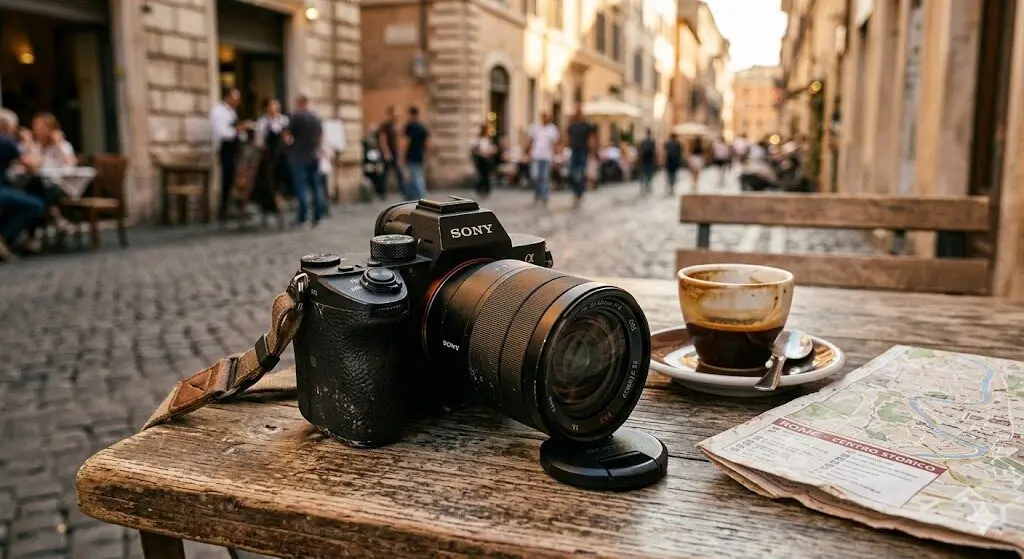
Travel photography demands a unique combination of capabilities: enough image quality for meaningful prints and social media, compact enough to carry all day without fatigue, versatile enough to handle street scenes, landscapes, and portraits without changing equipment mid-scene, and reliable enough for once-in-a-lifetime moments. Sony’s 2024–2025 lineup offers strong options at every budget tier.
Best Sony Travel Cameras at a Glance
| Camera | Best For | Weight (body) | Price |
|---|---|---|---|
| Sony A7C II | Full-frame compact travel hybrid | 514g | ~$2,499 |
| Sony A6700 | APS-C performance travel | 493g | ~$1,399 |
| Sony ZV-E10 II | Budget content creator travel | ~400g | ~$800 |
| Sony A7C R | High-resolution travel (61MP) | 514g | ~$3,499 |
| Sony A7 V | Best-all-round travel full-frame | 514g | ~$3,299 |
The Best Sony Travel Camera Overall: Sony A7C II
The Sony A7C II wins for most travel photographers because it delivers full-frame image quality in the smallest and lightest Sony full-frame body. At 514g, it’s lighter than the A7 V (514g—actually identical) but more compact due to its rangefinder-style design. The fully articulating touchscreen handles any shooting angle from ground-level landscapes to overhead crowd shots. Battery life (~560 shots) comfortably covers a day of travel shooting.
The A7C II’s 33MP BSI sensor delivers exceptional dynamic range and clean high-ISO performance—both critical for travel where you can’t control lighting conditions. Paired with the Sony FE 28-60mm f/4-5.6 kit lens (167g, collapsible), the entire setup weighs under 700g and fits in any daypack. Add the FE 20mm f/1.8 G for wide landscapes and you have a comprehensive two-lens travel kit under 1.2kg.
A7C II Limitations
The side-mounted EVF (rangefinder position) divides opinion—some photographers adapt quickly, others find it uncomfortable long-term. The A7 V, though same weight, has a center-mounted EVF that some travelers prefer. For photographers who shoot exclusively on the touchscreen, this is irrelevant.
Best Sony Travel Camera Under $1,500: Sony A6700
The A6700 is the best-value travel photography camera in Sony’s lineup. Its APS-C sensor delivers enough resolution (26MP) and dynamic range for all meaningful travel outputs. The AI autofocus—identical to the A7 V’s system—handles street candids, wildlife encounters, and environmental portraits equally well. The built-in 5-axis IBIS helps with low-light handheld shooting in cathedrals, museums, and markets.
The reach advantage of the 1.5× crop is genuinely useful for travel: a Sigma 18-135mm gives 27-202mm equivalent coverage in a single compact package. The smaller body is less conspicuous in markets and crowded tourist areas, reducing both camera theft risk and subject self-consciousness for street portraits.
A6700 Paired with the Right Zoom
The Sony E PZ 16-50mm f/3.5-5.6 OSS kit lens (24-75mm equivalent) is the compromise kit option. For more versatile travel, the Sigma 18-135mm f/3.5-5.6 DC DN OS (27-202mm equivalent, ~$499) is a one-lens travel solution at reasonable size and weight.
Best Sony Travel Camera for Video and Vlogging: Sony ZV-E10 II
For content creators who travel and prioritize video output for YouTube or social media, the ZV-E10 II is the clear choice under $1,000. Oversampled 4K, AI autofocus, fully articulating screen, and compact form factor—it’s optimized for exactly the solo creator travel use case. The trade-off is no IBIS (electronic stabilization only) and no EVF, but for vlog-focused travel, these matter less.
Best Sony Travel Camera for Maximum Resolution: Sony A7C R
The A7C R combines the A7C II’s compact rangefinder body with the A7R V’s 61MP sensor. For travel photographers who plan to print large or want maximum detail for architecture, landscape, and fine textile work (markets, textile souks, traditional crafts), 61MP in a compact body is compelling. The smaller file size penalty (60MB+ RAW files) is the practical trade-off versus 33MP.
What Lenses to Pack for Travel Photography
One-Lens Travel Kit
| Camera | Lens | Range | Notes |
|---|---|---|---|
| A7C II / A7 V (FF) | Sony FE 20-70mm f/4 G | 20-70mm | Best one-lens travel zoom for full-frame |
| A7C II / A7 V (FF) | Sony FE 28-60mm f/4-5.6 | 28-60mm | Lightest FF travel zoom (167g, collapsible) |
| A6700 (APS-C) | Sigma 18-135mm f/3.5-5.6 | 27-202mm equiv | Excellent range for APS-C travel |
| ZV-E10 II (APS-C) | Sony E 16-50mm f/3.5-5.6 PZ | 24-75mm equiv | Kit lens, very compact |
Two-Lens Travel Kit (Full-Frame)
- Wide prime: Sony FE 20mm f/1.8 G (490g, 67mm filter) — landscapes, interiors, night shooting
- Versatile zoom: Sony FE 20-70mm f/4 G or Sony FE 28-60mm f/4-5.6 — environmental portraits, architecture, general coverage
Total weight: ~1.1kg including a body. A Shimoda Explore 30L backpack carries this kit comfortably alongside 2 days of travel clothing.
Key Travel Considerations Beyond Specs
Weather Sealing
The A7 V, A7C II, A7R V, and A6700 all have dust and moisture resistance. This isn’t submersion-proof, but it handles shooting in light rain, dusty markets, humid tropical conditions, and splashes at waterfalls. For serious adventure travel, the Sony Tough SD cards and weather-sealed lenses (most G and G Master lenses) complete a rain-resistant kit.
Battery Strategy for Travel
Pack at least 3 NP-FZ100 batteries for A7 V/A7C II. For A6700 (NP-FZ100 compatible), same applies. For ZV-E10 II (NP-FW50), pack 4+ batteries—the smaller battery depletes faster. USB-C charging means a power bank or hotel USB port works overnight.
Storage for Multi-Week Trips
Pack enough cards to avoid deleting images to make room. 4× 256GB V60 SD cards provide 1TB storage—enough for 3–4 weeks of RAW travel shooting. Offload to a portable SSD (Samsung T7, ~$100 for 1TB) every 2–3 days.
Frequently Asked Questions
Is the Sony A7C II worth the price over the A6700 for travel?
For full-frame image quality, low-light performance, and maximum compatibility with Sony FE lenses: yes. The A7C II’s full-frame sensor delivers noticeably better high-ISO results (ISO 6,400+ for night scenes) and more dynamic range for contrasty outdoor travel. For photographers who primarily shoot in good to moderate light and prioritize smaller size and lower cost, the A6700 is excellent at a $1,100 saving.
What’s the best Sony lens for landscape travel photography?
The Sony FE 20mm f/1.8 G is the top recommendation: wide field of view, f/1.8 for night landscapes and astro, 67mm filter thread, weather-sealed, and at 490g it’s light enough to always have in the bag. The Sony FE 20-70mm f/4 G is the zoom alternative when you want versatility across focal lengths without carrying multiple primes.
Should I bring a tripod for travel photography?
A travel tripod (Peak Design Travel Tripod Carbon, ~$600; MeFoto RoadTrip Air, ~$200) enables long-exposure night photography, timelapse, and self-portraits that handheld shooting can’t achieve. Sony’s IBIS handles handheld shots down to 1/4s on most bodies, but for exposures longer than 1 second, a tripod is necessary. Carbon fiber travel tripods weigh under 1.5kg and pack in carry-on luggage.
Is the Sony A7 V too large for travel photography?
No—it’s the same weight as the A7C II body (514g) and handles most travel photography scenarios better due to its center-mounted EVF, deeper grip for long lenses, and slightly more accessible controls. The A7C II is more discreet on the street due to its smaller apparent profile; the A7 V is more ergonomic for extended use. Both are practical travel cameras.
For travel photography in 2025, Sony’s lineup provides some of the most capable and practical systems available. Whether you optimize for maximum quality (A7 V + 20-70mm f/4 G), compact versatility (A7C II + 28-60mm), or value (A6700 + Sigma 18-135mm), Sony’s AI autofocus, excellent sensor performance, and mature FE lens ecosystem makes building a travel kit straightforward.